We’re not particular fans of snow. Sure, it’s fun especially while growing up but with games and the occasional snowball fight aside, trudging through snow day by day, dealing with the inevitable bits that melt inside your boots, ending up all wet, cold and dirty.
Indeed we’re not exactly snow’s biggest fans however, it’s even harder for our canine companions. First off, we at least have footwear and clothes to keep us warm and safe, dogs don’t and they usually get the full brunt of it right on the chin. It’s harder for dogs to get around in the snow, most of them resorting to hopping around like a bunny.
Traction is one of the biggest issues that the dog faces when dealing with snow because the vast majority of dog breeds don’t have to deal with it and their paws are ineffective on snow. Frostbite is the other big issue that affects our canine friends during snowy days.
It can and it will get quite cold and your dog’s paws are exposed and sitting directly on frozen water. Needless to say that prolonged exposure, especially when the air temperature is below the freezing point, will cause the dog to start experiencing the first symptoms of frostbite.
Another thing that most people don’t really take into consideration is the fact that there are things sitting underneath the snow that can and will hurt your dog’s paws when he or she steps on them.
Anything from shards of glass to toothpicks, rusty nails, bits of sticks protruding from the ground and the list goes on. Dogs have to be careful otherwise they can get hurt, and another world of problems opens up with the risk of infection, parasites entering the body through the wound and so on.
So yeah, walking around as a dog is not exactly a comfortable and safe occupation, and the reason we don’t really think about it is the fact that we have footwear that is designed to protect us from all these risks while keeping us warm and insulated from the elements at the same time.
The Solution
It comes as no surprise that action was taken in order to fix this problem. It might not of have been the most intuitive thing that hit the market, nor the most imaginative, however the solution is a rather effective one, granted your dog will need some time to adjust accordingly. The solution, of course, was doggy footwear, doggy boots to be more precise.
That’s right, canine footwear designed to do for dogs what it already does for us humans, and all the challenges that it presents. You didn’t think it was that easy, did you?
First off, you will have to expect a lot of resistance from your dog, and rightfully so, he or she has spent his or her entire life walking around without footwear, and has grown accustomed to this habit.
Doggy boots will seem a bit uncomfortable at first, and for a short period of time your dog will be more than hesitant to even walk around with those things on, however with time your dog will grow accustomed to them, and will start enjoying them.
Second thing to worry about is your dog’s shoe size. That’s right, that doggy footwear mentioned earlier does not come in a “one size fits all” setup, but rather in different sizes which are designed to fit different breeds, so expect to do a bit of research.
Third think you will have to keep an eye out for is the actual style of the boots and how useful they are for your dog.
A general rule of thumb here is that you are looking for boots with a rubber sole that can grip slippery surfaces. The body needs to be made out of insulating material, so mesh, cotton, wool and other fibers are out of the question. Rubber, vinyl, leather, and other solid components are a good bet to go on.
Plastic and foam are things to be aware of because some merchants will try to pass these on to you and they will cause your dog to be very uncomfortable, up to the point of getting hurt.
Fourth thing you will have to think long and hard about is the style of the boot. Unlike our boots, where the style of the boot refers to how the boot looks, doggie boots actually have different proper styles.
There are the simple boots, the ones that go halfway up the leg, there are boots with suspenders, there are clogs, there are laced boots, Velcro boots, zipped boots, there are quite a few things to keep in mind when setting out to get your dog the perfect set of doggie boots.
Where Can You Find These Boots?
These boots are actually a lot harder to come by than normal human boots. There are only a few places that sell them, and the demand for them is not exactly a small one, and needless to say, where there is high demand there are also knock-offs.
That being said, the safest bets that you have are 2 in number.
The first one is a supplier or a store that your veterinarian recommends unless the vet can place the actual order for you, and the second one is Amazon, where you can find not only some of the best dog boots around at very low prices, but you can also arrange them to be delivered as a gift, and even return them if they end up being either faulty or a generally bad choice in terms of size.
Top Picks Best Dog Booties for Snow
There are actually a few dog boots on there that stand out as being the perfect ones to cover all of your dog’s wants and needs in order to deal with snow, lack of traction in a snowy environment and any nasty surprises that it can bring with it.
1. Muttluks Reflective 4 Dog Boots
This one is the perfect example of a set of light dog boots. They are agile, they can be worn without a problem, they go up over the dog’s ankle, and they are easy to wear.
Securing these boots on your dog’s paws is simple, you simply thread the self-tightening strap through the metal hoop and adjust it according to your dog’s paw and every time pressure is applied to the strap, the strap itself will tighten itself slightly in order to compensate thus maintaining a nice tight fit around the dog’s paw.
It comes in 6 different sizes, so you will be able to buy these for your dog regardless of the breed, and it also comes equipped with reflective straps in order to improve nighttime visibility and allow you to locate your dog during the night.
The upside with these boots is simple to understand, they are light. This means that the dog will have an easier time adjusting to them and will feel a lot better wearing them earlier on.
They do their job, they do what it says on the box, they will protect your dog’s paws against the elements, they will provide the insulation that they need and they will help your dog negotiate snowy terrain easier than he or she would of have done without them.
There is also a downside, which is also the fact that they are light. Light boots work best in the city or in a town, where there is no off-road terrain to negotiate, and the dog simply has to deal with snow and a bit of ice here and there.
In a rural environment, or right in the middle of an off-road situation, these boots might not live up to your expectations.
Forest environments, mountainous terrain, all manner of off-road terrain will cause a lot of wear and tear on these boots, and most of the time your dog will find it a lot harder to maintain traction with thee boots than without them.
So they are perfect for the city, not so much for nature.
If you interested in this product you can purchase it on Amazon.
2. JML Puppy Dog PU Sneakers
This example is somewhat of a medium level; however it is the type of medium that can easily be mistaken for a heavy.
Right off the bat you notice something a bit different in comparison to the previous example, these are more solid, sturdier, and they don’t go up as high.
They are, in fact, stronger, a lot more solid, and they don’t allow for as much flexibility as the last pair, which is why they stop just short of the dog’s ankles. Otherwise they might lock the paw in place and rob the dog of a certain degree of mobility.
They can be locked in with a zip, which is then locked in by a Velcro strap, just for good measure. They have a thick rubber sole which allows the dog to maintain traction on some rather slippery and uncomfortable sections of terrain, and they will keep the dog nice and warm while they are being worn.
There isn’t actually a heavy boot style or a survivalist style boot for dogs, and this is actually some really good news for our 4 legged friends. Truth be told, they don’t really need heavy boots like we do because the medium ones can provide them with the grip that they need and the footing that they require, while their muscles can power them through safely.
The good part about these boots is the fact that they are a lot sturdier and a lot more solid, allowing the dog to negotiate more difficult terrain and frolic around in nature without worrying about anything.
They are durable, they can take a lot of punishment and a lot of abuse from the dog, and they will help the dog keep his or her grip.
These are the type of boots that are chosen for endurance dog races like the Iditarod or the Siberian dog trek, and that is due to the fact that they can take a lot of abuse and they can be subjected to extreme conditions while under constant physical stress and still perform without a great deal of wear and tear added to them.
Like this product? Then you can purchase it on Amazon.
Final Words
One could argue that the dog loses the extra inch of coverage height over the leg that the light ones are able to offer, however if you find yourself in need of such boots for your dog, chances are that you don’t exactly have a dog that is not built to cope with the weather.
The bad part about these boots is the fact that they had to be made specifically shorter, meaning that only the actual paws are protected, the rest of the leg is not.
Another thing to bear in mind when it comes to these boots is the fact that the dog will need a bit more time than he or she would with light boots in order for him or her to get used to them, and if you happen to have a dog with a stronger than average personality, you will spend a lot of time looking at him or her trying to chew his or her way through the boots.
And remember before buying you must measure your dog’s paws.
That being said, dog boots can be both a blessing and a curse at the same time, depending on the dog that you are buying them for.
You will live some rather hilarious moments watching your dog trying to get used to the boots and the weird and hilarious struts that follow, however you will also live some rather scary moments when you are trudging through the snow and you see your dog all of a sudden shoot forward like an arrow and head off into the distance because he or she has the grip needed in order to do so.
As with everything, think long and hard before buying a pair of dog boots for your pooch, and if you feel that your dog needs them, now you know what look for, what to stay away from, and where to find them.
Check out more similar products:
If you’re a fan of hiking but also passionate about your dog, then you’ll know there’s no better feeling than setting off on a trip with your four-legged friend.
Whether you’re heading off on a long multi-day hike or a quick half-day walk in your local area, there’s many products available these days to make your hike even more enjoyable. Keep reading for our round-up of the best dog backpacking gear.
Comparison Table:
Hiking gear for dogs can range from doggy backpacks, to specialized leashes and of course the all-essential poop bag! These are designed to make your treks more enjoyable, no matter how long you’re going.
There are a number of different things to consider when you’re thinking about which gear to purchase for your dog.
What Backpacking Gear Should I Buy for My Dog?
This really depends a lot on the length of hike you’re planning on doing.
Some equipment such as a leash and poop bags are pretty much essential no matter how far you’re going, but whether or not you decide to invest in some other gear such as harnesses and doggy backpacks will be determined by the sort of backpacking or hiking you’re going to do with your dog.
Here are a few things to take into consideration.
Types of Leashes
1. Standard Leash
You might be a fan of a standard short leash with a clip on one end and a loop for your hand on the other, but if you’re hiking for a considerable distance there are a few other specialized leash options that you might want to consider.
2. Bungee Leashes
These are designed to absorb more shock than a standard leash as they contain a length of reinforce elastic which stretches as your dog moved forward, cushioning some of the force from them. These leashes are often designed to be used hands-free and attached to a waistband.
This is great if you need both hands free to support yourself on tricky sections of trail, or just enjoy the freedom of being able to take photos whilst not worrying about what to do with your dog’s leash.
4. Retractable Leashes
This leashes are also a great option if you are on a hiking trail which requires your dog to be on a leash all the time, such as the Appalachian Trail, as you can give your dog some additional freedom by making the leash longer if you wish.
These usually come with a bulkier plastic handle which contains the additional leash and a spring system to release or retract the leash as necessary. This is controlled by a small button on the top, usually operated with your thumb.
Portable Food and Water Bowls
If you’re off on a multi-day hike and have packed your camping stove and pan, don’t forget to do the same for your dog. There are lots of portable bowls on the market that either squash or roll up to take up very little space in your backpack.
This means that you can easily feed your dog and offer them water wherever you are. On some hikes there won’t always be running sources of water so having something to pour water into for your dog to drink is essential.
Harnesses
If you want a little extra control over your dog, as well as making them easy for other hikers to see then consider investing in a harness.
This will give you extra control compared to a collar, especially when the leash is attached to the chest of the harness. This can be great when starting to train your dog to hike as they will quickly learn how to behave on the trail.
Doggy Backpacks
Some dogs love to have a job, and if your dog is like this then they will probably enjoy carrying a backpack of their own! Once they’ve used it a few times, you will probably notice them waiting excitedly by the door when you start packing it.
These are designed for lightweight items, so don’t be tempted to weigh your dog down too much. Our friends from Backpacking Mastery created a list of the best dog backpacks for you — check out their choices to find the best options.
Poop Bags
Every dog owner will have a supply of these! Consider whether or not you want a compostable bag but bear in mind that these won’t be as tough as non-biodegradable ones. Most bags come on a roll that easily fits standard dispensers which clip onto your backpack or leash.
Doggy Boots
If you’re hiking in very cold or hot weather, these are a great thing to consider investing in. They will protect your dog’s paws from hot tarmac or very icy roads, whilst also providing some extra traction.
Medical Kit
Whilst you probably have a medical kit for yourself, you should definitely consider taking one for your dog too. They are just as likely to run into trouble and end up with a cut or scrape that needs attention on the trail.
Top Picks Best Dog Backpacking Gear
1. Collapsible Travel Pet Bowl
Dimensions: 6.5 x 2.5 inchesCollapsible Travel Pet Bowl
Specific features: Collapsible, waterproof and with a handy clip
Best use: Great for all dog owners, whether you’re on a short summer walk or long multi-day hike
A set of two collapsible bowls, these are perfect for any trip with your dog. Collapsible Travel Pet Bowl is designed to be rolled up when you and your dog are ready to head off, but you can also collapse them flat and slot them into your backpack.
Once packed, the bowls are extremely compact and light, and you can even attach them to your dog’s collar or to the outside of your backpack, using the clip.
The material is a tough blue canvas with a black waterproof lining. The size of these bowls when unrolled is perfect for any size dog, or even cats. The 2.5-inch depth means that there is plenty of room for a big drink for your furry friend.
Users were impressed with how well these bowls held their shape when filled with water, so there’s no need to worry about accidental spillages.
The clip is secured to the bowl by a piece of elastic, so once you’ve rolled the bowl up you simply pop the elastic around it to hold it securely, and clip it to whatever you like!
The bright blue color will be easy to spot as you pack up your lunch spot or campsite, so there’s no chance of you leaving them behind. They are also lined with a waterproof lining, which also makes them easy to wipe clean if you have fed your dog wet food.
2. Hands-Free Dog Leash
Dimensions: Leash ranges from 5 ft (un-extended) to 7.5 ft longHands Free Dog Leash
(bungee fully extended), 1”wide. Waistband is 1.5” wide, adjustable from 29” to 49”. Waist pouch size is 7.8” x 4” x 1.75”.
Specific features: Reflective bungee leash with waistband and pouch
Best use: Hikers with dogs using trails which require dogs to be on a leash at all times.
This Hands Free Dog Leash comes in a range of colors, so you’re sure to find one to suit you. This is equally well suited to hikers on multi-day treks, or people running with their dog. The waistband is easy to adjust and fastens with a quick release buckle clip. The reflective bungee leash is designed to absorb any shock from your dog pulling, and attaches easily and quickly to the waistband.
This also comes with a waist pouch with separate pockets designed to hold essential items such as your phone and dog treats. The leash also has a standard handle so if you want to un-clip your dog for any reason you can hold the leash as normal.
Users have commented on how well made and heavy-duty this leash is, well able to stand up to some tough use on those hiking trails.
However, the pouch is not as well made as the rest of the product as some users reported that the loops on the back of the pouch broke after limited use. Additionally, if you have a particularly small breed dog, you may find this leash a little too chunky for them.
As a bonus, this leash also comes with a free dog care and training Ebook so you can work on making your relationship with your beloved companion even better than ever.
3. Ruffwear Adventure Harness
Dimensions: XX-Small to X-LargeRuffwear Adventure Harness
Specific features: Customizable fit with padded chest, leash attachment points and reflective trim
Best use: Great for hikers who want flexibility and control over their dog
This harness comes in seven different colors and five sizing options. There are no less than five points of adjustment on this harness which means that no matter what size your dog, you’re guaranteed a perfect fit. The additional padding to the chest and belly area ensure that your dog is comfortable in this harness, even all day.
The Ruffwear Adventure Harness has two secure attachment points for your leash, to give you both flexibility and control. Whilst the aluminum v-ring on the back of the harness is suitable for everyday relaxed walking, you also have the option of attaching your leash to the reinforced webbing on the dog’s chest which provides additional control when training.
The reflective trim on this harness is great for low-light conditions, and the harness also comes with an ID pocket to store your dog’s identifications tags or additional information. The multiple adjustment points on this harness ensure a great fit but some users have found this is much easier to adjust when the harness is not on the dog.
This is a great harness if you are trying to train your dog out of pulling as the front attachment point can be used to discourage this. Some users have mentioned that this harness caused slight chafing on their dogs so that’s something to bear in mind if you plan on using this for long hikes, or your dog has particularly sensitive skin.
4. AMK Me and My Dog Medical Kit
Weight: 1.5 poundsBest Dog Backpacking Gear: For Adventures with your Canine Companion
Dimensions: 7.6 inches high
Specific features: Lightweight medical kit packed in its own carry bag
Best use: Extensive portable medical kit perfect for long distance hiking with your dog
This compact and portable medical kit contains all you need to keep you and your dog safe on your hikes. It contains all the equipment you need to deal with minor accidents including a wide selection of bandages, antiseptic wipes, antibiotic ointment, emergency blanket, moleskin and much, much more.
The included triangular bandage can also be used as a muzzle on your dog, as a precaution before safe administration of any first aid. Despite the wide range of contents, the AMK Me and My Dog Medical Kit is still compact and light enough to easily be stowed away in your backpack.
This medical kit comes complete with a field manual, which is a comprehensive guide to wilderness and travel medicine. Whilst this kit is very well stocked, users noted that there is enough space to add a few items of your own if you wanted to.
5. Taotronics Retractable Dog Leash
Dimensions: 16 ftTaoTronics Retractable Dog Leash
Specific features: 16 ft long retractable leash, ergonomic handle
Best use: Easy control when you need to have your dog on a leash but want to allow them some additional freedom
This retractable leash has braking, release and recoil functions which are all easy to operate one-handed. The leash extends to 16 ft. which means you can give your dog some extra freedom whilst still knowing that you’re in full control should you need to stop your dog. The handle is ergonomically designed, with an anti-slip handle which will not become slippery in wet weather.
The casing of the handle is a durable ABS plastic which will stand up to repeated use. The leash is stated as suitable for dogs weighing up to 110 lbs, but some users have not found this to be the case.
TaoTronics Retractable Dog Leash also comes with a free roll of plastic poop bags in a handy bone-shaped holder which attaches to the handle of the leash with a handy clip.
Some users commented that the handle on this leash is not that large, so if you have bigger hands then you may want to bear that in mind.
Some users have complained that this leash is not as heavy duty as they would have liked, and the leash does not always retract so they have to spend time fiddling with the button.
6. Ultra Paws Durable Dog Boot
Dimensions: Available in six sizes, petite to extra-largeUltra Paws Durable Dog Boot
Specific features: Flexible, skid-resistant soles, Velcro straps for easy and secure closure
Best use: To provide extra protection for your dog’s paws in very hot or cold conditions
These boots provide your dog with additional protection from the elements. They come in black or red, with an anti-slip sole which will provide extra traction is snow and ice, as well as offering protection against residue from rock salt used to grit roads that can cause damage to your dog’s paws.
The material of these boots is quite thick so they will also provide protection from very hot surfaces which can also damage your dog’s delicate paws.
These can be machine washed on a cold cycle when necessary. Ultra Paws Durable Dog Boot come with a double Velcro strap closure, designed to ensure you can fit these perfectly to your dog’s paws. Some users found that when worn for a long time (typically indoors on an older dog) these boots did cause some irritation to their dogs paws.
If you decide to buy these boots, measure your dog’s paws carefully to ensure the correct sizing. The boots can be a bit difficult to put on but the Velcro closure is very effective at keeping them in place once they’re on.
7. Earth Rated® Dog Poop Bags
Dimensions: Each bag measures 9 x 13 inchesEarth Rated Dog Poop Bags
Specific features: Ultra-long, easy to open bag
Best use: All dog owners cleaning up after their dog on long hikes or walks around the block
These essential poop bags come in either unscented or lavender scented options, in packs of 8 rolls (120 bags) or 18 rolls (270 bags). The rolls are designed to fit perfectly in the Earth Rated leash dispenser, but also fit all standard sized dispensers.
Earth Rated® Dog Poop Bags are bigger, thicker and tougher than most other poop bags on the market. They offer quality and affordability as well as biodegrading more quickly than your average poop bag. These bags are quick and easy to open, as well as tough enough not to rip.
These poop bags are also longer than most other options on the market, which gives added protection further up your arm rather than just covering your hand.
Whilst these bags are not compostable and do take a long time to break down in landfill, they can be considered more eco-friendly than some poop bags, as they also contain a recycled cardboard core as opposed to plastic which is more common.
8. Outward Hound Dog Backpack
Dimensions: Three sizes, from small to largeOutward Hound Dog Backpack
Specific features: Expandable pockets, comfortable mesh and reflective accents
Best use: Dog hiking
This DayPak is a doggy backpack, designed to allow your dog to comfortably carry some of your essential hiking gear. The saddlebag design features four expandable pockets which can be filled with lightweight items such as medical kits, collapsible bowls, and dog treats.
The Outward Hound Dog Backpack fits similar to a standard harness, and also comes complete with a D-ring clip to the top which allows you to attach your dog’s leash.
This comes in a choice of two vibrant colors, making it easy to see your dog even from a distance. Both color options come with reflective accents to enhance the visibility even further, especially in low-light conditions. The weight is distributed over the shoulders as opposed to the back, allowing your dog full freedom of movement.
The handle on the top of the pack allows you to steady your dog over rough terrain or help them up rocky parts of the track, if necessary.
Most users were happy with the lightweight yet durable quality of this product however some did note that if the dog brushes up on a rough surface then the bag may get scuffed and can rip.
What Hiking Gear Will You Choose for Your Furry Friend?
Consider what sort of hiking you do with your dog and plan to invest in some new kit in the near future.
Whether you’re looking for a new leash that allows you to have your hands free, or a way to protect your dog’s paws from blisteringly hot summer trails, you can rest assured that there are some great products out there to suit you and your canine companion.
If we’ve missed your favorite bit of kit off the list and you want to let other dog owners know about it, please leave us a comment!
Responsible ownership of bringing up a puppy to the identity of a dog that is capable of taking care of himself, fearlessly and gallantly to become a part and parcel of your own existence is indeed a little more than the roughest tough!
The chapter enfolds basic definitions of how to teach your puppy to be obedient as well as intelligent and emotionally mature.
Apart from historical, traditional, and modern techniques of training your dog to communicate and obey you, the subsequent data also encompasses the potty, crate, feeding, and other training mechanisms to aid in teaching your dog obedience.
Dog training is indeed a difficult task, but if you love your little guy, he will stun you par this world!
Why Teach Obedience to Your Dog or Puppy?
A puppy is the best way man can heal his emotional wounds, and achieve mental satisfaction and bliss, second only to meditation and consciousness-altering drugs perhaps.
One must understand that teaching obedience to your puppy or dog will establish better communication between you both. Nevertheless, to get past the woof-woof and the endless moans, one must be dedicated, patient, and in love with the dog.
Harsh methods of obedience and discipline are possible but the focus should always be aimed at the fact that rules are not for imposing a harsh, hard, or fast reality but it is to aid in the betterment of one’s lifestyle or activity.
In the same way, teaching your puppy to walk beside you with confidence and authority is not simply training but an effective relationship with the help of healthy communication that requires love rather than a stick!
To your little guy, who is looking onto you with hunger, adoration, and love so mighty that you need to start off the best life for him, just like your little baby.
Simply put, obedience training teaches your dog to respond to your gestures, commands and other forms of linguistic or expressive output for interaction. Obedience is not a virtue that is short-lived but immortal, which you give your dog in order to reach out to you in the best ways.
One of the most effective ways of house training, crate training, and teaching your puppy and dog the first lessons of bowel control and the right place to potty is dependent on his obedience to your previous commands.
With the aforementioned training mechanisms, a dog starts to communicate with the master, which enhances its freedom as well as response and comprehension skills.
How to Train Your Dog: Intelligence and Communication
Training your dog with emotional and physical intelligence of being aware of the surroundings as well as proper communication is effective only through proper ways of communication.
For pups, the job is easy, as your voice and your commands will be the first sound that he hears and wakes up to. This tends to create an impact of superior safety, comfort, and faith in you, from the puppy.
However, adult dogs need to be trained strenuously and consistently to establish a bond, let alone the response to his own name!
Following provides some of the best techniques for training your dog into obedience and its virtues, gradually in a step-by-step program.
Choose your dog according to your lifestyle
The first and the foremost thing to do when choosing a dog is to research its breed, needs, hair growth, and grooming as well as feeding techniques in order to be prepared and practically accommodated your dog’s growing demands.
Finding the right breed of dog that suits your style of living might seem difficult in the start, although it is a very convenient start to co-existence with your dog.
Additionally, before finalizing on welcoming any dog into the house, you must understand that every dog has a different set of necessities and requirements. Look up maintenance works that you require for each kind of dog, and find the one that requires high or low maintenance depending upon your leisure house or time available to spend at home.
To make the process a bit easier, check out our article on the easiest dog breeds to train so you can find the right companion for your lifestyle.
Call him by his name
In order to start training your dog, one must start by calling your dog by his own name. Repeating the name-calling will establish awareness in your dog about his name as his own. One must take care to command the dog only with his own name.
In 3-4 days, your dog will start responding to the name. When the name is registered, you can train your dog to respond effectively to the commands you give as the dog is already listening whenever you command anything to your dog.
Never be harsh or employment chains and cages to teach or train your dog
Another important thing to take care of from the very start is to control your temper and tone toward your dog. If you resort to ways of scolding and harsh punishments on your dog, the result will be obedience out of fear, which remains short-lived.
The harsher mechanisms you choose to instruct him, the more problems you will notice in his behavior and emotional stability.
If obedience training is not conducted through healthy and proper ways of training with love and care, the dog grows up into an aggressive and problematic dog that is violent to everyone, regardless of the commands of the owner.
Additionally, such dogs refuse to continue obeying the commands of the owner when the owner is not in sight. This gives much probability of developing violent behavior in the dog that is untamed and aggressive when unleashed.
It is slightly difficult to train adult dogs into obeying your commands; nevertheless, it is highly possible if you are dedicated and regular with your practice techniques.
Be regular at communicating with your dog:
Obedience training is not a two-day act that you can just plunge into it and forget all about it for the rest of your life. For a pup, if you start to train it obedience since the very start, your communication will establish a strong foundation in a week of perpetual training and practice. For an adult dog, it is difficult to attain perfect obedience in under a week.
So, one must continue to call the dog by his name, carry out regular feeding and potty breaks as well as command it with the same commands to avoid any confusion in the dog. If you are regular at this healthy and stable communication with your dog, even an adult dog can be trained into obedience in under 4 weeks.
Teach your dog basic commands
The next step to training and teaching your dog to obey you is through commands. Some of the basic commands to teach your dog at the very start are, ‘sit’, ‘stay’, ‘come’, ‘heel’, and ‘down’. None of these commands is independently effective, but only alongside explicit commands with even tones, hand gestures, and other cues.
One can enhance commands with gestures that signal ‘up’ and ‘down’ as well as actions to help the dog understand what the commands mean, through the act of doing it yourself.
This is employed through commands stated along with rewards, acknowledgments, and appreciative actions whenever he does things the right way.
Another important command to teach and train your dog is the command of ‘listen’, it is trained by steadying him by repeatedly stating ‘listen’. To learn what the basics are, take a look at this article on teaching your dog the basics.
Potty train
The most difficult training part of house training or crate training your dog starts with the awareness of his potty hours. From the very start, one must start potty training the puppy or dog properly.
The newspaper method of potty training renders damaging results such as the dog pooping or peeing on every item that remains flat on the floor like clothes that look akin to a spread newspaper, which was trained to potty the dog in.
If your dog is house-trained well then the first training that he starts to adhere to is through potty training.
Crate train
An effective training technique after house training your puppy is through training him to be realizing the coziness and comfort of the special crate you have for him. Crate training relies on healthy house training.
Crate training requires discipline of keeping a check on your dog’s feeding and potty timings so that you are always there to help your dog whenever he is confused as to controlling his bowels or afraid of his isolation.
Crate training is dependent on the strength of the obedience you have on your dog through right commanding and discipline so that everything you command your dog is obeyed.
Crate training requires regularity in keeping the dog inside the cage at proper intervals without keeping the dog in the crate for more than 4 hours. You can start to learn the process by reading this article on crate training your puppy.
Teach him to lead
Start by making your dog walk on your left. Right confuses your dog. Take your dog on regular walks and start by engaging him in leading you.
When playing with your dog, let him lead to show you new ways of playing as well as walking. An effective of teaching him to lead is by making him walk at an even pace in his route.
Feeding
Eat before him: One should take care to always eat before the dog and make him watch you having food.
One must teach the dog to learn to ignore as well as await the master’s meal so that he prepares himself to eat his own afterward. After finishing your meal, directly go and prepare food for your dog, immediately.
This will make them patient, healthy, and disciplined about the feeding time. Additionally, maintain a regular feeding calendar for your dog to keep a focused observation on his health and diet.
Acknowledge, appreciate and reward your dog whenever he’s right
This is a very important stage of helping your dog grow disciplined and healthy. One must avoid all loud or hard form of punishment and reaction on the dog and learn to appreciate as well as reward his positive efforts to do things right.
Whenever your dog does something right, reward him with a treat. Take care to measure the treatment and not help him get obese.
History of Obedience Training in Dogs
Obedience has been an inherent phase of the relationship in between dogs and humans, for ages.
Dogs have proved to be guards and best friends of humans and obedience hence have been a regular routine while acquainting oneself with a dog.
Working dogs have always been the part and parcel of human existence through helping shepherds, military, hunting, chasing and police.
The beginning of the 20th century saw the rise of dog obedience training officially in military and police forces for operant conditioning as well as reinforcements on account of animal welfare, intelligence, and training.
AKC is the American Kennel Club, which records the house-trained dogs to provide certification of Canine Good Citizen. Even insurance companies have exclusive policies to waive the restriction of dogs with CGC certificates.
Tools for Obedience Training in Dogs
Information
The first thing one should equip the self is information. Research and surf enough to assure that you know everything about the breed and training of your dog.
Through this comes the information about the health and safety of your dog regarding its food and sleep.
Leash and collar
One must take care to buy the right size, shape, and material of collar for the dog. Observe if you need the collar or chain on your dog. If your dog has learnt to walk and lead without the leash or collar, it is time that you abandon the same during your private walks.
However, always take care to be thoroughly equipped and safe while on the road or amongst the public, when with your dog. You never know what can suddenly aggravate your little guy. Make sure none of your chains or leashes make the little guy to choke or be suffocated!
Bowl
Make sure you buy a good bowl that is produced from healthy materials to provide the right space for liquids and solids in your dog’s diet.
Also, make sure to fix a location for your bowl from the first day of feeding him.
Crate
Along with the bowl, buy a good crate that is comfortable for your dog. Changing crates for growing up pups and dogs can be a touchy deal.
Hence, buy big crates to teach your puppy into associating them with his safest and coziest place in the house!
Vest and clothes
Many options of safe and secure vests and clothes to train an adult dog or to aid in cleaning up the accidents that happen during dog training are available today.
Research enough to find the best equipment to aid in a healthy and comfortable dog training period.
Toys and entertainment
Apart from health and hygiene, there are zillions of entertainment stuff for aiding dog obedience training such as toys like safe balls, discs, bones, and musical dolls.
Just like a little baby, your dog needs sufficient care and attention all the while. Be posted up on new and advanced dog-obedience-training tools like potty training dolls and such.
Food, Potty, and Sleep
Feeding your pup in disciplined and regular ways can be quite tough, but certain ways to teach your dog about healthy feeding and diet are through the following
Understanding the appetite of your dog: one must know the need, hunger, and thirst of the dog in order to feed him appropriately. Record how much your dog eats.
Maintaining a feeding calendar: now, start recording your observations to note the growth, change and increase in the quantity or change in the diet of your dog; this also helps in knowing the physical health of your dog properly;
Opting for the right and ever-transient diet: never feed your dog the same thing for month; instead, fill his bowl with varied treats on different days of the week.
Checking with a physician: with all these observations and experiences, visit your veterinarian with your dog to assert and recognize the health and growth of your dog;
Potty Training in Pups
Keep a potty calendar and clock: just like the feeding calendar and clock that you regularly maintain and infer from, keep a religious potty calendar so that you don’t trouble your dog with controlling his bowels and being confused about where to safely pee.
Be regular on potty breaks: Always make sure that you take your dog every four hours; after each meal as well as during nighttime breaks.
Do not confuse your dog about potty places: another important thing is the improper potty training. If you teach your dog to potty on a newspaper, he will end up pooping and peeing on any item that resembles the newspaper on the floor.
Many issues and problems arise during the obedience training of a dog.
One must learn to love and care for the dog just like one’s own sweet baby.
Only through apt love and dedication can an adult dog be trained to behave. Apart from the regular commands and communication that is general to teach all the dog-training techniques, you can also teach your dog exclusive commands and habits to follow.
All that you need to train your dog is through love, dedication and company that you do without any hassle or stress.
The best dog tags are those that can offer durability and excellent utility for its owners. This means that the tag should be able to withstand a lot of wear and tear as well as maintain the readability of its content even after a long time of use.
This is due to the fact that the real purpose of a dog tag is to give your pet an identity and to stay with your dog no matter where he goes. You can add in a lot of aesthetic features but these too should be able to provide the said purposes.
Dog tags are not for decorative purposes only; they serve an important purpose of identifying your dog especially if they tend to wander off from your home. Some people forget the fact that even though your pet can be very loyal to you, there can be situations in which they can become disoriented and may end up going somewhere else.
It would be better if you can prepare yourself and your dog for this event. By getting him or her good dog tag, you are helping them find their way back into your arms.
Characteristics of a Good Dog Tag
In finding the best tag for your dog, there are several things that you should be after.
First, it should be made of high quality materials.
Secondly, it must have clear engraving or printing that can withstand wear and tear.
Third, it should fit your dog properly meaning it should not get caught on things or hang so low that it can get on their water or food. Lastly, it should come at the right price.
This can be hard to find on the market especially since businesses are becoming more focused on profits but with a diligent search you will definitely find one that is right for you.
Materials
The tag must come with durable materials more specifically metals that can withstand a lot of scratches and even heavy activities. Some examples are stainless steel, brass, and anodized aluminum.
Engraving
Although printed owner information can also be a good option, they cannot last long enough or even withstand getting wet. Thus, it is better to have engraved names and contact info rather than printed ones. Laser engraving is often more durable than the traditional hand engraved or machine engraved versions.
Proper fit
Your dog’s tag should not hang low enough that it touches their food or water when they stoop down. It should not also be too loosely hanging that it can bang on their chest or other items especially if they are made of metal. Aside from being a nuisance for your pet, they can also create unnecessary noise when they hit solid metal objects.
Right pricing
Your tag should not be too expensive or too cheap. You can easily assess whether it is improperly priced by looking at its materials as well as the finish or workmanship of the tag. Does it contain expensive materials to justify its price or do you think it is based more on the popularity of the brand?
Now that you know what to look for, you can then easily find the right tag for your pet. There are plenty of options in the market and the best one is that which will suit your needs as well as your pet’s size. You will find a lot of brands in the market and the best step is to browse all available options first before deciding on which one to buy.
You can read reviews about the products and you can also look at product standings or ratings on various online shops. This way, you can better judge the real quality of the product and not just base your assumptions on the manufacturer’s guaranty.
Top Picks Best Dog Tags
To help you select the best one that can work with you, here are some of the top products in the market today. Most of these dog tags have one or more of the said characteristics above which makes them an ideal tag for your pet.
The prices differ however, so you may have to decide on this based on what you can afford. But either way, you will be making a great investment for your pet that can help you save your dog if ever they get lost.
You can also make use of high-tech dog tags equipped with GPS technology to ensure that you will find them no matter what happens.
1. Luckypet Rivet-on Dog Tags
One of the things that you will love about this product is that it is made from high quality materials. You can choose from stainless steel or polished brass which are definitely durable and can last a long time.
The metal material ensures that you can get engraved letters on the tag which means that the information that you put in it will be preserved longer as well.
The company offers four lines of engraving so you can enter a lot of information in it and they also use laser engraving method which means long-lasting results.
The tag has just the right width which is 9/16th of an inch so it does not feel uncomfortable on your dog’s collar and they are also just the right length to fit collars from 5/8 of an inch up to 1 inch wide.
The company provides the rivets that you will need which are also made of high quality materials so you don’t have to worry about how you are going to attach it to a collar. Make sure though that the collar is not more than 1/8 of an inch thick or it would not fit. Although you will be the one to put the rivets in, it is really an easy affair.
All that you will need is a hammer and a padded surface to protect the tag. As to its price, it is reasonable at $10.95 given the kind of product that you are going to receive. The design also makes it impossible for your dog to get snagged by branches or shrubs if they are wandering around the yard.
2. Pet ID Tags by Providence Engraving
This is your next best option if you are looking for sturdy materials yet more affordable price. The tags are made of anodized aluminum which is a very strong metal that can withstand different types of weather and has a strong reinforced structure. This metal can withstand a lot of corrosion and is also tough enough that your dog would not be able to chew on it even if he is a large dog.
What is good about this set of tags is that it is highly affordable at just $3.10 which is the current offer of Amazon today. You can also choose from eight different designs (bone, heart, hydrant, round, star, cat face, and paw) and two different sizes: 1 inch to 1.5 inch. So if you have a larger dog, you can easily get the size that you need.
Since it is anodized, you can find it in a variety of colors: pink, orange, blue, silver, purple, black, gold, and green. This means you can customize and personalize the tag to your own liking.
The colors also stand out easily which makes it easier for anyone who finds your pet to get your contact information. Although the company does not engrave, they do provide laser printing which is durable as well. Some customers however complained about how easily the printing had become erased but these only happened in very active dogs.
So perhaps, normal or average use will not lead to the same results. The rounded edges make sure that it doesn’t poke your dog and it also allows for up to four lines of information to be entered both at the front and at the back of the tag. Considering its price and the utility that it provides, I can say that this is a very good option.
3. Slide-On Pet ID Tags by Gotags
This dog tag comes with stainless steel material which is one of the toughest materials that you can find for this accessory. It can withstand a lot of wear and tear and different types of weather as well. You don’t have to worry about rusting or of getting the tag deformed since it has a well-built structure.
What is also good about this design is that it easily slides on to your dog collar and does not require any other tool for installation. You cannot use it on collars with plastic buckles though as the company clearly states that it is for single thickness, metal-buckle collars only.
The company allows up to four lines of engraving on the front with up to 18 characters for each line. What is nice about this is that the first one comes with huge letters. So if you want to put your pet’s name on it, it easily stands out on the tag.
Another thing is that it comes in three different sizes that can fit small to large dogs. You can choose from .06 inches wide to a full inch wide which can definitely suit standard sizes of dogs.
The engraving is made with laser and highlighted with a black color so the info is really easy to read. It costs $8.45 on Amazon so it is pretty much on the mid-range in terms of pricing.
There are problems that you may encounter with it though. First, it has a flat design which can make it quite difficult for your dog to wear since it does not conform to the more rounded shape of the neck.
Next, the edges are quite sharp so it can poke your dog on the neck. Lastly, it only works on dog collars with metal buckles which mean you may have to buy a new collar just for this dog tag to fit.
But considering the other benefits that you can get from it, including the fact that it wouldn’t snag on bushes or cause a lot of noise, this is still a good option for your pet.
4. Swarovski Crystal Pet ID Tags Bone Shape by Providence Engraving
This is your dog tag if you are into stylish and glitzy tags. This product comes with 26 real Swarovski crystals that will make your dog look more fashionable. The tags are made of aluminum which is a good material since it does not rust although it is not as strong as steel.
The crystals are attached to the tag by grooves and are glued with industrial grade epoxy so you don’t have to worry about losing them unless your pet gets the chance to chew on them. You can also put up to four lines of information containing up to 16 characters each.
This tag measures 1 inch thick and 1.5 inch long so it is pretty large dog tag. It comes with a hole for you to easily attach it to a ring or a clip for the collar.
As for the quality of engraving, the company uses laser engraving so you are assured of high quality and long lasting engraving. You can also choose from five different colors: black, blue, pink, red, and purple.
Information is also placed both on the front and at the back of the tag which allows you to put as much info as you want. As of writing, the tag only costs $7.95 with free shipping so it really is a good buy if you want to put some “bling” on your dog.
5. Tagg Pet GPS Plus
This is a good option if you want a dog tag that tells you exactly where your dog is. It uses GPS technology to locate your dog anywhere in the US so it only means that you can’t use it if you live outside of the US.
The device is pretty lightweight so it does not really weigh your pet down and it has a plastic material that is water-proof and weather proof. Due to the accuracy of the device in pinpointing location, this is highly recommended for pet owners whose pets tend to wander off or if they are usually active in outdoor activities.
Attaching the device to your dog collar is really easy since it has a receptacle where you can insert the collar and which also attaches to the device. It is quite bulky though measuring 1 x 3.5 inches so it may well suit larger dogs.
But it does provide a lot of uses for a pet owner. First, it tells you exactly where your pet is. Second, it monitors his physical activities so you will know whether he or she is getting sufficient exercise. Third, it sends text and email alerts if your pet ever wanders off.
Lastly, it sends information regarding the ambient temperatures that your pet is in so you would know if they are suffering from extreme cold or heat.
One of the downsides of this device however, is that it really costs a lot of money. It currently sells at almost $80 dollars so you may have to think twice before investing in this type of dog tag.
It also has a monthly subscription for the GPS service and as stated above, it is quite bigger than an average dog tag. But aside from these, the device offers long battery life, water and dog-proof, as well as a sophisticated technology that allows you to find your dog.
If you have the resources to pay for this kind of device then you should definitely do so especially if you have a highly valued pet. Remember though that it does not contain actual written information so anyone who finds your dog may not be able to return them to you.
Final Thoughts
Dog tags are a valuable investment for any dog owner. They do not only serve decorative purposes but they also provide practical purposes as well. They can help your dog for identification purposes as well as for providing your own information. This way, anyone who finds them can easily know where to return your pet in case they get lost.
Another advantage of a dog tag is that it helps distinguish them from stray dogs which are often ignored and neglected if they are lost.
Knowing that a dog has an owner can easily change the way other people may view your pet.
They would instantly know that the dog that they found is a cherished member of a family and that they have owners that are looking for them. This way, your dog can be returned to you and be reunited with them much faster if they ever get lost or wander away from home.
Whether you are on a budget or not, you can find a dog tag that will suit your needs, is elegant, and made of high quality materials that will last long.
Check this article on how to make dog tags yourself at home, if you’re on a budget!
Take a look at more products like that:
Cross breeding dogs is a very controversial issue. For those who believe in the strength of a purebred, a cross-breed puppy is basically a mutt. However, it is certainly true that some dog breeds in particular have been bred much too closely for many generations, leading to various significant congenital health issues.
It can be very difficult to determine which one of the two sides is right. However, although there are some disadvantages to cross-breed puppies, you may feel the advantages weigh more heavily. Let’s take a look at the disadvantages before exploring four reasons why you may want to buy a cross-breed puppy yourself.
Potential Disadvantages to Buying Cross-Breed Puppies
Source: theminimalistvegan.com
Difficult to predict temperament.
Hard to judge potential adult size.
Potentially risky deliveries.
Congenital health issues may continue to exist.
They can be more expensive overall
Advantages of Cross Breeding
Source: petinsurance.com
Now that you know that there are some potential issues with cross breeding, let’s take a look at four reasons why you may still decide to choose this:
The look of your dog will be completely unique. Not everybody wants a dog that looks exactly like every other dog of that breed. Two cross bred puppies will never look the same, as they take different pieces of the genetic makeup of both their mother and their father. This means that each puppy in the litter will have its own markings, overall look and size.
They can make great pets. As stated, however, you are not guaranteed a certain temperament with a cross-breed puppy. A lot of it is down to how you raise the puppy and how you allow it to socialise.
In many cases, although not all, there are far fewer congenital issues. This is because there is less chance of these conditions being passed on, so long as neither parent already has them. Unfortunately, most dog breeders don’t know if their dogs already have congenital issues.
Overtime, a cross-breed can become a pure breed. Today’s pure breeds are, after all, results of older cross-breeds. Selective breeding allows for the best qualities in a certain dog to come to the front and if this is done sufficiently over time, then they may become known as purebreds. Two examples are the Cockapoo and the Labradoodle, very popular cross-breed puppies at Kellys Kennels (UK).
As you can see, the advantages to buying a cross-breed puppy are very significant. If you are on the lookout for a new puppy, and you want one that will not be overcome with various illnesses much too early, then a cross-breed may be right for you. It will also allow you to have a dog that lacks certain qualities. With the Labradoodle, for instance, you can have a dog that has the temperament of a Labrador, but with hypoallergenic fur.
Greater Genetic Diversity: The Benefits of Choosing a Cross-Breed Puppy Over a Purebred One
When considering adding a furry companion to your household, it’s important to weigh the pros and cons of different options. One factor to consider is whether to choose a cross-breed or a purebred puppy. One major benefit of choosing a cross-breed is greater genetic diversity.
Benefits of Greater Genetic Diversity
Source: betterbred.com
Cross-breed puppies typically have a greater genetic diversity than purebred ones. This is because they are the offspring of two different breeds of dogs, resulting in a wider variety of genes being passed down to them. This greater genetic diversity can result in several benefits for your new pet.
Firstly, it can lead to better health outcomes. Purebred dogs are more likely to inherit genetic disorders that are specific to their breed, such as hip dysplasia in German Shepherds or eye problems in Bulldogs. With cross-breeding, there is a lower likelihood of these genetic disorders being passed down to the puppies, as they inherit a wider range of genes that can help to reduce the risk.
Additionally, greater genetic diversity can result in more robust immune systems, better adaptability to changing environments, and improved longevity. All of these factors can help to ensure that your new furry friend stays healthy and happy for many years to come.
Unique Characteristics
When it comes to choosing a puppy, some people prefer the predictability of a purebred, while others are drawn to the unique characteristics that come with cross-breeding. One major benefit of choosing a cross-breed is the opportunity to get a dog with a combination of characteristics from two different breeds.
Benefits of Unique Characteristics
Source: animalreikisource.com
Cross-breed puppies offer a unique combination of traits from their two parent breeds. This can result in a dog with a more personalized fit for the owner’s lifestyle and personality.
For example, a cross-breed might inherit the intelligence and loyalty of a German Shepherd, but also the smaller size and low-shedding coat of a Poodle. These unique combinations can make for a one-of-a-kind furry friend that suits your individual needs.
Additionally, cross-breeds are often healthier than purebreds due to their genetic diversity, which can result in a longer lifespan and better overall health.
Lower Cost
When considering getting a new furry friend, one of the factors to consider is the cost. Purebred puppies can be quite expensive, often costing thousands of dollars, while cross-breed puppies tend to be more affordable. One major benefit of choosing a cross-breed puppy is the lower cost.
Benefits of Lower Cost
Source: gobankingrates.com
Choosing a cross-breed puppy can be a great option for those on a budget or who don’t want to spend a lot of money on a pet. Cross-breeds are often less expensive than purebred puppies, and can still offer all of the benefits of a loving and loyal companion. This lower cost can make it easier for more people to experience the joys of owning a pet without breaking the bank.
Additionally, the lower cost of a cross-breed puppy can allow for more financial flexibility in other areas of pet care, such as food, toys, and vet bills. This can result in a happier and healthier pet overall.
Availability
When it comes to adding a new furry friend to your household, availability is an important factor to consider. Purebred puppies can be harder to find and may have long waiting lists, while cross-breed puppies tend to be more readily available. One major benefit of choosing a cross-breed puppy is the greater availability.
Benefits of Availability
Cross-breed puppies are often more readily available than purebred ones. This is because cross-breeding allows for a wider range of options when it comes to choosing a puppy. With more breeds to choose from, there are often more puppies available to adopt or purchase, which can make the process of finding your perfect furry friend easier and more efficient.
Whether you’re getting a new dog or you’re interested in changing your dog’s look, having a dog tag is incredibly important. Sometimes, you want something different from the options that they have available in the local pet store.
Instead of shelling out money for a small piece of metal that you get engraved, there are plenty of other options available to you that you can make at home.
DIY dog tags are becoming the next biggest trend, as they can be fun to make and are unique to both you and your dog.
Even with the advent of microchipping, dog tags are incredibly important for the common layperson to find out who your dog belongs to and where he lives. By providing a dog tag, it makes it easier for your lost dog to be returned to you.
But instead of using the common tags that you can find in the store, creating your own can make it more special. It doesn’t hurt to pamper and accessorize your pets, and make them more recognizable from the crowd.
You can even make a gift out of a shiny new tag, one that was made out of love. Be careful, however. Once you make just one, you’ll want to make even more in different styles, just to show off your creativity.
Plastic ID Tags
The easiest method of making a dog tag is to use plastic. It’s very durable, extremely light, and highly customizable, so you can make them look however you want.
What you’ll need is the polystyrene plastic (the #6 plastic) that many takeout containers are made of. If you can’t find this, then buying a pack of Shrinky Dinks at the craft store can work as well. The other materials that you’ll need are:
metal hoop to attach the tag to the collar
parchment paper
colored markers
fine-tipped black marker
scissors
hole punch
ruler
sandpaper
A toaster oven or regular baking oven will do when you’re finished designing your tag. Before you start, you should do a test piece to see how much the tag is going to shrink. If it shrinks too much, then it can become too difficult for you to write legibly on a small piece of plastic.
To do a test run, cut a small piece of plastic and measure the length and width. Once that’s done, cut out the desired size of plastic and place it on a piece of parchment paper. Place it in the toaster oven or your regular oven and open the windows to provide some ventilation. Set the oven to about 250 degrees Fahrenheit.
The plastic will start to curl first and then uncurl before shrinking. There is no set time that it takes for the plastic to full shrink (unless you’re using Shrinky Dinks), so it’s important that you keep an eye on it at all time.
Once the plastic uncurls and isn’t doing anything else, then it’s not going to get much smaller. Using an oven mitt, take out a piece of parchment paper and place something heavy on top of the plastic to flatten it out. Wait for it to cool and then re-measure the tag.
Cut out the desired shape from the shrunken plastic with a pair of scissors, as long as there is enough space to write your dog’s name and your contact information. You can choose any shape you like, so you’re free to exercise some creativity in the process.
Once that’s done, you may have to use some sandpaper to make your plastic opaque. Use a piece of medium grit sandpaper and sand evenly over the entire surface. This will also make it easier for you to write on, and for other people to read as well. If you choose to use Shrinky Dinks, they are available in opaque sheets.
Using a hole puncher to put a hole in the top middle of the tag. Make sure that it’s big enough for the metal hoop to fit through. Once that’s done, then you can color the background. This may or may not be necessary, depending on the color of your dog’s coat. If it’s dark, then it’s likely that it won’t need to be colored.
Adding some color does help the tag to stand out more, however, so it can still be beneficial. Lighter colors are recommended to make it easier to read the text you’re going to be writing on the tag. Allow the marker to dry for some time to prevent smudging.
Add your dog’s name and contact information with a fine-tipped black marker. Make sure that you write clearly. Add some more decorations, such as drawing flowers, bones, or anything else that you believe fits the personality of your dog.
Once you’ve gotten your tag to look the way you want, then it’s time to place it in the toaster oven for shrinking. Large pieces tend to curl a bit more, so once you remove it from the oven, place something heavy on it very quickly to flatten it out before it cools.
Then add the metal hoop to the tag and it’s ready to be worn.
If you’re not very good at designing your own tags, then you can make the process even easier by using Shrinky Dinks and a computer. There are plenty of online tag templates that you can print off onto a plastic sheet.
Downloading these templates makes it easy for you to customize the information on them instead of having to write it by hand. Then once it’s printed, place the tag in the toaster oven to shrink. Because it uses printer ink, it would be a good idea to spray both sides of the tag with a clear coat spray in order to seal it before attaching it to your dog’s collar.
Temporary Travel Tags
There are some times when you go off on vacation and you take your faithful companion along for the trip. Sometimes you want to have a backup plan in case your dog gets loose and wanders away from you.
In the terrible event that you forgot to put his collar on, or that it’s fallen off somehow, making a temporary travel tag is a good idea. Your current tag may have your current address on it, which is not going to help you if you’re vacationing in another state.
You can make a quick and simple temporary tag by getting some card stock or a random piece of cardboard and cutting out a tag. Write your current information on it (such as the hotel or cabin you’re staying in) and then sandwich the tag between two pieces of clear shelf liner. If you don’t have any shelf liner, you can use sturdy packing tape.
This way, the tag is less likely to fray and the information on the tag won’t wash away. Punch a hole and attach a key ring to place it on a collar. It’s always handy to place another collar on your dog when you’re traveling just in case, so that you have a secondary tag that can be used to identify him.
Using Label Makers
We all used to have one in the nineties to label moving boxes or craft drawers. They’re not so common anymore, but if you managed to get your hands on one, then they can be quite helpful in creating dog tags for your pet. All you have to do is print off your dog’s information and then encase the label in some kind of plastic laminate.
This protects the letters and ensures that the label doesn’t wear out from exposure to the elements. Simply punch a hole at one end of it and attach it to your dog’s collar with a jump ring. It’s very simple and doesn’t have a lot of color, but it’s very effective in a pinch.
Cloth Dog Tags
Cloth labels are meant to endure the wear and tear of normal use so that we can still read them years later. They’re made from printable fabric paper, which you can purchase online, in craft stores, or you can try to make your own fabric paper from scraps of fabric lying around your home.
No matter which medium you choose, it’s easy to write on. In order to protect the tag, use some kind of laminate to cover both sides to preserve the information that you have on it.
If you’re skilled in crafts, you can even try embossing the information onto the fabric paper, though this does take a lot more time to make, but the quality of your dog tag will certainly be a lot higher.
Penny Tags
We all have pennies lying around, either in a jar or between the cushions of our couches. A great way to put them to use is to up cycle them to create a tag for your pet. The process is quite easy and allows you to decorate it as much as you want.
The first thing you’re going to need is a penny. It’s best if you wash it in order to remove any dirt or debris that is stuck to it. This makes it easier to work with, and your tag can be nice and shiny on the other side. You’ll also need some Modge Podge, some craft paper, and a jump ring.
The next step is to cut a piece of paper that is the same size as the penny’s face. Trace around the shape of the penny to get the right dimensions, and then cut it out using a pair of scissors or an exacto knife.
Next, write down your pet’s information and your contact information on the piece of paper. Be sure to use something that won’t bleed through the paper, so it’s best not to use a marker. Be sure that your handwriting is legible.
Apply a light layer of Modge Podge to one side of the penny and then press the piece of paper onto it. Apply another later of Modge Podge over the paper and allow it to dry. This will create a clear barrier over the paper to protect the writing.
Then flip the penny over, place a jump ring on it, and apply a generous amount of Modge Podge. You can also add a small dab of crazy glue to provide some extra security to the jump ring.
Cover the entire back of the penny with Modge Podge in order to create a clear and shiny surface, just like the front. Allow it to dry over night, and your pet tag is complete. For larger pets, you can choose to use twenty-five cents as tags, and it gives you a lot more room to write more information and decorate.
Although pet tags are designed to last an extremely long time, it’s important that you inspect them on a regular basis to make sure that you can still read the information. The same can be said for pets that you make yourself, as they may not be able to last as long as metal tags.
They tend to fade a bit faster, so you should replace them on a regular basis. It’s also a good idea to have to extra sets of tags made, in case one of them goes missing. It will save you time and money than having to go back to the store to make another one.
After all, it’s in everyone’s interests that your dog be kept safe at all times.
The best thing about creating your own pet tags at home is that you have a lot more options open to you. They can match the personality of your pet, accessorize with your dog’s outfit, or just be something fun you can make in your own time.
No matter which of the above methods you use, you’ll have fun doing it, and your dog will appreciate the extra attention you put into saving them from getting lost.
If you own a dog then it is highly likely that your biggest fear is that one day your beloved canine companion might end up going missing. Maybe this is even something that you have experienced in the past.
If so, then you will know just how devastating it can be – not to mention the crushing feelings of guilt that it is somehow your fault. It is because of this that keeping your dog safe should be one of your number one priorities.
Dog identification tags can help you with this task by providing anyone who might find your lost dog with a quick and easy way to get in touch with you and arrange to return your dog.
They might not stop your pet from getting lost, but if it happens then they can certainly increase the chances of you and your dog being reunited in a timely fashion! Let’s take a look at doggy ID with this guide that will explain all of the important points about ID tags for dogs.
What Are Dog Identification Tags?
Dog identification tags are fixed to your dogs collar in order to clearly identify the owner.
They are usually metal and are engraved with the owner’s contact information so that lost pets can be easily returned. Many areas actually require you by law to have these tags affixed to your dog’s collar even if it is also micro-chipped.
Legal Requirements Around the World
The legal requirements pertaining to whether or not your Dog has to wear an identification tag will vary depending on where you live. Even within the same country the laws can vary between states or territories.
If you are thinking of getting a dog then it is well worth checking with the local authorities or even your local vet what the legal requirement is in terms of identifying your dog by way of tags on his or her collar. As a general guideline, here are some of the requirements for different countries:
United Kingdom – In the United Kingdom, dog owners are legally required to add the appropriate doggy ID onto their pet’s collar so that the animal can be easily identified if it is found away from the owner. The information required is a house name/number along with the postal code.
United States – In the United States, dogs must legally be licensed. This is indicated with an engraved identification tag on the dog’s collar showing the owner’s contact details.
Canada – In Canada, dog owners are required to secure a license and then add a tag to the pet’s collar with the license holder’s details engraved on it.
Australia – In Australia, there is a legal requirement for dog owners to take their animal to the local council for registration when they are more than 3 months old. At this time the owner is issued with a council registration tag which must be worn on the collar. Owners may also choose to get an ID tag which can be worn alongside it and/or a microchip tag but these are optional whereas the council registration tag is not.
Choosing the Right Dog Identification Tags
There are a huge number of dog identification tags on the market and it can be very difficult to decide which one is the best to get for your dog.
They are available in all manner of styles, shapes, and materials that the choice can actually be fairly overwhelming. So, how exactly do you choose the right sort of tag to wear on your dog’s collar?
One of the first things that you need to look at is the material. Dogs are active animals and they enjoy rolling around and getting in among shrubs and trees while outside.
This means that you need a hard-wearing material that can stand up to a great deal of punishment over the years. Ideally, you only ever want to have to replace your dog’s ID tag if the information on it becomes invalid, for example, if you move house.
Metal is probably your best option. The most popular choices are nickel, brass, and steel. They are all equally as good and fit for purpose so it really comes down to your own preference.
I prefer nickel or steel because the silver color goes with the silver rivets on my dog’s collar, but you may prefer the golden color that brass offers. It is worth considering whether you or your dog has an allergy to a particular metal as well since it will always be touching the dog and you are also going to need to handle it at times.
You will also need to think about the style of the ID tag. The most common options are a flat disc or another shape with engraving on it, or alternatively, you can choose a small tube that screws open to allow a slip of paper to be inserted containing your details.
I would always advise the metal disc option since the tube or barrel style tags present an opportunity for the bottom half to become undone and then the paper can be lost.
This can happen if the dog is rolling around and manages to accidentally unscrew the two sections. In addition, it may not be instantly clear that this is an ID tag if the person who finds your dog is not used to that particular style.
However, you can avoid this by getting your dog tag from a reputable source. Not sure where? We have a great list of places to find the best dog tags for your pooch.
I mentioned that the metal disc style of the tag is also available in a wide range of shapes. Circular discs are the most common, but you will also see plenty of hearts, bones, diamonds and other shapes. This is purely a style choice on the owner’s part! The only real consideration is making sure that the shape you chose has no sharp points which could hurt your dog if he or she leans on it awkwardly.
There are some designs that you may find just don’t suit your dog. For example, few people would choose a heart shaped tag for a dog, but may find it perfectly suitable for a bitch. Although depending on the breed you may find it is not a good choice for a bitch either. I can’t really picture a full grown Rottweiler with a sweet little love heart tag!
On the topic of breeds, you are also going to need to consider the size of the ID tag in relation to the size of your dog. It should go without saying that a miniature dachshund is going to wear a far smaller tag than a Great Dane or a St Bernard so do think about the size carefully.
It can be tough if you are buying a tag for a puppy as you know it is going to grow. Most owners get a small puppy sized tag and then purchase a new one as the dog reaches maturity. They are usually relatively inexpensive to purchase so this is not a massive expense.
In some areas, you may be issued with a tag when registering your dog. However, you may not necessarily have to use that particular tag. It is worth asking if you are permitted to have custom dog ID tags engraved with the relevant information on them instead.
If you’re feeling particular crafty, you could actually make your own ID tags for your dog. Please take a look at our article on making your dog ID tags at home.
What Information to Include on Custom Dog ID Tags
There is some debate about what information should and should not be included on your dog’s identification tag. The minimum information that should be included is as follows:
A contact telephone number (preferably home and mobile numbers)
Your Zip Code / Postal Code
Your House Name/Number
That is all of the relevant information that is required for someone to return your dog to you if they find it wandering around having escaped or run off. Any additional information that you choose to add is completely optional.
Some people choose to include the dog’s name on the tag, but opinion is divided on this. Many people believe that if the name is included, it can make it easier for someone looking to steal your dog knowing how to address the animal so that it responds.
However, other believe that providing the name will help a Good Samaritan trying to return your dog to comfort him or her. There is no requirement to include the dog’s name, so this one comes down to your own personal choice.
I feel that even if a person knows my dog’s name, he probably would not respond to a stranger as he does with his family, so I include their names!
Many dog owners will also include a note to indicate that the dog is microchipped. This both tells the finder that they can take the animal to be scanned for complete information about the owner and warns a thief that the dog has identification that they cannot remove!
One thing that it is advisable not to include when ordering custom dog id tags is the owner’s surname.
This is a security recommendation since a surname combined with the address from the tag could allow someone to commit identity fraud! If your dog has particular medical needs then it could also be helpful to include this or to add a medical alert tag.
Do I Need ID Tags if My Dog is Micro-chipped?
There is a growing popularity for having dogs implanted with microchip identification on the scruff of their necks. This is even becoming a legal requirement in some areas.
However, it is important that dog owners understand that micro-chipping is not an alternative to wearing dog identification tags. It is best to think of a micro-chip as a backup in case the tag falls off or the dog slips out of the collar altogether.
Microchip identification can only be read by police or veterinary practices who have the required equipment to scan the implant and get the information it contains. This means that if your dog is found and handed in then you are more likely to have some kind of finder’s fee or kennel charge for your dog’s accommodation while lost.
However, with a visible id tag, the finder may be able to simply return your dog direct to you instead which cuts out this in-between time and potential expense. It is still wise to get a micro-chip as well since this is a non-removable form of id and only the registered owner is able to change the details making it a good fail-safe for if your dog is stolen, or if it loses the collar and tags.
Why Are ID Tags So Important for My Dog?
If we are being completely honest here, it is well documented that the legal requirement for dogs to be wearing identification is something that is not regularly enforced. In rural areas, nobody really minds one way or another. Even in rural areas more often than not it only becomes an issue of your dog bites someone or is otherwise causing a nuisance.
It is highly unlikely that you will be stopped in the street while walking your dog on a leash and asked to show the tags. In a recent study, only 33 percent of dog owners said that their pet actually has an ID tag.
However, it is still illegal in most places to neglect to get an ID tag for your dog and the penalty can be a fairly hefty fine and the risk of having the animal confiscated. Is it really worth the risk when you could be getting custom dog ID tags for just a few bucks?
Some dog owners neglect to purchase an ID tag simply because they think they are too responsible to ever lose their dog! However, even if you have a perfectly trained dog who always walks on his leash, you could still end up losing your dog. Even the most well trained animals could get spooked and slip their collar, or someone could steal him from you.
He could escape from your yard after a visitor leaves the gate lying open. There are any number of scenarios where your dog could be lost. Having them micro-chipped or hanging an ID tag from their collar is not a guarantee that you will get your dog back, but it is without a doubt going to increase your chances.
As an example, if your dog is genuinely lost rather than stolen and a kind person finds him and takes him home, seeing an ID tag gives them the chance to get in touch with you directly and arrange to get your beloved pet home to you.
Even if the tag came off somehow, if the dog has a micro-chip then the finder can take it to a shelter, a vet or a police station to have it scanned and then they will get in touch with you. You can learn about the procedure involved in our article about microchipping your dog. It never hurts to have a backup means of finding your dog.
However, if your dog is neither micro-chipped nor sporting an ID tag of some sort then neither the finder nor the authorities have much clue about how to reunite your dog with you. The best you can hope for is that he goes to local shelter and you see him advertised. Again, it just is not worth risking this when it is so easy to add identification to your dog’s collar.
In conclusion, as a dog owner it is your duty to make an effort to keep your pet safe and you can increase the chances of recovering your animal if it ever goes missing by ensuring that you carry out the appropriate registration process and by having the dog micro-chipped as well as wearing an ID tag of its collar.
Veterinarians, dog experts, and dog enthusiasts are of the opinion that dogs have been domesticated to serve a particular purpose. This is the main reason why dogs have been selectively bred to retrieve game, pull a sled, or herd livestock. However, with the constant change in the lifestyle of pet parents, there has been a slight reduction in such purposes.
These days it’s common to find herding dogs living in suburban areas even when there are no available sheep or cattle to herd or sled dogs thriving in cities where sledding is not even a typical activity.
Due to this modification in their canine lifestyle, many dogs feel uninspired because they are not doing the job incorporated into their genes. These fur babies feel unfulfilled and may exhibit unruly behavior to divert their energy.
This is where dog backpacks come in — simple contraptions that can give dogs physical and mental challenges that can serve as distractions to maintain balance and calmness in both indoor and outdoor settings. However, even if this accessory looks simple to use and acquire, we should be responsible enough to finding the best available on the market to suit the needs of the dog using it.
If you mistakenly thought this was an article dedicated to backpacks you can carry your dogs in, then you may want to check out this wonderful article instead on backpacks for carrying dogs in.
Considerations for Backpacks for Dogs
When a pet parent is looking for an ideal backpack for his or her pet, there are several factors that should be considered before making the purchase. These backpacks may be simple accessories, but when badly mismatched, can actually pose long-term health complications.
Remember that not all dogs are compatible with backpacks because of size, trainability, and innate personality. The most common dogs that wear backpacks are those under the sporting, herding, sledding, and therapy categories.
These dogs are anatomically compatible with backpacks due to their strong shoulder and back muscles that can carry a reasonable load, as well as the shape of their body that can allow a backpack to fit comfortably.
Size
Is important to ensure comfort whenever a dog wears its backpack. A backpack that is too tight or too loose will compromise balance and can become a bad kind of distraction because the dog will not be able to walk properly. Backpack sizes are typically classified into the four usual categories: Small, Medium, Large, and Extra Large.
The size that you should get depends on your dog’s size and its corresponding weight. There are also custom sizes that are being offered by both local pet supply stores and online retailers that are not in the mainstream size categories, such as Extra Small and Triple Extra Large.
Sizing will also determine whether the side pockets can accommodate the weight that will be loaded, because overloading will damage the pockets when used inappropriately.
Shape
There are backpacks that follow the conventional design with side pockets and straps for proper fitting. However, due to competition and innovation, there are actually new designs that are being introduced. These designs deviate from the usual patterns due to the addition of a larger pocket or more segments on both sides that create both aesthetic appeal and function.
Keep in mind that some new designs can actually work, but always observe whether these additions can be beneficial to your dog or if it would be better to use the usual designs. The size will still depend on how much the dog can carry as an acceptable load.
Fabric
Backpacks for dogs are usually made with lightweight materials that are typically breathable and durable. The fabric and size should be coordinated to ensure a comfortable fit. By comparing the materials used, you can find the best backpack for your pooch. This can determine whether the fabric is strong enough to handle the weight placed inside the backpack without compromising comfort.
Materials used in the stitching and the type of stitching done, such as single and double stitching, can add up to the durability of the backpack. There are backpack fabrics that can only handle so much before they tear apart, so remember that if you are challenging your dog by adding more load, you are also stretching the backpack’s fabric natural strength. It is quite common to find that the more durable a backpack is, the more expensive it will be.
Tip: If you will be purchasing a backpack for your dog from a local pet supply store and not via an online store, always check the parts for any tears and missing stitches. Observe if the buckles and zippers are properly aligned to ensure a proper zipper mechanism, locking, and unbuckling.
The same tips can be applied to other accessories you get for your dog, such as hiking gear. To know what to look for, please check out this great article on dog hiking gear.
Additional Features
Additional features include reflective trimmings for safety and visibility, especially during low-light days or when walking at night. Backpacks can also be water resistant, designed for dogs that engage more in waterfowl hunting or field hunting in areas where weather is unpredictable.
Water resistance is vital in making sure that the dog is not overly exposed to excessive water, as well as in promoting warmth and comfort despite the elements in the location.
We were able to gather a list of the best-reviewed backpacks for dogs online based on rating, consumer reviews, and expert opinions from online dog discussions. These backpacks are available in different sizes and have a size guide that will help dog owners decide on the correct size for their dogs.
Complications When Choosing the Wrong Backpack
Selecting the best backpack for your dog is not just about choosing the perfect color, shape, or size.
These features should only be part of the secondary considerations that will help you find the ideal backpack that will not hinder your dog’s activities whenever it wears this accessory. Here are the potential complications that a dog may experience when it wears an inappropriate backpack.
Curvature of the Spine
Backpacks that are bigger than the recommended size for the dog that will wear it will be prone to receiving more excess weight then what it can endure. This introduces stress to the dog’s spine, curving it and compromising physical and anatomical function.
This can be prevented at the earliest onset when you observe the dog is not quite as active as before, showing signs of weight bearing struggle whenever it wears a backpack that is not as suitable size. Getting the right size cancels out the possibility of spine injury.
Loss of Natural Balance
When the dog receives a smaller or larger backpack that what is recommended for it, this will result in a loss of natural balance because of the weight and strain that it will be subjected to upon wearing the backpack.
There should be even weight distribution on both sides, as well as the front and rear portion of the backpack, to ensure that the normal balance is not compromised. This is essential for dogs that are full of energy and that need longer walks and more physical activity than other dog breeds.
While the loss of natural balance can be treated by correcting the weight distribution or reconsidering a new backpack, the possibility of an injury that can be received during use is considerably increased.
Increased Muscle Strain
When a backpack is too tight, it can add muscle strain, particularly to the shoulder and back muscles. These muscles are important whenever the dog is walking or running. Remember that unlike humans, walking and running for dogs involve holistic muscle movement, and additional strain aside from the tension in walking and running can hurt muscles and impede their repair, especially when the dog is in this kind of routine on a daily basis.
Compromised Lung Function
Because of the backpack’s location, there is a tendency to add tension to the chest area, which will make it a bit harder for the dog to breathe, especially when the load is too heavy or when the dog’s activity will include running and following a track. Make sure that the backpack is snug and secure enough, but not too tight around the chest and back.
Ideally, these complications should be addressed at the soonest possible time by consulting your dog’s veterinarian about the manifestations or symptoms that you have observed.
However, if the symptoms have been observed at a later time, there can be additional interventions that have to be performed to address and treat health concerns with prompt medical intervention.
These actions will determine whether the dog can still wear a backpack without suffering from further health concerns or if should it be weaned off a backpack to avoid aggravating the symptoms.
Top Picks Best Dog Backpack
1. Kyjen Outward Hound Backpack
Amazon Rating: 4.2 out of 5.0 Stars based on 1,020 consumer reviews
The Kyjen Outward Hound backpack features a detachable pack that allows the weight to be removed from your dog during stops. It has bright-colored reflective accents for improved visibility during low-light days and dog walks at night.
It is equipped with convenient pockets for carrying water and food. A mesh pocket can carry water bottles with ease. The Kyjen Outward Hound Backpack is ideal for dogs that weigh fifty to sixty-nine pounds, with girth size ranging from twenty to thirty-five inches.
This is the highest-rated dog backpack currently available in the market based on feedback and consumer reviews, primarily due to its conventional design that allows proper weight distribution. It is also the kind of backpack that does not compromise on style. It has a wide variety of colors available that will surely appeal to even the most design-centric pet parents.
If you think that this product could be useful for you, then you can check its price on Amazon.
2. Kurgo Wander Dog Backpack
Amazon Rating: 4.1 out of 5.0 stars based on 240 consumer reviews
The Kurgo Wander dog backpack is ideal for hiking along the trail or for an easy walk around town. This backpack is made from heavy-duty, high-quality polyester that can withstand even the rugged outdoors. The adjustable saddle system will ensure a customized fit.
This backpack is ideal for dogs that weigh from thirty to eighty-five pounds and is more inclined for use during rugged activities such as hiking. The Kurgo Wander Dog Backpack features a padded spine support that follows the contour of the dog’s back to prevent spine-related injury from tension, and it has four reflective strips as an added safety feature.
If you interested you can check the current deal for it on Amazon.
3. Ruffwear Approach Dog Backpack
Amazon Rating: 4.8 out of 5.0 stars based on 96 consumer reviews
The Ruffwear Approach dog backpack features a weight forward design that allows even weight distribution and reduction of spine and back-related tension.
It has a harness frame that ensures further weight distribution, load stability, and overall balance and prevention of injury. This backpack also has an assistance handle, which is padded to allow the owner to help the dog by lifting it up over obstacles.
It is equipped with trail-ready features, such as stash pockets, external gear loops, and coated zippers. The Ruffwear Approach Dog Backpack is ideal for dogs with girth size that range from thirty-two to forty-two inches.
Like this amazing product? Then you can check the current deal for it on Amazon.
Maintaining Your Pooch Backpack
Like other dog accessories, backpacks should be taken care of to make sure that they will last longer. Investing in a good backpack will ensure lasting service and durability, which will range from several months to several years depending on the frequency of use and the exposure to the elements.
While there are such features as backpacks being weatherproof, this does not mean that you should just let your dog simply wear this accessory and go.
Before washing the backpack, always check the pockets for any morsels or crumbs left, which may cause lodging as it is immersed in water. This can harbor bacterial growth that can cause complications or infection.
Backpacks designed for dogs should be cleaned and dried before being stored and used for the next activity. As a general rule, it is not recommended for these accessories to be machine-washed.
A gentle wash with soap and water is going to be good enough to clean the visible dirt, and removal of mud. Make sure that the cleaning agent you’ll be using is not too strong, as it may irritate the dog’s skin during the constant friction that occurs every time the dog uses the backpack.
You may also consult your dog’s veterinarian if a power disinfectant or flea powder can be applied to the straps as part of the disinfection process. A dog backpack should be air-dried and not spin-dried or blow-dried, because spin-drying can damage the parts, whereas blow-drying can make the threads brittle and will wear off faster.
In combination with maintaining a backpack, the dog’s body parts that are in contact with the backpack should be brushed to promote air circulation and blood circulation to the skin. This also removes loose fur that impedes circulation and can harbor bacteria.
A Backpack First-timer
Bear in mind that dogs that will be wearing a backpack for the first time have the possibility of exhibiting reluctance. This is considered as a normal behavior because this is something new and outside of their comfort zone. Do not force the dog to wear the backpack on the first attempt because this can lead to psychological trauma and stress.
You can make this a gradual process for both you and your dog because it will require a good amount of patience and time. The introduction of a backpack to the dog is important because how it will be associated as an experience will lead to long-term connection.
If the dog had a favorable experience wearing a backpack for the first time and it was able to connect the experience to something positive such as a walk in the park or a short hike, then it will promote good emotional recall.
However, when a dog experienced trauma in fitting a backpack, then it can lead to traumatic experience that will be triggered whenever it will be wearing or seeing a backpack.
Once the dog becomes acclimated to the experience of wearing a backpack, you as the dog owner can observe whether the accessory has a comfortable fit. There are backpacks that are comfortable when worn in a resting position but are straining when already engaging in an activity, such as walking and running.
This can be observed when the straps look stretched. There can even be a faint, stretching sound heard. When this occurs, you can adjust the straps by loosening them to a more comfortable fit.
Dogs in Backpacks for the Long-term
Dogs that will be successfully trained to wear backpacks are in for a wonderful experience of sharing long walks and hikes with their pet parents. To some, it is just another accessory, but for others in a deeper dog–owner relationship, it is a matter of mutual bonding that will last for years.
A backpack can remind a dog of its purpose and can let it know that it has worth and that its owner appreciates its effort to stay by his side with the load it is carrying.
It is an experience that promotes more enjoyable moments of bonding, improved self-confidence for the dog, and a stronger definition of a companion in the field as the dog gains another purpose.
To ensure that your dog is always comfortable, whether it’s for the short- or long-term, you should check out this great list of tips and tricks when you’re backpacking with your dog.
Embarking on the journey of training your dog can often feel exhausting. Whether you’re aiming for basic obedience or gearing up for more complex commands, the process requires patience, consistency, and a sprinkle of creativity.
This guide aims to simplify your training endeavors, offering actionable tips to foster a harmonious learning environment for both you and your dog. From leveraging positive reinforcement to understanding the role of training sessions, we’ve got you covered.
Let’s dive in to make dog training a rewarding experience for all involved.
1. Understand Your Dog’s Breed and Instincts
Recognizing and respecting your dog’s breed-specific characteristics and instincts is paramount in tailoring an effective training program. For instance, a Border Collie may excel in tasks involving herding and agility due to its breeding for those very tasks, whereas a Greyhound might show more interest in activities that involve running.
Understanding these innate behaviors allows you to craft training sessions that are not only enjoyable but also instinctually satisfying for your dog. This alignment of training with your dog’s natural tendencies not only makes learning more intuitive for them but also significantly enhances the overall effectiveness of the training process.
2. Utilize Dog Agility Training Facilities
Dog agility trial facilities are an excellent resource for trainers looking to infuse variety and excitement into their training routines. These facilities offer a structured environment where dogs can navigate obstacles, which is an excellent way for them to enhance their agility and obedience skills.
Training in such dynamic settings not only breaks the monotony of routine sessions but also provides mental stimulation and physical exercise to your dog. Additionally, agility training at these facilities can significantly boost your dog’s confidence and improve their ability to follow commands amidst distractions.
The key here is to ensure that the training remains fun and stress-free, allowing your dog to learn at their own pace without feeling pressured.
3. Establish a Routine
Dogs thrive on predictability. By establishing a consistent routine, you lay down a foundation of trust and security. Training sessions, meals, walks, and playtimes should ideally happen around the same time each day.
This consistency not only helps in setting clear expectations but also aids in managing your dog’s energy levels, making them more receptive to learning. A routine acts as a guide for your dog’s day-to-day activities, significantly reducing their stress levels and making it easier for them to understand and remember what is expected of them during training sessions.
4. Use Positive Reinforcement
Positive reinforcement is a cornerstone of modern dog training techniques. Rewarding your dog for a job well done with treats, praise, or playtime encourages them to repeat those behaviors.
This approach not only enhances the bond between you and your dog but also ensures that training is a positive experience for them. Be immediate and consistent with rewards so your dog clearly understands which behavior is being rewarded.
Over time, this method builds a foundation of good behavior and obedience, all nurtured in a positive, affirming environment.
5. Keep Training Sessions Short and Sweet
Given that dogs have relatively short attention spans, it’s crucial to keep training sessions concise and engaging. Ideally, training should last between 5 to 10 minutes, allowing for multiple sessions spread throughout the day.
This strategy ensures that your dog remains focused and eager to learn without the risk of overstimulation or boredom. Short sessions also allow for more frequent reinforcement of learned behaviors, making it easier for your dog to retain and recall commands.
Remember, the goal is to make each session enjoyable and rewarding, fostering a love for learning in your dog.
6. Be Patient and Consistent
Patience and consistency form the foundation of successful dog training. It’s vital to remember that progress may be slow and that each dog learns at their own pace.
Displaying patience during training sessions conveys to your dog that you understand and support them through their learning journey. Consistency in commands, rewards, and even the tone of voice you use helps your dog understand what is expected of them, minimizing confusion and anxiety.
This consistent approach ensures that the training process is smooth and that your dog can build upon what they learns each day without backtracking.
7. Socialize Your Dog Early
The importance of early socialization cannot be overstated. Exposing your dog to a variety of people, animals, and environments at a young age helps them become more adaptable and less fearful in new situations.
Socialization is not just about play; it’s about teaching your dog how to behave in various settings, reducing the likelihood of behavioral problems in the future. This foundation of social skills makes your dog more confident and easier to train because they are less likely to be distracted or overwhelmed by new experiences during training sessions.
8. Use the Right Training Tools
The right training tools can significantly enhance the effectiveness of your sessions. Whether it’s a clicker for marking desired behavior, a specific type of harness for better control during walks, or interactive toys for mental stimulation, each tool serves a purpose.
However, it’s crucial to choose tools that are appropriate for your dog’s size, breed, and specific training needs. Misusing or choosing the wrong tools can lead to confusion, fear, or even injury. Always introduce new tools gradually and in a positive context, ensuring your dog associates them with a pleasant training experience.
9. Focus on One Command at a Time
To avoid overwhelming your dog, it’s best to focus on teaching one command at a time. This focused approach allows your dog to fully grasp each command before moving on to the next.
It prevents confusion and ensures that your dog can confidently respond to commands in various situations. Once a command is mastered, you can celebrate this achievement together before gradually introducing a new command.
This systematic approach to training ensures clarity, better retention, and a sense of accomplishment for your dog at each step.
10. Monitor Your Dog’s Body Language
Understanding your dog’s body language is crucial for effective communication during training. It allows you to gauge their mood, comfort level, and readiness to learn.
Signs of stress, such as yawning, licking lips, or avoidance, indicate that it might be time to take a break or reassess your training approach. Conversely, a relaxed body, wagging tail, and eager eyes show that your dog is engaged and ready to learn.
Being attuned to these non-verbal cues enhances the training process by allowing you to adjust your methods better to suit your dog’s needs at any given moment.
Conclusion
Training your dog is an opportunity to build a stronger bond and enhance their well-being. By following the tips outlined above, you’re not just teaching your dog commands; you’re fostering a relationship based on mutual respect and understanding.
Each dog is unique, requiring patience, positivity, and perseverance to discover what works best for them. Celebrate the small victories along the way and remember that the journey of training is as rewarding as the outcomes.
With consistency, understanding, and a dash of creativity, you and your furry companion will enjoy a harmonious and obedient relationship. Remember, the goal of training is not perfection but progress, fostering a happy and healthy life together.
Knowing how to pack a dog survival kit is a very important skill for a dog owner. No one can predict just when and where a disaster can occur especially now when storms, floods, hurricanes, and earthquakes just seem to be happening more frequently than before.
Preparing yourself for any type of calamity is a must but sometimes we tend to forget our pet’s needs, too. It is a common misconception that since a dog is just an animal they can survive even with the least amount of assistance during emergencies.
Although this is true in some points, our pets can also need some extraordinary care in some instances. There are some important things to keep in mind when packing this kit. First, it should be easy for you to find and carry when the need arises. Second, it should contain fresh or unexpired supplies and up-to-date information.
Lastly, it must be able to address any special need that your dog might have such as an allergy or a medical condition. The type of supplies that you may need can also vary depending upon the kind of emergency situation that you will most likely be in.
For example, if you are going on a hiking trip then your kit would likely contain fish hooks and flexible saws whereas this would seem unnecessary if you are living in the city and preparing for an earthquake.
Bag
The best types of bags for survival kits are those that have durable materials and as many pockets as possible with a sturdy stitching. The choice between a backpack and a travel bag depends on which is more comfortable for you to carry. You can choose from nylon to plastic and you can also choose the size depending on how much supply you need although the recommended size is that which you can easily grab when disaster strikes.
You also have to consider the person who will be carrying this pack. For instance, if you are quite older or are disabled then you would only be able to carry a light and compact kit compared to a mountaineer who could carry a heavier bag. You can also have your dog carry their own survival kit through a dog backpack or a harness where you can attach side-packs. It would be best if you can find waterproof materials or if you can wrap them in a plastic bag.
Food
The most recommended food to pack for a survival kit are dry kibble since they don’t need a lot of space and are also lighter to carry. But, if you are health conscious and would like to keep your dog as healthy as possible then you can try to dehydrate and vacuum-seal your own dog food such as dried chicken, fruits, and vegetables. You will need to add water to these foods though before your dog can eat them.
Canned dog food, on the other hand, is much heavier but they taste better and they contain moisture which can cut down the need for water. Pack foods that your dog is used to and bring enough that can last for at least two or three days. Small dogs require ½ cup per serving, mediums need 2 to 3 cups, while large and giant breeds will need from 4 to 6 cups of food for each meal.
Water
You can buy several emergency water packets or you can just opt for those contained in water gallons. There are advantages and disadvantages for each. Water packets are much easier to pack and contain just the exact amount that your dog would need. Purified water in gallons on the other hand is definitely heavier to carry and the content can get contaminated once you open it. But you can also refill them once your supply runs out unlike with water packets.
Your dog will need about an ounce of water for each 10 pounds of weight. Their water needs can increase if you are feeding them dry food or when the temperature is warm. Make sure to give them water when engaging in physical activities or during each meal.
Blanket
This will be important if you and your dog would not be able to get a good shelter to sleep in. The blanket will ensure that your pet will be warm and comfortable even if sleeping conditions are not that good such as on the streets or under a tree. Thick blankets are more preferred since they can also protect them from slight drizzles or snow.
Water and Food Bowls
Of course you can let your dog eat from a flat surface but you will need a bowl so he or she could drink. But if you prefer to let your dog eat from a clean surface then bringing your own bowls will be the best.
You can take disposable containers with lids or you can buy collapsible dog food bowls which can be more costly. As for drinking bowls, there are also dog water bottles which come with a large cap or bowl where you can pour the water directly. Never squirt water on your dog’s mouth as this can get to their lungs and it is also wasteful.
Plastic Garbage Bags
These can be used for packing up your dog’s things, as a bed insulator, or for building a temporary shelter for your dog.
You can also use them as your pet’s poncho in case of a storm or heavy rain. You can also bring dog poop bags if you think that you will need them such as if you will be staying in the city or a crowded shelter.
Treats, Snacks, Energy bars
Aside from your dog’s daily ration for food, you will also need to carry some snacks and treats for them. Just like you, they will get tired of eating the same food everyday so giving them a few treats will help eliminate the monotony of their diet.
Since most of these are compact sources of energy, it can also help address their added nutritional need especially since evacuating can be a stressful situation for them.
Matches, Light Sticks, and Flint
You will need these items in case of blackouts especially if it would take days before power supply is resumed. Light sticks are good for providing hours of minimal brightness and you can also tie them around your dog’s collar or harness so you can easily point out where they are during the night.
Matches and flint are for making fire and as a backup in case you lost yours or if they got wet. You would definitely need a source of warmth especially if you will be sleeping outdoors.
First Aid Kit
You can buy one from your local drug store or you can make your own by getting a first aid book, bandages, gauze pads, vet wraps, antiseptic wipes and rinses, small blunt-ended scissors, medical adhesives, antibiotic creams, hydrogen peroxide, iodine solutions, tweezers, milk of magnesia, styptic powder, cooling and heating pads, saline solutions for your pet’s eyes, and other items that you may need for emergency medical situations.
Medications
This is different from the first aid kit as this would contain specific drugs and medicines that your dog needs. These include allergy medications, treatments for specific conditions such as arthritis or diabetes, and health supplements. Pack them in small containers and make sure to indicate the name, dosage, and expiry date for each.
Hygiene Products
Disasters can unleash a variety of health risks for you and your dog so maintaining good hygiene is really important. Since water resources can be minimal, it is important to use products that will not require a lot of water for rinsing.
Leave-on dog shampoos, as well as wipes for their paws, will help eliminate bacterial infections or the presence of allergens on their fur and skin. Oral rinses which can be added to their drinking water will help maintain their oral hygiene with minimal fuss.
Dog bed
When packing for a survival kit, choose one that is light and can be rolled up so you can just easily stick it inside the bag. Although this can be considered as a “luxury,” this is actually one of the things that your dog will need the most.
Cold, damp, and dirty surfaces are not good for your dog to sleep on and it can affect their health and quality of sleep. This in turn will lead to infections and illness since lack of sleep affects their immune system. Make sure to train your pet to get used to the bed beforehand so they will be familiar and comfortable with it when the time comes for them to use it.
Important Documents
During times of natural disasters and emergencies, you may be required to move out of your home into a designated shelter. Since your pet may be sent to an animal shelter, you have to provide all necessary documents such as those for shots and vaccines and licenses so they would know that your dog does not have any contagious disease or ailment that can be a problem in the shelter. You also need to carry with you your pet’s photos just in case they get lost and you need some way to identify them.
Leash, Rope, and Collar
These are all to help you restrain your dog or tie them in a tree or a pole. Dogs tend to get stressed and anxious in times of natural disasters and they could wander away if you don’t have them on a leash.
You will need the extra collar just in case the old one gets broken and the rope is for tying them at night. Just make sure that they have ample space to move around.
Dog Clothes
This will depend on the type of climate you are in. If you are staying in a colder climate and if your dog does not have a sufficient amount of fur to keep them warm, you will need at least one dog jacket, a pair of dog booties, and a pair of socks.
The jacket will help keep them warm during the day and the socks and booties will help protect their feet from ice and sharp frozen objects. Those in warmer temperatures can do with a dog vest made of mesh to help keep them cool.
Dog Toys
To help your dog cope with the strange surroundings and situations that they are in, it would be of help if you can bring one or two of their favorite toys.
This will help divert and reduce their anxiety and help them become less aggressive and irritable. Toys can provide a bit of comfort for your pet especially if you will be leaving them in a shelter or on a friend’s home.
Being in an emergency situation such as during earthquakes, storms and floods can be a very stressful situation for you, your family, and your dog. You can help ease your dog’s stress by preparing what your dog will need through a survival kit.
This way, they will not have to face the lack of essential elements such as food, water, and comfortable sleep in case these needs come in short supply or when you have to sleep in a shelter or out in the streets. Make sure that you also bring important documents such as certificates of vaccination just in case the shelter requires it from you.
Caring and looking out for your dog’s well-being during times of natural calamities is one of your responsibilities as their owner. Never leave your pet dog alone when have to move out of your home in these types of emergency situations as they cannot fend for themselves.
A lot of them can end up with injuries, malnutrition, diseases, or even death since they usually cannot judge whether they are getting into a dangerous situation or not. Prepare the things that they would need for these types of emergencies early on so that when disaster strikes, you can easily get yourself and your pet out into safety.
We use cookies to ensure that we give you the best experience on our website. If you continue to use this site we will assume that you are happy with it.

 Anything from shards of glass to toothpicks, rusty nails, bits of sticks protruding from the ground and the list goes on. Dogs have to be careful otherwise they can get hurt, and another world of problems opens up with the risk of infection, parasites entering the body through the wound and so on.
So yeah, walking around as a dog is not exactly a comfortable and safe occupation, and the reason we don’t really think about it is the fact that we have footwear that is designed to protect us from all these risks while keeping us warm and insulated from the elements at the same time.
Anything from shards of glass to toothpicks, rusty nails, bits of sticks protruding from the ground and the list goes on. Dogs have to be careful otherwise they can get hurt, and another world of problems opens up with the risk of infection, parasites entering the body through the wound and so on.
So yeah, walking around as a dog is not exactly a comfortable and safe occupation, and the reason we don’t really think about it is the fact that we have footwear that is designed to protect us from all these risks while keeping us warm and insulated from the elements at the same time.
 Second thing to worry about is your dog’s shoe size. That’s right, that doggy footwear mentioned earlier does not come in a “one size fits all” setup, but rather in different sizes which are designed to fit different breeds, so expect to do a bit of research.
Third think you will have to keep an eye out for is the actual style of the boots and how useful they are for your dog.
A general rule of thumb here is that you are looking for boots with a rubber sole that can grip slippery surfaces. The body needs to be made out of insulating material, so mesh, cotton, wool and other fibers are out of the question. Rubber, vinyl, leather, and other solid components are a good bet to go on.
Plastic and foam are things to be aware of because some merchants will try to pass these on to you and they will cause your dog to be very uncomfortable, up to the point of getting hurt.
Fourth thing you will have to think long and hard about is the style of the boot. Unlike our boots, where the style of the boot refers to how the boot looks, doggie boots actually have different proper styles.
There are the simple boots, the ones that go halfway up the leg, there are boots with suspenders, there are clogs, there are laced boots, Velcro boots, zipped boots, there are quite a few things to keep in mind when setting out to get your dog the perfect set of doggie boots.
Second thing to worry about is your dog’s shoe size. That’s right, that doggy footwear mentioned earlier does not come in a “one size fits all” setup, but rather in different sizes which are designed to fit different breeds, so expect to do a bit of research.
Third think you will have to keep an eye out for is the actual style of the boots and how useful they are for your dog.
A general rule of thumb here is that you are looking for boots with a rubber sole that can grip slippery surfaces. The body needs to be made out of insulating material, so mesh, cotton, wool and other fibers are out of the question. Rubber, vinyl, leather, and other solid components are a good bet to go on.
Plastic and foam are things to be aware of because some merchants will try to pass these on to you and they will cause your dog to be very uncomfortable, up to the point of getting hurt.
Fourth thing you will have to think long and hard about is the style of the boot. Unlike our boots, where the style of the boot refers to how the boot looks, doggie boots actually have different proper styles.
There are the simple boots, the ones that go halfway up the leg, there are boots with suspenders, there are clogs, there are laced boots, Velcro boots, zipped boots, there are quite a few things to keep in mind when setting out to get your dog the perfect set of doggie boots.
 These boots are actually a lot harder to come by than normal human boots. There are only a few places that sell them, and the demand for them is not exactly a small one, and needless to say, where there is high demand there are also knock-offs.
That being said, the safest bets that you have are 2 in number.
The first one is a supplier or a store that your veterinarian recommends unless the vet can place the actual order for you, and the second one is Amazon, where you can find not only some of the best dog boots around at very low prices, but you can also arrange them to be delivered as a gift, and even return them if they end up being either faulty or a generally bad choice in terms of size.
These boots are actually a lot harder to come by than normal human boots. There are only a few places that sell them, and the demand for them is not exactly a small one, and needless to say, where there is high demand there are also knock-offs.
That being said, the safest bets that you have are 2 in number.
The first one is a supplier or a store that your veterinarian recommends unless the vet can place the actual order for you, and the second one is Amazon, where you can find not only some of the best dog boots around at very low prices, but you can also arrange them to be delivered as a gift, and even return them if they end up being either faulty or a generally bad choice in terms of size.
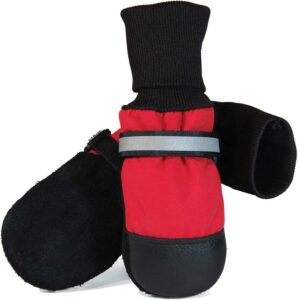 This one is the perfect example of a set of light dog boots. They are agile, they can be worn without a problem, they go up over the dog’s ankle, and they are easy to wear.
Securing these boots on your dog’s paws is simple, you simply thread the self-tightening strap through the metal hoop and adjust it according to your dog’s paw and every time pressure is applied to the strap, the strap itself will tighten itself slightly in order to compensate thus maintaining a nice tight fit around the dog’s paw.
It comes in 6 different sizes, so you will be able to buy these for your dog regardless of the breed, and it also comes equipped with reflective straps in order to improve nighttime visibility and allow you to locate your dog during the night.
The upside with these boots is simple to understand, they are light. This means that the dog will have an easier time adjusting to them and will feel a lot better wearing them earlier on.
They do their job, they do what it says on the box, they will protect your dog’s paws against the elements, they will provide the insulation that they need and they will help your dog negotiate snowy terrain easier than he or she would of have done without them.
There is also a downside, which is also the fact that they are light. Light boots work best in the city or in a town, where there is no off-road terrain to negotiate, and the dog simply has to deal with snow and a bit of ice here and there.
In a rural environment, or right in the middle of an off-road situation, these boots might not live up to your expectations.
Forest environments, mountainous terrain, all manner of off-road terrain will cause a lot of wear and tear on these boots, and most of the time your dog will find it a lot harder to maintain traction with thee boots than without them.
So they are perfect for the city, not so much for nature.
If you interested in this product you can purchase it on Amazon.
This one is the perfect example of a set of light dog boots. They are agile, they can be worn without a problem, they go up over the dog’s ankle, and they are easy to wear.
Securing these boots on your dog’s paws is simple, you simply thread the self-tightening strap through the metal hoop and adjust it according to your dog’s paw and every time pressure is applied to the strap, the strap itself will tighten itself slightly in order to compensate thus maintaining a nice tight fit around the dog’s paw.
It comes in 6 different sizes, so you will be able to buy these for your dog regardless of the breed, and it also comes equipped with reflective straps in order to improve nighttime visibility and allow you to locate your dog during the night.
The upside with these boots is simple to understand, they are light. This means that the dog will have an easier time adjusting to them and will feel a lot better wearing them earlier on.
They do their job, they do what it says on the box, they will protect your dog’s paws against the elements, they will provide the insulation that they need and they will help your dog negotiate snowy terrain easier than he or she would of have done without them.
There is also a downside, which is also the fact that they are light. Light boots work best in the city or in a town, where there is no off-road terrain to negotiate, and the dog simply has to deal with snow and a bit of ice here and there.
In a rural environment, or right in the middle of an off-road situation, these boots might not live up to your expectations.
Forest environments, mountainous terrain, all manner of off-road terrain will cause a lot of wear and tear on these boots, and most of the time your dog will find it a lot harder to maintain traction with thee boots than without them.
So they are perfect for the city, not so much for nature.
If you interested in this product you can purchase it on Amazon.
 This example is somewhat of a medium level; however it is the type of medium that can easily be mistaken for a heavy.
Right off the bat you notice something a bit different in comparison to the previous example, these are more solid, sturdier, and they don’t go up as high.
They are, in fact, stronger, a lot more solid, and they don’t allow for as much flexibility as the last pair, which is why they stop just short of the dog’s ankles. Otherwise they might lock the paw in place and rob the dog of a certain degree of mobility.
They can be locked in with a zip, which is then locked in by a Velcro strap, just for good measure. They have a thick rubber sole which allows the dog to maintain traction on some rather slippery and uncomfortable sections of terrain, and they will keep the dog nice and warm while they are being worn.
There isn’t actually a heavy boot style or a survivalist style boot for dogs, and this is actually some really good news for our 4 legged friends. Truth be told, they don’t really need heavy boots like we do because the medium ones can provide them with the grip that they need and the footing that they require, while their muscles can power them through safely.
The good part about these boots is the fact that they are a lot sturdier and a lot more solid, allowing the dog to negotiate more difficult terrain and frolic around in nature without worrying about anything.
They are durable, they can take a lot of punishment and a lot of abuse from the dog, and they will help the dog keep his or her grip.
These are the type of boots that are chosen for endurance dog races like the Iditarod or the Siberian dog trek, and that is due to the fact that they can take a lot of abuse and they can be subjected to extreme conditions while under constant physical stress and still perform without a great deal of wear and tear added to them.
Like this product? Then you can purchase it on Amazon.
This example is somewhat of a medium level; however it is the type of medium that can easily be mistaken for a heavy.
Right off the bat you notice something a bit different in comparison to the previous example, these are more solid, sturdier, and they don’t go up as high.
They are, in fact, stronger, a lot more solid, and they don’t allow for as much flexibility as the last pair, which is why they stop just short of the dog’s ankles. Otherwise they might lock the paw in place and rob the dog of a certain degree of mobility.
They can be locked in with a zip, which is then locked in by a Velcro strap, just for good measure. They have a thick rubber sole which allows the dog to maintain traction on some rather slippery and uncomfortable sections of terrain, and they will keep the dog nice and warm while they are being worn.
There isn’t actually a heavy boot style or a survivalist style boot for dogs, and this is actually some really good news for our 4 legged friends. Truth be told, they don’t really need heavy boots like we do because the medium ones can provide them with the grip that they need and the footing that they require, while their muscles can power them through safely.
The good part about these boots is the fact that they are a lot sturdier and a lot more solid, allowing the dog to negotiate more difficult terrain and frolic around in nature without worrying about anything.
They are durable, they can take a lot of punishment and a lot of abuse from the dog, and they will help the dog keep his or her grip.
These are the type of boots that are chosen for endurance dog races like the Iditarod or the Siberian dog trek, and that is due to the fact that they can take a lot of abuse and they can be subjected to extreme conditions while under constant physical stress and still perform without a great deal of wear and tear added to them.
Like this product? Then you can purchase it on Amazon.
 And remember before buying you must measure your dog’s paws.
That being said, dog boots can be both a blessing and a curse at the same time, depending on the dog that you are buying them for.
You will live some rather hilarious moments watching your dog trying to get used to the boots and the weird and hilarious struts that follow, however you will also live some rather scary moments when you are trudging through the snow and you see your dog all of a sudden shoot forward like an arrow and head off into the distance because he or she has the grip needed in order to do so.
As with everything, think long and hard before buying a pair of dog boots for your pooch, and if you feel that your dog needs them, now you know what look for, what to stay away from, and where to find them.
Check out more similar products:
And remember before buying you must measure your dog’s paws.
That being said, dog boots can be both a blessing and a curse at the same time, depending on the dog that you are buying them for.
You will live some rather hilarious moments watching your dog trying to get used to the boots and the weird and hilarious struts that follow, however you will also live some rather scary moments when you are trudging through the snow and you see your dog all of a sudden shoot forward like an arrow and head off into the distance because he or she has the grip needed in order to do so.
As with everything, think long and hard before buying a pair of dog boots for your pooch, and if you feel that your dog needs them, now you know what look for, what to stay away from, and where to find them.
Check out more similar products:

 This really depends a lot on the length of hike you’re planning on doing.
Some equipment such as a leash and poop bags are pretty much essential no matter how far you’re going, but whether or not you decide to invest in some other
This really depends a lot on the length of hike you’re planning on doing.
Some equipment such as a leash and poop bags are pretty much essential no matter how far you’re going, but whether or not you decide to invest in some other 


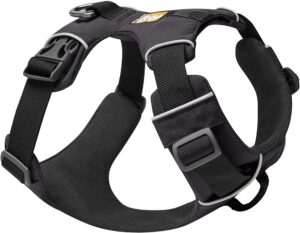


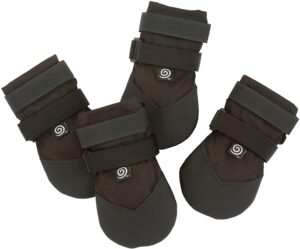

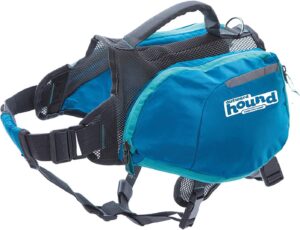
 A puppy is the best way man can heal his emotional wounds, and achieve
  Following provides some of the best techniques for training your dog into obedience and its virtues, gradually in a step-by-step program.
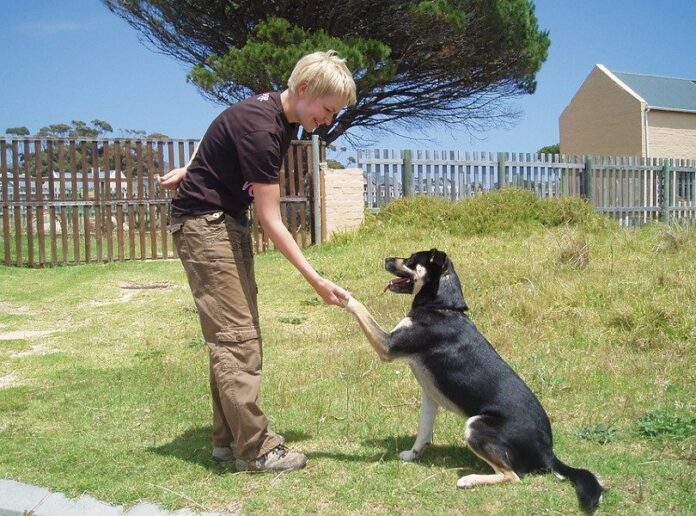 Obedience has been an inherent phase of the relationship in between dogs and humans, for ages.
Dogs have proved to be guards and best friends of humans and obedience hence have been a regular routine while acquainting oneself with a dog.
Working dogs have always been the part and parcel of human existence through helping shepherds, military, hunting, chasing and police.
The beginning of the 20th century saw the rise of dog obedience training officially in military and police forces for operant conditioning as well as reinforcements on account of animal welfare, intelligence, and training.
AKC is the American Kennel Club, which records the house-trained dogs to provide certification of Canine Good Citizen. Even insurance companies have exclusive policies to waive the restriction of dogs with CGC certificates.
Obedience has been an inherent phase of the relationship in between dogs and humans, for ages.
Dogs have proved to be guards and best friends of humans and obedience hence have been a regular routine while acquainting oneself with a dog.
Working dogs have always been the part and parcel of human existence through helping shepherds, military, hunting, chasing and police.
The beginning of the 20th century saw the rise of dog obedience training officially in military and police forces for operant conditioning as well as reinforcements on account of animal welfare, intelligence, and training.
AKC is the American Kennel Club, which records the house-trained dogs to provide certification of Canine Good Citizen. Even insurance companies have exclusive policies to waive the restriction of dogs with CGC certificates.

 One must learn to love and care for the dog just like one’s own sweet baby.
Only through apt love and dedication can an adult dog be trained to behave. Apart from the regular commands and communication that is general to teach all the dog-training techniques, you can also teach your dog exclusive commands and habits to follow.
All that you need to train your dog is through love, dedication and company that you do without any hassle or stress.
One must learn to love and care for the dog just like one’s own sweet baby.
Only through apt love and dedication can an adult dog be trained to behave. Apart from the regular commands and communication that is general to teach all the dog-training techniques, you can also teach your dog exclusive commands and habits to follow.
All that you need to train your dog is through love, dedication and company that you do without any hassle or stress. 
 In finding the best tag for your dog, there are several things that you should be after.
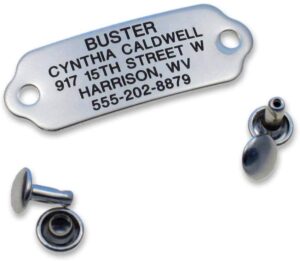 One of the things that you will love about this product is that it is made from high quality materials. You can choose from stainless steel or polished brass which are definitely durable and can last a long time.
The metal material ensures that you can get engraved letters on the tag which means that the information that you put in it will be preserved longer as well.
The company offers four lines of engraving so you can enter a lot of information in it and they also use laser engraving method which means long-lasting results.
The tag has just the right width which is 9/16th of an inch so it does not feel uncomfortable on your dog’s collar and they are also just the right length to fit collars from 5/8 of an inch up to 1 inch wide.
The company provides the rivets that you will need which are also made of high quality materials so you don’t have to worry about how you are going to attach it to a collar. Make sure though that the collar is not more than 1/8 of an inch thick or it would not fit. Although you will be the one to put the rivets in, it is really an easy affair.
All that you will need is a hammer and a padded surface to protect the tag. As to its price, it is reasonable at $10.95 given the kind of product that you are going to receive. The design also makes it impossible for your dog to get snagged by branches or shrubs if they are wandering around the yard.
One of the things that you will love about this product is that it is made from high quality materials. You can choose from stainless steel or polished brass which are definitely durable and can last a long time.
The metal material ensures that you can get engraved letters on the tag which means that the information that you put in it will be preserved longer as well.
The company offers four lines of engraving so you can enter a lot of information in it and they also use laser engraving method which means long-lasting results.
The tag has just the right width which is 9/16th of an inch so it does not feel uncomfortable on your dog’s collar and they are also just the right length to fit collars from 5/8 of an inch up to 1 inch wide.
The company provides the rivets that you will need which are also made of high quality materials so you don’t have to worry about how you are going to attach it to a collar. Make sure though that the collar is not more than 1/8 of an inch thick or it would not fit. Although you will be the one to put the rivets in, it is really an easy affair.
All that you will need is a hammer and a padded surface to protect the tag. As to its price, it is reasonable at $10.95 given the kind of product that you are going to receive. The design also makes it impossible for your dog to get snagged by branches or shrubs if they are wandering around the yard.
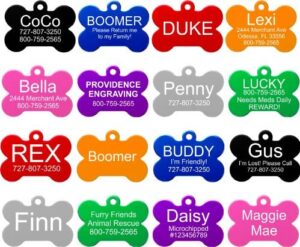 This is your next best option if you are looking for sturdy materials yet more affordable price. The tags are made of anodized aluminum which is a very strong metal that can withstand different types of weather and has a strong reinforced structure. This metal can withstand a lot of corrosion and is also tough enough that your dog would not be able to chew on it even if he is a large dog.
What is good about this set of tags is that it is highly affordable at just $3.10 which is the current offer of Amazon today. You can also choose from eight different designs (bone, heart, hydrant, round, star, cat face, and paw) and two different sizes: 1 inch to 1.5 inch. So if you have a larger dog, you can easily get the size that you need.
Since it is anodized, you can find it in a variety of colors: pink, orange, blue, silver, purple, black, gold, and green. This means you can customize and personalize the tag to your own liking.
The colors also stand out easily which makes it easier for anyone who finds your pet to get your contact information. Although the company does not engrave, they do provide laser printing which is durable as well. Some customers however complained about how easily the printing had become erased but these only happened in very active dogs.
So perhaps, normal or average use will not lead to the same results. The rounded edges make sure that it doesn’t poke your dog and it also allows for up to four lines of information to be entered both at the front and at the back of the tag. Considering its price and the utility that it provides, I can say that this is a very good option.
This is your next best option if you are looking for sturdy materials yet more affordable price. The tags are made of anodized aluminum which is a very strong metal that can withstand different types of weather and has a strong reinforced structure. This metal can withstand a lot of corrosion and is also tough enough that your dog would not be able to chew on it even if he is a large dog.
What is good about this set of tags is that it is highly affordable at just $3.10 which is the current offer of Amazon today. You can also choose from eight different designs (bone, heart, hydrant, round, star, cat face, and paw) and two different sizes: 1 inch to 1.5 inch. So if you have a larger dog, you can easily get the size that you need.
Since it is anodized, you can find it in a variety of colors: pink, orange, blue, silver, purple, black, gold, and green. This means you can customize and personalize the tag to your own liking.
The colors also stand out easily which makes it easier for anyone who finds your pet to get your contact information. Although the company does not engrave, they do provide laser printing which is durable as well. Some customers however complained about how easily the printing had become erased but these only happened in very active dogs.
So perhaps, normal or average use will not lead to the same results. The rounded edges make sure that it doesn’t poke your dog and it also allows for up to four lines of information to be entered both at the front and at the back of the tag. Considering its price and the utility that it provides, I can say that this is a very good option.
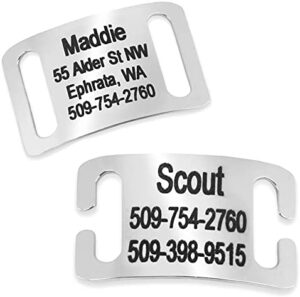 This dog tag comes with stainless steel material which is one of the toughest materials that you can find for this accessory. It can withstand a lot of wear and tear and different types of weather as well. You don’t have to worry about rusting or of getting the tag deformed since it has a well-built structure.
What is also good about this design is that it easily slides on to your dog collar and does not require any other tool for installation. You cannot use it on collars with plastic buckles though as the company clearly states that it is for single thickness, metal-buckle collars only.
The company allows up to four lines of engraving on the front with up to 18 characters for each line. What is nice about this is that the first one comes with huge letters. So if you want to put your pet’s name on it, it easily stands out on the tag.
Another thing is that it comes in three different sizes that can fit small to large dogs. You can choose from .06 inches wide to a full inch wide which can definitely suit standard sizes of dogs.
The engraving is made with laser and highlighted with a black color so the info is really easy to read. It costs $8.45 on Amazon so it is pretty much on the mid-range in terms of pricing.
There are problems that you may encounter with it though. First, it has a flat design which can make it quite difficult for your dog to wear since it does not conform to the more rounded shape of the neck.
Next, the edges are quite sharp so it can poke your dog on the neck. Lastly, it only works on dog collars with metal buckles which mean you may have to buy a new collar just for this dog tag to fit.
But considering the other benefits that you can get from it, including the fact that it wouldn’t snag on bushes or cause a lot of noise, this is still a good option for your pet.
This dog tag comes with stainless steel material which is one of the toughest materials that you can find for this accessory. It can withstand a lot of wear and tear and different types of weather as well. You don’t have to worry about rusting or of getting the tag deformed since it has a well-built structure.
What is also good about this design is that it easily slides on to your dog collar and does not require any other tool for installation. You cannot use it on collars with plastic buckles though as the company clearly states that it is for single thickness, metal-buckle collars only.
The company allows up to four lines of engraving on the front with up to 18 characters for each line. What is nice about this is that the first one comes with huge letters. So if you want to put your pet’s name on it, it easily stands out on the tag.
Another thing is that it comes in three different sizes that can fit small to large dogs. You can choose from .06 inches wide to a full inch wide which can definitely suit standard sizes of dogs.
The engraving is made with laser and highlighted with a black color so the info is really easy to read. It costs $8.45 on Amazon so it is pretty much on the mid-range in terms of pricing.
There are problems that you may encounter with it though. First, it has a flat design which can make it quite difficult for your dog to wear since it does not conform to the more rounded shape of the neck.
Next, the edges are quite sharp so it can poke your dog on the neck. Lastly, it only works on dog collars with metal buckles which mean you may have to buy a new collar just for this dog tag to fit.
But considering the other benefits that you can get from it, including the fact that it wouldn’t snag on bushes or cause a lot of noise, this is still a good option for your pet.
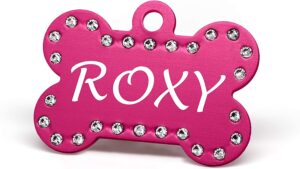 This is your dog tag if you are into stylish and glitzy tags. This product comes with 26 real Swarovski crystals that will make your dog look more fashionable. The tags are made of aluminum which is a good material since it does not rust although it is not as strong as steel.
The crystals are attached to the tag by grooves and are glued with industrial grade epoxy so you don’t have to worry about losing them unless your pet gets the chance to chew on them. You can also put up to four lines of information containing up to 16 characters each.
This is your dog tag if you are into stylish and glitzy tags. This product comes with 26 real Swarovski crystals that will make your dog look more fashionable. The tags are made of aluminum which is a good material since it does not rust although it is not as strong as steel.
The crystals are attached to the tag by grooves and are glued with industrial grade epoxy so you don’t have to worry about losing them unless your pet gets the chance to chew on them. You can also put up to four lines of information containing up to 16 characters each.
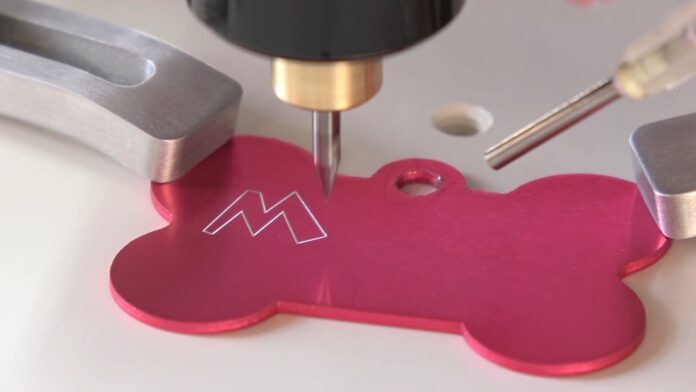 This tag measures 1 inch thick and 1.5 inch long so it is pretty large dog tag. It comes with a hole for you to easily attach it to a ring or a clip for the collar.
As for the quality of engraving, the company uses laser engraving so you are assured of high quality and long lasting engraving. You can also choose from five different colors: black, blue, pink, red, and purple.
Information is also placed both on the front and at the back of the tag which allows you to put as much info as you want. As of writing, the tag only costs $7.95 with free shipping so it really is a good buy if you want to put some “bling” on your dog.
This tag measures 1 inch thick and 1.5 inch long so it is pretty large dog tag. It comes with a hole for you to easily attach it to a ring or a clip for the collar.
As for the quality of engraving, the company uses laser engraving so you are assured of high quality and long lasting engraving. You can also choose from five different colors: black, blue, pink, red, and purple.
Information is also placed both on the front and at the back of the tag which allows you to put as much info as you want. As of writing, the tag only costs $7.95 with free shipping so it really is a good buy if you want to put some “bling” on your dog.
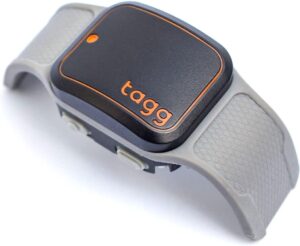 This is a good option if you want a dog tag that tells you exactly where your dog is. It uses GPS technology to locate your dog anywhere in the US so it only means that you can’t use it if you live outside of the US.
The device is pretty lightweight so it does not really weigh your pet down and it has a plastic material that is water-proof and weather proof. Due to the accuracy of the device in pinpointing location, this is highly recommended for pet owners whose pets tend to wander off or if they are usually active in outdoor activities.
Attaching the device to your dog collar is really easy since it has a receptacle where you can insert the collar and which also attaches to the device. It is quite bulky though measuring 1 x 3.5 inches so it may well suit larger dogs.
This is a good option if you want a dog tag that tells you exactly where your dog is. It uses GPS technology to locate your dog anywhere in the US so it only means that you can’t use it if you live outside of the US.
The device is pretty lightweight so it does not really weigh your pet down and it has a plastic material that is water-proof and weather proof. Due to the accuracy of the device in pinpointing location, this is highly recommended for pet owners whose pets tend to wander off or if they are usually active in outdoor activities.
Attaching the device to your dog collar is really easy since it has a receptacle where you can insert the collar and which also attaches to the device. It is quite bulky though measuring 1 x 3.5 inches so it may well suit larger dogs.
 But it does provide a lot of uses for a pet owner. First, it tells you exactly where your pet is. Second, it monitors his physical activities so you will know whether he or she is getting sufficient exercise. Third, it sends text and email alerts if your pet ever wanders off.
Lastly, it sends information regarding the ambient temperatures that your pet is in so you would know if they are suffering from extreme cold or heat.
One of the downsides of this device however, is that it really costs a lot of money. It currently sells at almost $80 dollars so you may have to think twice before investing in this type of dog tag.
It also has a monthly subscription for the GPS service and as stated above, it is quite bigger than an average dog tag. But aside from these, the device offers long battery life, water and dog-proof, as well as a sophisticated technology that allows you to find your dog.
If you have the resources to pay for this kind of device then you should definitely do so especially if you have a highly valued pet. Remember though that it does not contain actual written information so anyone who finds your dog may not be able to return them to you.
But it does provide a lot of uses for a pet owner. First, it tells you exactly where your pet is. Second, it monitors his physical activities so you will know whether he or she is getting sufficient exercise. Third, it sends text and email alerts if your pet ever wanders off.
Lastly, it sends information regarding the ambient temperatures that your pet is in so you would know if they are suffering from extreme cold or heat.
One of the downsides of this device however, is that it really costs a lot of money. It currently sells at almost $80 dollars so you may have to think twice before investing in this type of dog tag.
It also has a monthly subscription for the GPS service and as stated above, it is quite bigger than an average dog tag. But aside from these, the device offers long battery life, water and dog-proof, as well as a sophisticated technology that allows you to find your dog.
If you have the resources to pay for this kind of device then you should definitely do so especially if you have a highly valued pet. Remember though that it does not contain actual written information so anyone who finds your dog may not be able to return them to you.



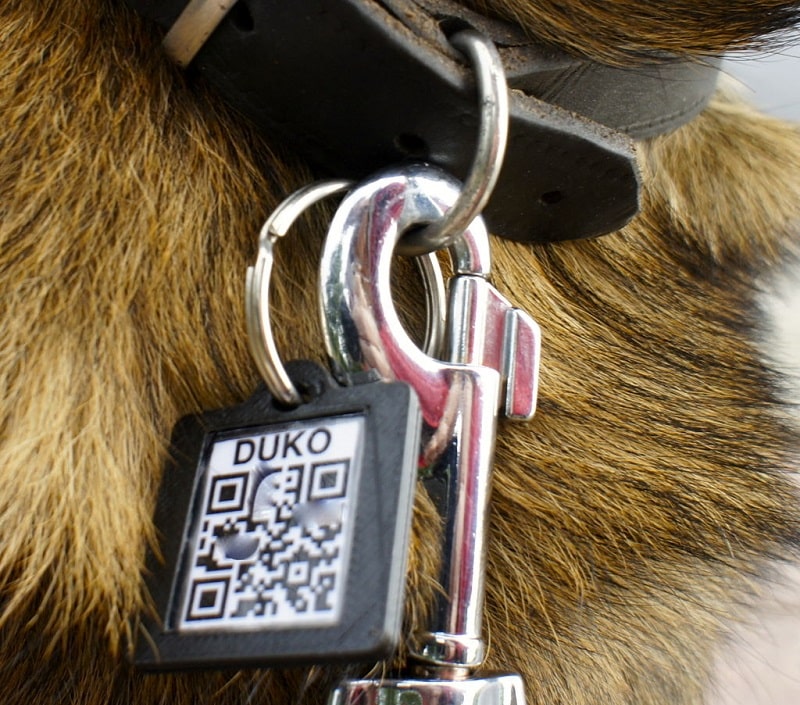 The easiest method of making a dog tag is to use plastic. It’s very durable, extremely light, and highly customizable, so you can make them look however you want.
What you’ll need is the polystyrene plastic (the #6 plastic) that many takeout containers are made of. If you can’t find this, then buying a pack of Shrinky Dinks at the craft store can work as well. The other materials that you’ll need are:
The easiest method of making a dog tag is to use plastic. It’s very durable, extremely light, and highly customizable, so you can make them look however you want.
What you’ll need is the polystyrene plastic (the #6 plastic) that many takeout containers are made of. If you can’t find this, then buying a pack of Shrinky Dinks at the craft store can work as well. The other materials that you’ll need are:
 Then add the metal hoop to the tag and it’s ready to be worn.
If you’re not very good at designing your own tags, then you can make the process even easier by using Shrinky Dinks and a computer. There are plenty of online tag templates that you can print off onto a plastic sheet.
Downloading these templates makes it easy for you to customize the information on them instead of having to write it by hand. Then once it’s printed, place the tag in the toaster oven to shrink. Because it uses printer ink, it would be a good idea to spray both sides of the tag with a clear coat spray in order to seal it before attaching it to your dog’s collar.
Then add the metal hoop to the tag and it’s ready to be worn.
If you’re not very good at designing your own tags, then you can make the process even easier by using Shrinky Dinks and a computer. There are plenty of online tag templates that you can print off onto a plastic sheet.
Downloading these templates makes it easy for you to customize the information on them instead of having to write it by hand. Then once it’s printed, place the tag in the toaster oven to shrink. Because it uses printer ink, it would be a good idea to spray both sides of the tag with a clear coat spray in order to seal it before attaching it to your dog’s collar.
 We all used to have one in the nineties to label moving boxes or craft drawers. They’re not so common anymore, but if you managed to get your hands on one, then they can be quite helpful in creating dog tags for your pet. All you have to do is print off your dog’s information and then encase the label in some kind of plastic laminate.
This protects the letters and ensures that the label doesn’t wear out from exposure to the elements. Simply punch a hole at one end of it and attach it to your dog’s collar with a jump ring. It’s very simple and doesn’t have a lot of color, but it’s very effective in a pinch.
We all used to have one in the nineties to label moving boxes or craft drawers. They’re not so common anymore, but if you managed to get your hands on one, then they can be quite helpful in creating dog tags for your pet. All you have to do is print off your dog’s information and then encase the label in some kind of plastic laminate.
This protects the letters and ensures that the label doesn’t wear out from exposure to the elements. Simply punch a hole at one end of it and attach it to your dog’s collar with a jump ring. It’s very simple and doesn’t have a lot of color, but it’s very effective in a pinch.
 Cloth labels are meant to endure the wear and tear of normal use so that we can still read them years later. They’re made from printable fabric paper, which you can purchase online, in craft stores, or you can try to make your own fabric paper from scraps of fabric lying around your home.
No matter which medium you choose, it’s easy to write on. In order to protect the tag, use some kind of laminate to cover both sides to preserve the information that you have on it.
If you’re skilled in crafts, you can even try embossing the information onto the fabric paper, though this does take a lot more time to make, but the quality of your dog tag will certainly be a lot higher.
Cloth labels are meant to endure the wear and tear of normal use so that we can still read them years later. They’re made from printable fabric paper, which you can purchase online, in craft stores, or you can try to make your own fabric paper from scraps of fabric lying around your home.
No matter which medium you choose, it’s easy to write on. In order to protect the tag, use some kind of laminate to cover both sides to preserve the information that you have on it.
If you’re skilled in crafts, you can even try embossing the information onto the fabric paper, though this does take a lot more time to make, but the quality of your dog tag will certainly be a lot higher.
 The first thing you’re going to need is a penny. It’s best if you wash it in order to remove any dirt or debris that is stuck to it. This makes it easier to work with, and your tag can be nice and shiny on the other side. You’ll also need some Modge Podge, some craft paper, and a jump ring.
The next step is to cut a piece of paper that is the same size as the penny’s face. Trace around the shape of the penny to get the right dimensions, and then cut it out using a pair of scissors or an exacto knife.
Next, write down your pet’s information and your contact information on the piece of paper. Be sure to use something that won’t bleed through the paper, so it’s best not to use a marker. Be sure that your handwriting is legible.
Apply a light layer of Modge Podge to one side of the penny and then press the piece of paper onto it. Apply another later of Modge Podge over the paper and allow it to dry. This will create a clear barrier over the paper to protect the writing.
Then flip the penny over, place a jump ring on it, and apply a generous amount of Modge Podge. You can also add a small dab of crazy glue to provide some extra security to the jump ring.
Cover the entire back of the penny with Modge Podge in order to create a clear and shiny surface, just like the front. Allow it to dry over night, and your pet tag is complete. For larger pets, you can choose to use twenty-five cents as tags, and it gives you a lot more room to write more information and decorate.
Although pet tags are designed to last an extremely long time, it’s important that you inspect them on a regular basis to make sure that you can still read the information. The same can be said for pets that you make yourself, as they may not be able to last as long as metal tags.
They tend to fade a bit faster, so you should replace them on a regular basis. It’s also a good idea to have to extra sets of tags made, in case one of them goes missing. It will save you time and money than having to go back to the store to make another one.
After all, it’s in everyone’s interests that your dog be kept safe at all times.
The best thing about creating your own pet tags at home is that you have a lot more options open to you. They can match the personality of your pet, accessorize with your
The first thing you’re going to need is a penny. It’s best if you wash it in order to remove any dirt or debris that is stuck to it. This makes it easier to work with, and your tag can be nice and shiny on the other side. You’ll also need some Modge Podge, some craft paper, and a jump ring.
The next step is to cut a piece of paper that is the same size as the penny’s face. Trace around the shape of the penny to get the right dimensions, and then cut it out using a pair of scissors or an exacto knife.
Next, write down your pet’s information and your contact information on the piece of paper. Be sure to use something that won’t bleed through the paper, so it’s best not to use a marker. Be sure that your handwriting is legible.
Apply a light layer of Modge Podge to one side of the penny and then press the piece of paper onto it. Apply another later of Modge Podge over the paper and allow it to dry. This will create a clear barrier over the paper to protect the writing.
Then flip the penny over, place a jump ring on it, and apply a generous amount of Modge Podge. You can also add a small dab of crazy glue to provide some extra security to the jump ring.
Cover the entire back of the penny with Modge Podge in order to create a clear and shiny surface, just like the front. Allow it to dry over night, and your pet tag is complete. For larger pets, you can choose to use twenty-five cents as tags, and it gives you a lot more room to write more information and decorate.
Although pet tags are designed to last an extremely long time, it’s important that you inspect them on a regular basis to make sure that you can still read the information. The same can be said for pets that you make yourself, as they may not be able to last as long as metal tags.
They tend to fade a bit faster, so you should replace them on a regular basis. It’s also a good idea to have to extra sets of tags made, in case one of them goes missing. It will save you time and money than having to go back to the store to make another one.
After all, it’s in everyone’s interests that your dog be kept safe at all times.
The best thing about creating your own pet tags at home is that you have a lot more options open to you. They can match the personality of your pet, accessorize with your 
 There are a huge number of dog identification tags on the market and it can be very difficult to decide which one is the best to get for your dog.
They are available in all manner of styles, shapes, and materials that the choice can actually be fairly overwhelming. So, how exactly do you choose the right sort of tag to wear on your dog’s collar?
One of the first things that you need to look at is the material. Dogs are active animals and they enjoy rolling around and getting in among shrubs and trees while outside.
This means that you need a hard-wearing material that can stand up to a great deal of punishment over the years. Ideally, you only ever want to have to replace your dog’s ID tag if the information on it becomes invalid, for example, if you move house.
Metal is probably your best option. The most popular choices are nickel, brass, and steel. They are all equally as good and fit for purpose so it really comes down to your own preference.
I prefer nickel or steel because the silver color goes with the silver rivets on my dog’s collar, but you may prefer the golden color that brass offers. It is worth considering whether you or your
There are a huge number of dog identification tags on the market and it can be very difficult to decide which one is the best to get for your dog.
They are available in all manner of styles, shapes, and materials that the choice can actually be fairly overwhelming. So, how exactly do you choose the right sort of tag to wear on your dog’s collar?
One of the first things that you need to look at is the material. Dogs are active animals and they enjoy rolling around and getting in among shrubs and trees while outside.
This means that you need a hard-wearing material that can stand up to a great deal of punishment over the years. Ideally, you only ever want to have to replace your dog’s ID tag if the information on it becomes invalid, for example, if you move house.
Metal is probably your best option. The most popular choices are nickel, brass, and steel. They are all equally as good and fit for purpose so it really comes down to your own preference.
I prefer nickel or steel because the silver color goes with the silver rivets on my dog’s collar, but you may prefer the golden color that brass offers. It is worth considering whether you or your  You will also need to think about the style of the ID tag. The most common options are a flat disc or another shape with engraving on it, or alternatively, you can choose a small tube that screws open to allow a slip of paper to be inserted containing your details.
I would always advise the metal disc option since the tube or barrel style tags present an opportunity for the bottom half to become undone and then the paper can be lost.
This can happen if the dog is rolling around and manages to accidentally unscrew the two sections. In addition, it may not be instantly clear that this is an ID tag if the person who finds your dog is not used to that particular style.
However, you can avoid this by getting your dog tag from a reputable source. Not sure where? We have a great list of places to find the
You will also need to think about the style of the ID tag. The most common options are a flat disc or another shape with engraving on it, or alternatively, you can choose a small tube that screws open to allow a slip of paper to be inserted containing your details.
I would always advise the metal disc option since the tube or barrel style tags present an opportunity for the bottom half to become undone and then the paper can be lost.
This can happen if the dog is rolling around and manages to accidentally unscrew the two sections. In addition, it may not be instantly clear that this is an ID tag if the person who finds your dog is not used to that particular style.
However, you can avoid this by getting your dog tag from a reputable source. Not sure where? We have a great list of places to find the  In some areas, you may be issued with a tag when registering your dog. However, you may not necessarily have to use that particular tag. It is worth asking if you are permitted to have custom dog ID tags engraved with the relevant information on them instead.
If you’re feeling particular crafty, you could actually make your own ID tags for your dog. Please take a look at our article on
In some areas, you may be issued with a tag when registering your dog. However, you may not necessarily have to use that particular tag. It is worth asking if you are permitted to have custom dog ID tags engraved with the relevant information on them instead.
If you’re feeling particular crafty, you could actually make your own ID tags for your dog. Please take a look at our article on  Many dog owners will also include a note to indicate that the dog is microchipped. This both tells the finder that they can take the animal to be scanned for complete information about the owner and warns a thief that the dog has identification that they cannot remove!
One thing that it is advisable not to include when ordering custom dog id tags is the owner’s surname.
This is a security recommendation since a surname combined with the address from the tag could allow someone to commit identity fraud! If your dog has particular medical needs then it could also be helpful to include this or to add a medical alert tag.
Many dog owners will also include a note to indicate that the dog is microchipped. This both tells the finder that they can take the animal to be scanned for complete information about the owner and warns a thief that the dog has identification that they cannot remove!
One thing that it is advisable not to include when ordering custom dog id tags is the owner’s surname.
This is a security recommendation since a surname combined with the address from the tag could allow someone to commit identity fraud! If your dog has particular medical needs then it could also be helpful to include this or to add a medical alert tag.
 Some dog owners neglect to purchase an ID tag simply because they think they are too responsible to ever lose their dog! However, even if you have a
 This is where dog backpacks come in — simple contraptions that can give dogs physical and mental challenges that can serve as distractions to maintain balance and calmness in both indoor and outdoor settings. However, even if this accessory looks simple to use and acquire, we should be responsible enough to finding the best available on the market to suit the needs of the dog using it.
If you mistakenly thought this was an article dedicated to backpacks you can carry your dogs in, then you may want to check out this wonderful article instead on
This is where dog backpacks come in — simple contraptions that can give dogs physical and mental challenges that can serve as distractions to maintain balance and calmness in both indoor and outdoor settings. However, even if this accessory looks simple to use and acquire, we should be responsible enough to finding the best available on the market to suit the needs of the dog using it.
If you mistakenly thought this was an article dedicated to backpacks you can carry your dogs in, then you may want to check out this wonderful article instead on 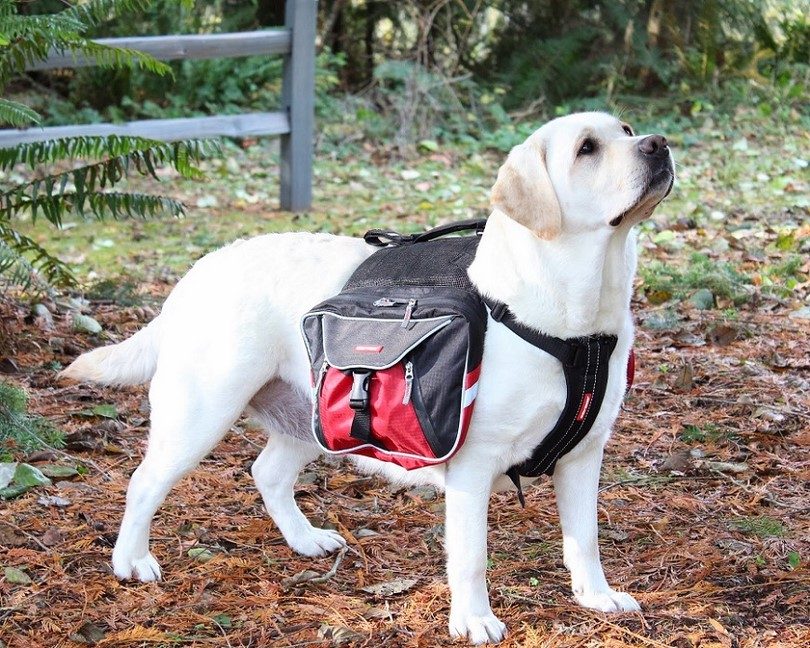 These dogs are anatomically compatible with backpacks due to their strong shoulder and back muscles that can carry a reasonable load, as well as the shape of their body that can allow a backpack to fit comfortably.


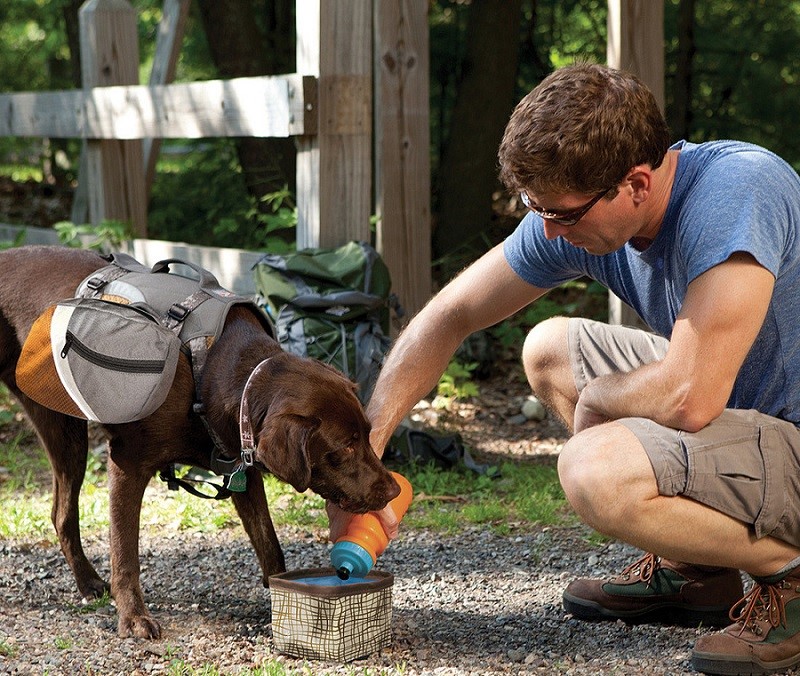 Backpacks designed for dogs should be cleaned and dried before being stored and used for the next activity. As a general rule, it is not recommended for these accessories to be machine-washed.
A gentle wash with soap and water is going to be good enough to clean the visible dirt, and removal of mud. Make sure that the cleaning agent you’ll be using is not too strong, as it may irritate the dog’s skin during the constant friction that occurs every time the dog uses the backpack.
You may also consult your dog’s veterinarian if a power disinfectant or flea powder can be applied to the straps as part of the disinfection process. A dog backpack should be air-dried and not spin-dried or blow-dried, because spin-drying can damage the parts, whereas blow-drying can make the threads brittle and will wear off faster.
In combination with maintaining a backpack, the dog’s body parts that are in contact with the backpack should be brushed to promote air circulation and blood circulation to the skin. This also removes loose fur that impedes circulation and can harbor bacteria.
Backpacks designed for dogs should be cleaned and dried before being stored and used for the next activity. As a general rule, it is not recommended for these accessories to be machine-washed.
A gentle wash with soap and water is going to be good enough to clean the visible dirt, and removal of mud. Make sure that the cleaning agent you’ll be using is not too strong, as it may irritate the dog’s skin during the constant friction that occurs every time the dog uses the backpack.
You may also consult your dog’s veterinarian if a power disinfectant or flea powder can be applied to the straps as part of the disinfection process. A dog backpack should be air-dried and not spin-dried or blow-dried, because spin-drying can damage the parts, whereas blow-drying can make the threads brittle and will wear off faster.
In combination with maintaining a backpack, the dog’s body parts that are in contact with the backpack should be brushed to promote air circulation and blood circulation to the skin. This also removes loose fur that impedes circulation and can harbor bacteria.
 Once the dog becomes acclimated to the experience of wearing a backpack, you as the dog owner can observe whether the accessory has a comfortable fit. There are backpacks that are comfortable when worn in a resting position but are straining when already engaging in an activity, such as walking and running.
This can be observed when the straps look stretched. There can even be a faint, stretching sound heard. When this occurs, you can adjust the straps by loosening them to a more comfortable fit.
Once the dog becomes acclimated to the experience of wearing a backpack, you as the dog owner can observe whether the accessory has a comfortable fit. There are backpacks that are comfortable when worn in a resting position but are straining when already engaging in an activity, such as walking and running.
This can be observed when the straps look stretched. There can even be a faint, stretching sound heard. When this occurs, you can adjust the straps by loosening them to a more comfortable fit.
 A backpack can remind a dog of its purpose and can let it know that it has worth and that its owner appreciates its effort to stay by his side with the load it is carrying.
It is an experience that promotes more enjoyable moments of bonding, improved self-confidence for the dog, and a stronger definition of a companion in the field as the dog gains another purpose.
To ensure that your dog is always comfortable, whether it’s for the short- or long-term, you should check out this great list of tips and tricks when you’re
A backpack can remind a dog of its purpose and can let it know that it has worth and that its owner appreciates its effort to stay by his side with the load it is carrying.
It is an experience that promotes more enjoyable moments of bonding, improved self-confidence for the dog, and a stronger definition of a companion in the field as the dog gains another purpose.
To ensure that your dog is always comfortable, whether it’s for the short- or long-term, you should check out this great list of tips and tricks when you’re 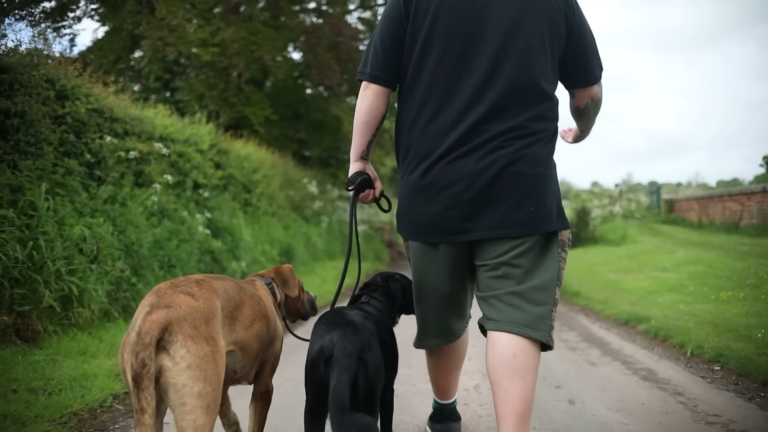
 Recognizing and respecting your dog’s breed-specific characteristics and instincts is paramount in tailoring an effective training program. For instance, a
  Dogs thrive on predictability. By establishing a consistent routine, you lay down a foundation of trust and security. Training sessions, meals, walks,
  Given that dogs have relatively short attention spans, it’s crucial to keep training sessions concise and engaging. Ideally, training should last between 5 to 10 minutes, allowing for multiple sessions spread throughout the day.
This strategy ensures that your dog remains focused and eager to learn without
Given that dogs have relatively short attention spans, it’s crucial to keep training sessions concise and engaging. Ideally, training should last between 5 to 10 minutes, allowing for multiple sessions spread throughout the day.
This strategy ensures that your dog remains focused and eager to learn without  To avoid overwhelming your dog, it’s best to focus on teaching one command at a time. This focused approach allows your dog to fully grasp each command before moving on to the next.
It prevents confusion and ensures that your dog can confidently respond to commands in various situations. Once a command is mastered, you can celebrate this achievement together before gradually
To avoid overwhelming your dog, it’s best to focus on teaching one command at a time. This focused approach allows your dog to fully grasp each command before moving on to the next.
It prevents confusion and ensures that your dog can confidently respond to commands in various situations. Once a command is mastered, you can celebrate this achievement together before gradually  Training your dog is an opportunity to build a stronger bond and enhance their well-being. By following the tips outlined above, you’re not just teaching your dog commands; you’re fostering a relationship based on mutual respect and understanding.
Each dog is unique, requiring patience, positivity, and perseverance to discover what works best for them. Celebrate the small victories along the way and remember that the journey of training is as rewarding as the outcomes.
With consistency, understanding, and a dash of creativity, you and your furry companion will enjoy a harmonious and obedient relationship. Remember, the goal of training is not perfection but progress, fostering a happy and healthy life together.
Training your dog is an opportunity to build a stronger bond and enhance their well-being. By following the tips outlined above, you’re not just teaching your dog commands; you’re fostering a relationship based on mutual respect and understanding.
Each dog is unique, requiring patience, positivity, and perseverance to discover what works best for them. Celebrate the small victories along the way and remember that the journey of training is as rewarding as the outcomes.
With consistency, understanding, and a dash of creativity, you and your furry companion will enjoy a harmonious and obedient relationship. Remember, the goal of training is not perfection but progress, fostering a happy and healthy life together. 
 Caring and looking out for your dog’s well-being during times of natural calamities is one of your responsibilities as their owner.