There are many ways to keep our dogs and pets healthy, and the most important key to any dog’s health is adequate hydration. Though we may have to leave for work, prior obligations, or errands for household items, our pets are perfectly safe at home without us as long as they have unrestricted access to water with the best dog water fountain.
Water is not only essential to the health of our pets because it carries important nutrients throughout the body, but it also helps our pets digest food, maintain normal body temperatures, and improve overall cell function.
Comparison Table:
Invest in the well-being of your favorite furry companion by considering from our recommendations for the best dog water fountain from the leading brands in pet accessories and appliances.
Top Picks Best Dog Water Fountain
Let’s explore nine of the bestselling drinking fountains for pets. Each of these products are designed for specific varieties of pets and applications, while all are available at affordable or moderate prices to suit any kind of budget.
1. Petsafe Drinkwell Platinum Pet Fountain
Water Capacity: 168 ounces (1.3 gallons)PetSafe Drinkwell Platinum Pet Fountain
Dimensions: 15.9 x 10.6 x 10.5 inches
Design Features: Replaceable carbon water filter, built-in reservoir, BPA-free plastic design, free-falling water system, and adjustable flow control
The Drinkwell Platinum Pet Fountain by PetSafe is a popular choice for many pet owners because it offers personal control over the rate of water flow, so you can conserve on water if your dog is prone to overhydrating or allow unlimited flow to encourage your dog to drink throughout the day. One problem a lot of pet owners face is that their dogs’ water bowls easily move across tile or hardwood floors.
This pet fountain includes rubber feet to prevent from sliding. This product is relatively easy to disassemble for routine cleaning. You will love the convenience of being able to wash everything except for the pump in your dishwasher.
With a relatively medium- to high-water capacity, this fountain offers a great value and is competitively priced. If you have multiple large dogs, you may want to consider a water fountain with a higher fluid capacity so you can save the time and energy it takes to continually replace water as they gulp it down.
Related: If you’re looking to spend a little less on your dog’s water fountain, PetSafe offers a more affordable alternative in their smaller Drinkwell Original Pet Fountain. If you have multiple pets, take a look at their Drinkwell 360 Fountain with a 128-ounce water capacity for dogs, cats, and any pet to enjoy from all angles.
2. Aspen Pet Cool Flow Pet Fountain
Water Capacity: 50 ounces (0.39 gallons)Aspen Pet Cool Flow Pet Fountain
Dimensions: 13.5 x 7 x 9 inches
Design Features: Easy-to-clean plastic, translucent reservoir, replaceable charcoal filter, whisper-quiet AC submersible pump, and two color options to choose from
The Aspen Pet Cool Flow Pet Fountain is a very affordable option for pet parents who want to promote health and well-being on a budget. This minimalistic water fountain is offered in two attractive, neutral colors, white and bleached linen, so you can order to match the rest of your home décor.
Although plastic may not seem as stylish as stainless steel or ceramic, this fountain will prove easy to clean and the clear reservoir lets you keep track of your dog’s daily water intake as well as any needed refills. A continuous stream also regulates the water to keep it cool and oxygenated.
The major drawback to choosing this product over its competitors is the low water capacity of 50 ounces.
Related: If you’re looking for more of a standard gravity water container, look no further than Aspen Pet’s Lebistro Gravity Waterer, offered in a variety of gallon sizes and colors for you to choose from. If you’re looking for a more affordable alternative, their Gravity Water Bottle is offered at lower water capacities with the same translucent reservoir so you can easily keep track of refill needs.
3. Petsafe Ceramic Pagoda Fountain
Water Capacity: 70 ounces (0.55 gallons)PetSafe Ceramic Pagoda Fountain
Dimensions: 10.6 x 12.2 x 8.4 inches
Design Features: Dual free-falling streams, replaceable carbon water filter, ceramic/porcelain design, upper and lower dishes, top-shelf dishwasher-safe, double filtration systems, and four color varieties
The PetSafe Ceramic Pagoda Fountain doubles as an important hydration source for your pet and an appealing home accessory for your kitchen, mudroom, or wherever your pets go to drink. With 70 ounces of water, this product is a great solution for pet owners with small to medium-sized dogs or cats.
The ceramic design is more hygienic than alternative materials, and we particularly admire the convenience of upper and lower dishes so pets have two drinking areas to choose from or share. The replaceable carbon water filter eliminates bad tastes and odors you commonly find with stagnant or non-filtered gravity waterers.
Due to its square design, this product may take up a little more space than competing fountains. Although this water system is not the most expensive choice in our review, it would be a luxurious investment to attain animal welfare and aesthetic appeal.
Related: Keeping with the tradition of incorporating your pet’s water fountain into your décor, PetSafe’s 360 Fountain as an ideal alternative at half the price. Their Ceramic Avalon Fountain has many of the same great features as the Pagoda, except that it features a circular upper dish design.
4. Petsafe Drinkwell Original Pet Fountain
Water Capacity: 50 ounces (0.39 gallons)PetSafe Drinkwell Original Pet Fountain
Dimensions: 11.4 x 9.1 x 7 inches
Design Features: Free-falling stream, replaceable activated carbon water filter, adjustable flow control knob, BPA-free plastic construction, top-shelf dishwasher-safe, receiving ramp, and a power cord
The PetSafe Drinkwell Original Pet Fountain is another quality selection for any pet owner with small to medium sized pets. Like the Platinum Pet Fountain, this product offers total customization over water flow by using a simple knob. Made from BPA-free plastic, you can feel better about the products your pets use on a regular basis.
This water system features a free-falling stream to encourage your pet to drink more while keeping the water oxygenated and fresher for longer. As with many of PetSafe’s products, this fountain includes a replaceable activated carbon filter to routinely eliminate bad tastes and odors so your pet only drinks the purest water.
What sets this fountain apart from other hydration systems in our review is that it features a six-foot-long power cord, so you’re not as limited as to where you can place it for your pets to access.
With only a 50-ounce water capacity, this fountain is suitable for small dog breeds and cats, but we would suggest looking at alternatives for larger dog breeds. If you’re looking to add a second water fountain to your home, this fountain is a great solution and features a handy receiving ramp that reduces splash and sound.
Related: If you’re looking for a higher water capacity, PetSafe’s Drinkwell Platinum Pet Fountain features a 168-ounce water reservoir so you can rest assured that your pet has constant access. If you would like a more affordable alternative, the Mini Pet Fountain by PetSafe offers a 40-ounce water capacity and is ideal for small dogs or cats.
5. Pioneer Pet Raindrop Drinking Fountain
Water Capacity: 60 ounces (0.47 gallons)Pioneer Pet Raindrop Drinking Fountain
Dimensions: 11.5 x 9 x 4.5 inches
Design Features: Continuous water flow, stainless steel construction, replaceable charcoal filter, patent-pending electric pump design, dishwasher-safe, and an adjustable spout
Pioneer Pet’s Raindrop Drinking Fountain features an ultra-sleek stainless steel design that will pair well with any of your appliances or décor. If you’re worried less about the aesthetic appeal in your dog’s water fountain, you’ll be happy to know that this product also features a circulating water flow for freshness and a centralized spout that prevents noise.
For reasons still unclear, pets are naturally drawn toward moving water. This water system also includes a quiet pump that circulates and oxygenates the water, keeping the bowl clean between uses. Although this is an affordable option, the 60-ounce capacity is rather limiting for pet owners with multiple pets or large dogs.
Otherwise, this drinking fountain is dishwasher-safe and easy to maintain, making it one of the better values in our review.
Related: If you own multiple dogs or pets, the Big Max Stainless Steel Fountain by Pioneer Pet may be better suited to your needs because of its 128-ounce water capacity. If you would prefer an alternative material to stainless steel, they also offer the Big Max Ceramic Drinking Fountain in white and black.
6. Petsafe Drinkwell Zen Water Fountain
Water Capacity: 128 ounces (1 gallon)PetSafe Drinkwell Zen Water Fountain
Dimensions: 13.4 x 13.4 x 6.3 inches
Design Features: Free-falling stream, replaceable carbon water filter, receiving ramp, BPA-free plastic upper, stainless steel drinking bowl, dishwasher-safe, submersible pump, and a low-voltage inline plug.
The PetSafe Drinkwell Zen Water Fountain is great for pets of all sizes. The large bowl shape holds as much as 128 ounces of water, so your pets have plenty to drink throughout the day while you’re running errands, working, or attending classes. Stainless steel is a popular material for water fountains because it is hygienic and dishwasher-safe.
Better yet, stainless steel naturally resists corrosion and is easy to clean. The pump housing is made from BPA-free plastic.
Like other PetSafe water fountains, this model comes with a replaceable carbon water filter that eliminates bad tastes and odors so you can avoid worrying about your pets drinking stagnant water. The constant circulation of water prevents bacteria growth between cleanings.
Best of all, the receiving ramp reduces splash so you save time cleaning up after your dog or cat and the submersible pump makes very little noise. With an easy assembly and the convenience of long-lasting filters, this is a great deal.
Related: The Drinkwell 360 Pet Fountain is a great alternative for pet owners who like to have adjustable flow control and an innovative 360-degree stainless steel design.
7. Pioneer Pet Raindrop Fountain
Water Capacity: 60 ounces (0.47 gallons)Pioneer Pet Raindrop Fountain
Dimensions: 11.5 x 9 x 4.5 inches
Design Features: Circulating water flow, stainless steel construction, replaceable charcoal filter, patent-pending electric pump design, low-voltage power system, dishwasher-safe, and an adjustable spout.
The Pioneer Pet Raindrop Fountain is the alternative to their Raindrop Stainless Steel Drinking Fountain. Like its counterpart, the circulating water flow naturally encourages dogs and cats to drink more, and the system keeps the bowl clean fresh and free from bacteria growth between cleanings.
This drinking fountain is offered in two colors, black and white, so you can order a fountain to match the rest of your home’s décor.
Maintenance is relatively simple, and this model is dishwasher-safe as long as you remove the pump. The ceramic construction is highly durable and will last a long time with regular cleanings and filter replacements. Hydration is essential to your dog’s health.
With a patent-pending electric pump design, this fountain operates quietly while enticing your pet to drink. Best of all, ceramic is preferred for feline drinking bowls because it can prevent feline acne. Heavier than plastic, this product is safe from tipping or pushing due to its helpful heft.
8. Petsafe Drinkwell Outdoor Pet Fountain
Water Capacity: 448 ounces (3.5 gallons)PetSafe Drinkwell Outdoor Pet Fountain
Dimensions: 21 x 14.1 x 12.5 inches
Design Features: Free-falling water stream, replaceable carbon water filter, deep drinking bowl with high sides, indoor/outdoor applications, and a BPA-free and UV-resistant plastic construction.
Although PetSafe Drinkwell Outdoor Pet Fountain may be the most expensive and bulkiest water fountain in our review, this product is the perfect solution for any dog or pet owner that spends as much time outside as he or she does inside. If your dog’s always by your side while you’re gardening, mowing the lawn, reading, or relaxing, look no further than this outdoor pet fountain.
This product is suitable for both indoor household use and seasonal outdoor use. If you plan to spend time outdoors with your dog in temperatures lower than 40°F, you may want to look at competing or alternative fountain options designed for cooler weather.
Because this hydration system is designed for seasonal outdoor use, PetSafe suggests that you clean it once a week, requiring a little more care than other systems in our review. Should you decide that this product is right for you, take advantage of the cutouts on the sides to help carry and place the fountain.
Related: With a slightly smaller water capacity, the Big Dog Fountain by PetSafe is a great alternative to the outdoor model, and it features a snap-on lid to prevent accidental spills or removal by curious pets. If you are looking for an outdoor fountain at a more affordable price, their Everflow Indoor-Outdoor Water Fountain is just the product you have been looking for.
9. Dogit Fresh and Clear Fountain
Water Capacity: 200 ounces (1.56 gallons)Dogit Fresh and Clear Fountain
Dimensions: 9.8 x 12 x 6.8 inches
Design Features: Recirculating water flow, large surface areas, elevated design, multi-stage filtration system, and a replaceable dual-function filter cartridge.
The Dogit Fresh and Clear Fountain is one of the most affordable drinking fountains in our review and, in our opinion, it looks the least like a conventional fountain. Although it may not be as stylish as the Raindrop Stainless Steel Fountain or the Ceramic Pagoda Fountain, it features a calmingly light blue top with a white base and blends in with most interior design themes.
Multi-stage filtration eliminates water impurities, such as food, hair, and residue, so your pets drink from a continuous supply of fresh and clean drinking water. The major advantage to choosing this product aside from its budget-friendly price is that it features a tall design, so it’s an ideal solution for larger dog breeds, senior pets, and even cats to gain easy access to cool and filtrated water.
With a 200-ounce water capacity, this product is one of the greatest values in our review and should serve as a quality starter drinking fountain for any pet parent that’s looking to stay within a strict budget.
Related: Dogit provides a similar design in their Fresh and Clear Drinking Fountain for Large Dogs, except that this alternative features a 360-degree rotating dome and can hold up to 355 ounces. If you spend a lot of time outdoors with your dog(s), choose a water fountain that could just as easily blend in with the rest of your tranquil garden décor with the Al Fresco Indoor/Outdoor Dog Fountain.
Best Dog Water Fountain – Buying Guide
Choosing the best water drinking fountain for your precious pet may seem like a difficult decision.
We’ve highlighted several of the most important features for you to consider before making a final decision.
1. Materials
Many of the water fountains in our review are made from plastic, ceramic, or stainless steel. Although the ultimate decision is yours to make, there are potential health concerns related to each material that are worth considering.
Plastic and ceramic drinking fountains may cause some nose pigmentation loss depending on the sensitivities of your pet’s skin.
Stainless steel is a reliable choice for its ease of cleaning, and it won’t cause immunologic reactions in dogs with known pigment sensitivities or histories of chin acne.
Several of the fountains in our review are made from BPA-free plastic, which is a healthier alternative to regular plastic. Make the smartest decision for your dog’s health, starting with the material of his or her water bowl.
2. Water Filtration
Traditional water bowls for pets are known as some of the dirtiest and germiest places in the home. Combat grime and bacteria by routinely replacing your dog’s or cat’s water. Each of the drinking fountains in our review features convenient filtration systems.
While many of these products include replaceable water filters made from carbon or charcoal, some products feature multi-stage filtration processes to better clean and freshen your dog’s water supply. Pay close attention to pump care and cleaning so your dog can enjoy the drinking fountain for a long time to come.
3. Height
The height of your chosen drinking fountain can deeply affect the stress put on your pet’s muscles, ligaments, tendons, and vertebrae. Higher water fountain designs are ideal for larger breeds with elongated torsos or long legs and senior pets with painful joints or limited mobility.
Reduce the strain your pets endures by reaching for a low-level water bowl. Your pet will benefit from improved comfort and the ease of chewing and digesting in a more natural body posture.
4. Water Capacity
The fluid capacity of your pet’s future drinking fountain is essential. A hydrated dog should drink one ounce per pound in weight per day. If you own a larger breed of dog, ranging from 40 to 100 pounds in size, a 50-ounce capacity just won’t do unless you’re prepared to change it every day, especially after a run, hike, or trip to the dog park.
Regardless of which drinking fountain you ultimately choose, the most important lesson in exploring the bestselling products is that your pets stay hydrated for optimum health and nutrition. Prevent dehydration by providing clean water at all times, even when you’re away from home.
Deciding Which Drinking Fountain is Best
Now that we’ve learned about the design features and best uses for each bestselling water fountain for pets, we hope that our research helped you to get one step closer to choosing the ideal solution for your pet’s health and overall well-being.
Treat your loyal companion well by providing clean water at all times, especially by choosing a drinking fountain that continually circulates water to keep it fresh and clean.
Look for common signs of dehydration as you introduce your dog or cat to the new drinking system so you can prevent potential illnesses and health risks. Bacteria and the health risks of drinking unsafe water can be unsettling for any dog owner.
Remember to consider the best material for your dog’s health, your ideal level of water filtration, the perfect height for your dog, and the highest water capacity that your dog or other pets may need daily to remain healthy and hydrated. Do you think we forgot to mention any of the other bestselling products available? If so, please let us know in the comments below!
Also commonly known as in-ground electric fences, the best invisible dog fence is an effective pet management systems and they play a key role in ensuring that pets especially dogs are safely confined to a specific area. This effectiveness is usually achieved without the need for a containment fence or supervision.
In-ground electric fences have been designed to operate by sending electric signals to a receiver that has been attached to the dog’s collar, thus shocking the dog in case it tries to leave the specified boundary. These types of pet management systems are widely used by a huge majority of dog owners because they eliminate both escapes and yard destruction.
Furthermore, unlike traditional fences, invisible fences will not only ensure that the aesthetic value of the property is maintained, but also as a dog owner you will still be able to enjoy the surrounding landscape together with water and ocean views.
Another reason why you should consider purchasing in-ground electric fences is that they require less upkeep when compared to the traditional fences which may require painting or trimming after short periods of time.
It is important to note that almost all invisible fences are guaranteed to work with any dog irrespective of the breed or animal characteristic. Furthermore, in-ground electric fences have been endorsed by many organizations such as the American Society for The Prevention of Cruelty to Animals, Ontario Society for The Prevention of Cruelty to Animals, and several others, hence they do not go for the humane treatment of dogs.
With that being said, here are some of the best in-ground electric fences that you should put into consideration when shopping for a safe and effective pet management system.
Top Picks Best Invisible Dog Fence
1. Petsafe Yardmax Pigoo
As a hobbyhorse of Petsafe, The Petsafe YardMax PIG00-1115 is an in ground electric fence that was designed exclusively for pets that weigh more than 5 pounds in weight.
As one of the best in-ground electric fences currently on the market, the Petsafe YardMax PIG00-1115 has been concocted with a waterproof receiver collar that can be fitted on neck sizes that range between 6 inches and 28 inches.
Furthermore, the Petsafe YardMax PIG00-1115 also features 5 adjustable static corrections with which the owner can adjust depending on the dog’s response or the amount of correction that he may deem suitable.
As a safe and effective pet management system, the Petsafe YardMax PIG00-1115 is a great in-ground electric fence that will allow you the dog owner to control and even expand your yard boundaries. With that being said, the YardMax technology is one of the key features that makes this fencing unit stand out from the rest.
With the yard max technology, dogs will not be able to run quickly through the boundary without receiving any kind of correction. Furthermore, dogs that leave the safe zone for more than fifteen minutes will still be able to reenter the compound without worrying about getting corrected.
Finally, the Yard Max technology allows the dog owner to create much more complex and smarter layouts such as the hourglass layout which can be used to isolate the front and the backyard. All in all, this product goes for 290 USD.
Pros
Very easy to set up
Can be used in tow modes; YardMax mode and traditional mode
Dogs cannot quickly run through the boundary without receiving a correction
Cons
No complaint has been received so far
Customer reviews:
Currently, the Petsafe YardMax PIGOO is among the few in ground electric fences that have received over 90% positive reviews.
Dog owners who purchased this product were extremely impressed with the YardMax technology which allowed them to create much more complex and smarter layouts that most invisible fences are not able to offer. Other customers also noted how easy it was to set up this product.
2. Innotek IUC-500
The Innotek IUC-5100 is a quality and performance driven in the ground electric fence that features up to nine levels of electric simulation together with a tone training package for dogs that are either 6 months or older. These two excellent features in turn make this product suitable for both guidance and containment purposes.
Apart from being a quality and performance product, the Innotek IU-5100 has also been tested for safety and health, meaning it is 100% safe to use on your pets. For fencing purposes, this system comes with a remote control which allows the dog owner to issue remote corrections as required.
The remote corrections can be conducted on two dogs simultaneously and each of these dogs should be 20 pounds or more. Furthermore, each purchase comes with a rechargeable waterproof receiver or dog collar that is designed to fit neck sizes 8 up to 24 inches.
Pros
Quick and easy to set-up
Every purchase comes with a tone training aid and a one year warranty
Cons
The batteries on the collar will need replacement after one and a half years
Customer reviews:
Dog owners who purchased this product were extremely happy with how easy and quick it was to set up this product. Furthermore, clients who had headstrong dogs also expressed their regards for how effective this unit was as a training aid.
Nonetheless, there were those who expressed their concerns about the availability of spares, especially the remote control. In addition, there are also other clients who also complained about the battery life since it only lasts for one and a half years. The Innotek IUC-5100 goes for 310 USD.
3. SportDog SDF-100A
As a cost-effective confinement alternative, the SportDog SDF-100A is a reasonable price with each complete unit going for approximately 260 US Dollars.
This unit is perfect for dogs that weigh 10 pounds, or more and every purchase comes with a transmitter that covers up to 100 acres which in turn maximizes the dog play area.
If the dog owner is keen on using this unit on more than one dog, he or she can purchase additional SDF R receivers that are available at very affordable rates. Apart from the receiver, this unit also includes other features such as a waterproof collar, 100 flags, and 1000 feet of wire.
In addition, the SportDog SDF-100A also presents the dog owner with four adjustable corrections levels that include both tone and vibration.
All in all, the main highlight of the SportDog SDF-100A is the anti-linger feature which was specifically designed to prevent dogs from running down the batteries.
Pros
Easy to use
Easy to install
Cons
Not suitable for fast dogs
Customer reviews:
This product has received many positive reviews and currently has an overall rating of 4.5 stars out of possible stars. Customers who purchased this product expressed their satisfaction with the much easier installation and setup processes. However, there were those customers who complained about the effectiveness of the SportDog SDF100A on fast paced dogs.
Customers who complained about the product pointed out the fact that there is a 3 seconds delay between the warning beep and the electric stimulation. Many brilliant and fast paced dogs had figured out how to blast through the boundary during the 3 seconds delay without experiencing the electric simulation. Currently, this unit goes for 259.95 USD.
4. Perimeter Ultra PTPCC200
Just like many other pet containment systems, the Perimeter Ultra PTPCC200 has been concocted with the latest technology however this unit uses a much softer approach to ensure that dogs stay within the predetermined boundaries.
Since this unit uses a much softer approach, dog owners have been presented with the chance to change the simulation of the device based on their dog’s temperament.
Furthermore, each collar features exclusive Comfort Contact cushions which use a soft rubber so as to provide a lighter alternative and solution to the common steel contacts. The Comfort Contact cushions have been recommended by many veterinarians because they play a key role in the avoidance of serious skin conditions and irritations.
Finally, this device has been concocted with a Temperature Check technology which is essential to keeping the field stable especially when outside temperature changes. This piece of technology is very important because if the temperature changes from 30F to 90F then the boundary will move up to 100% which can be extremely dangerous for your pet.
The Perimeter Ultra PTPCC200 has also been designed with the Wire CheckTM technology which is used to monitor the wire input and output automatically. This in turn ensures that the field width remains constant even if one of the boundary wires becomes damaged and will also notify you, the dog owner if there is any breach.
Pros
Easy to install
Cannot be easily affected by sudden changes in temperature
Cons
Non
Customer reviews:
Customers who purchased the product were impressed with the quality of the product. So far the Perimeter Ultra PTPCC200 has not received many reviews as well as any negative reviews. This product currently goes 209.95 USD.
5. Petsafe Ultrasmart PIG00-13619
Just like the PetSafe YardMax PIG00-11115, the PetSafe Ultrasmart PIG00-13619 is also a brainchild of Petsafe International a leading manufacturer of electronic collars and containment systems.
As an in the ground electric fence, the PetSafe Ultrasmart PIG00-13619 has been engineered to keep pets safely within a predetermined yard boundary. Apart from being easy to install, this product can cover up to 1/3 acres and according to the dog owner’s preferences, additional wires can be purchased to expand the area of coverage up to 25 acres.
The PetSafe Ultrasmart PIG00-13619 features 3 adjustable levels of static correction which is a little bit lower when compared to its counterpart the PIGOO -11115. All in all, this unit can be used on dogs that weigh 8 pounds or more and should have neck sizes that range between 8 inches and 2 inches.
Pros
Has a smaller and form fitting collar
Easy to set up and install
Has zone units where the owner can create zones where the collar goes off. Can be used to keep sneaky pets off the furniture and beds
Cons
The wire that comes with the unit is extremely light when compared to the wire that professional installers use
Customer reviews:
The PetSafe Ultrasmart PIG00-13619 has mostly received positive reviews with a high percentage of customers praising it for the quick installation process and its effectiveness as a correction and containment system.
Nonetheless, since this product has been discontinued a few customers complained about the lack of spare parts and batteries for the product.
6. Petsafe Stubborn PIG00-10777
The PetSafe Stubborn PIG00-10777 is a very effective option for resistant pets and stubborn dogs. Unlike many in ground electric fences that have mild correction levels, the PetSafe Stubborn PIG00-10777 has been designed with higher intensity levels which make it ideal for hard to train and extremely stubborn dogs.
This unit has 4 adjustable static corrections levels hence the owner can either choose to increase or reduce the correction intensity.
Furthermore, this unit also features a vibration option which in turn makes it a suitable option for hearing impaired pets.
The receiver collar is waterproof, ideal for neck sizes that range between 6 and 28 inches, and uses Petsafe alkaline batteries which are available for every purchase made. For pet owners who have more than one pet, additional in ground collars are available for purchase at very affordable rates.
The default coverage area is usually 1/3 of an acre. However, this can be expanded up to 10 acres with the purchase of additional wires. All in all, this unit is suitable for dogs that weigh 8 pounds or more and can be purchased for only 199.95.
Pros
Easy to set up and install
Works great with even the toughest dogs
Cons
The gauge wires are of lower quality when compared to that used by professional installers
Customer reviews:
The easy to install nature of this product is what got the attention of many customers. Dog owners who bought this unit were highly impressed with how this unit was very effective in managing even the most stubborn and strong headed dogs.
There are a few customers who pointed out that the gauge wire was of lower quality when they compared it to that used by the professional installer. However, for a huge majority of the buyers, this did not seem like a major issue.
Generally, this product is very effective hence has received mostly positive reviews and currently has a rating of 4.3 stars out of 5 stars.
7. Dogtek EF-4000
Ideal for both small-sized yards and open terrains, the Dogtek EF-4000 is a state of the art in-ground electric dog fence from DOGTEKTM. This unit comes with a total of 8 levels of static corrections. Hence, the dog owner can choose the level of correction that he or she may deem fit.
Apart from that the Dogtek EF-4000 also comes with a lightweight, fully waterproof collar that functions with one lithium battery.
Furthermore, this unit is safe and effective for dogs that weigh between 12 and 12 pounds and can cover up to five acres as long as the dog owner purchases additional fencing wire. If the dog owner has additional pets that he or she may want to use this correction unit on, additional receiver collars can be purchased at very affordable rates.
Pros
Very easy to install
Can be used on more than one pet provided the owner purchases additional collars
Simulation and warning areas can be set independently
Cons
Lacks a low battery warning
Customer reviews:
Dog owners who bought this product were extremely impressed with the functionality of this system since the simulation and warning areas can each be set independently. Another thing that many owners liked about the Dogtek EF-4000 is that it can be used to contain an unlimited number of pets while the receiver collar is non-proprietary.
However, there were customers who also expressed their dissatisfaction with the product especially due to the lack of a low battery warning. Furthermore, there were also those who complained that the product was not very effective on stubborn dogs. This product can be purchased for only 218 US Dollars.
If you think that this product could be useful for you, then you can buy it from Amazon.
In Conclusion
Most of the companies that deal with invisible fences usually assist the dog owner in training his or her dog is getting used to the boundaries. During the two weeks of training, a qualified trainer is going to make a periodic visit to your home so as to work with you and your dog. After the trainer leaves, you will be left to train your dog while in the process offering praises to the dog each time he or she respects the new boundary.
If you are planning to take the dog for walks or outside the boundary, you are expected to remove the collar.
If you have just purchased this product for the first time, there is no need to worry because there is a recommended procedure that you will always go through every time you will be training your dog on when it is okay and not okay to leave the yard.
It is very important to remove the collar at night during the first few months or at least once every week so as to prevent rashes and irritation which usually result from prolonged use of the collar.
Finally, pets that have thick fur coats are going to require regular trimming so as the collar correction to work effectively. All in all, invisible fences have proven beyond any reasonable down why they are the most effective pet management system
If your dog is asking for more activity than you can offer and likes to compensate by digging holes in your backyard and howling at the moon at night, you might be dealing with a hyperactive dog.
This means that he has A LOT of energy that he needs to direct somewhere. Some dogs are naturally hyper and some become like that due to boredom, anyway, yelling at him or locking him into a kennel will not solve your situation (this is not necessarily a problem).
If you’re now browsing the web in order to find out how to calm a hyper dog, then this is the right place. Dogs with excess energy are a frequent reason why rescue shelters are full, yet, they are not to blame. Their owners are the ones that did them wrong. Read through this article to find a way that will fit your lifestyle, and your canine’s desires and make both sides happy.
Know Your Breed
Here are the top 5 most active dog breeds that will become hyper destructive or loud if you don’t redirect their energy the right way:
Australian Shepherd — herding dogs are marked as one of the most intelligent breeds but they have excessive amounts of energy and require constant work or exercise.
Border Collie — The American Kennel Club says that these agile dogs LOVE having a job to do, so make sure to keep them busy and use their energy for the right thing.
Jack Russell Terrier — the proof that the size of a dog does not matter, these unstoppable creatures are adventurous and durable! To learn a little more about this hyperactive breed, check out this wonderful article on the Jack Russell Terrier.
Labrador Retriever — one of the most popular breeds in the U.S. and the so-called «waterproof» breed is able to swim, run, jump and do whatever they are said to, or whatever else crosses their minds if they get bored.
Siberian Husky — it is no wonder that dogs that are bred to pull sleds for hundreds of miles are one of the most energetic dog breeds. These beautiful, wolf-like canines are almost impossible to get tired of and are ready to go again in no time.
Start With Ignoring Negative Behavior
If your dog does not belong to one of the hyper dog breeds, this may be an easy solution. Dogs are easy to train, yet, they are smart enough to realize how to train us. Don’t believe me? Try imagining this situation: Your dog is chewing and scratching your furniture and you spend 10 minutes yelling at him and talking about how he did a bad thing. He needed your attention, and the goal was achieved.
It won’t take much time for them to realize that behaving badly will result in some time spent with a being they love the most – you. He trained you to spend time with him whenever he behaves badly and you have never even realized that. Try to ignore his excessive barking, for example, and see the results, you may be surprised.
On the other hand, try doing the same thing your dog did to you. Train him to behave well. Have you ever thought of rewarding your dog for lying calmly in his kennel and playing with his toy? Probably not, because we use that time to focus on something else we had in mind.
Put an effort to notice when your dog behaves the way you want him to, and surprise him with one loud “Good boy!” and reward him with a treat. Like when you trained him to sit, it will not take long until he realizes that being calm and relaxed will bring him your attention and a reward.
Stay Calm and Be an Alpha
Your dog sees you as the leader of the pack and you need to remain tranquil and positive. Our pets often mimic our behavior, so try representing yourself as a pack leader who controls the situation and knows what he is doing.
Negative energy is easily reflected and absorbed by our four legged friends, and it may be a reason why your dog is hyper. Toss away your stress from work, anger at your partner, and body language that reveals an insecure person.
This will benefit both you and your canine, and you will be able to focus on the pleasant sides of owning a dog.
1. Routine
Make a schedule of your dog’s activities and train him when to expect a certain event. Feeding time, playing with him, walking around the neighborhood and nap time should become a routine your dog will get used to.
Otherwise, he will be confused and expect a walk when you wanted him to rest.
2. Give Him a Task
Now that you have gone through the basics, it is time to put some effort into burning that energy your dog has.
Give him a task that will occupy his mind or body, any of those two will make your dog occupied and eventually tired. A tired dog is a happy dog, especially a hyper one.
3. Make Your Dog Work for His Food
Get rid the food bowl and make your dog earn his meal. Think of a brain game for your canine where the goal is to find or earn his food. Every dog will soon accept the rules you’ve set up for the game and search or work for their food.
For example, you can hide some kibble behind an object in the house or outside in your yard while your dog is not looking. Start with simple tasks and help him find it, and always add a code word, or command, so your dog will learn what he is supposed to do.
A great help for this are smart dog toys that allow your dog to play and work for his food. You can find these online and we’ve prepared some examples for you:
Our Pets Smarter Interactive IQ treat ball dog toy
Here’s one fun pet ball that will keep your dog busy both mentally and physically. The product comes in two sizes and different colors.
The process is simple — fill the ball with treats, and let your dog play with it. While it rolls, the ball will release some food and make your dog play with it more and more. The difficulty level may be adjusted as your dog learns how to earn his food. The cost of this toy is 8.92 $
PetSafe Busy Buddy Tug-A-Jug meal dispensing dog toy
This interactive dog toy provides a multi-sensory appeal to keep your pet engaged and it is made of durable non-toxic material that withstands prolonged play. It comes in 4 sizes and the price is 9.69 $.
PetSafe Busy Buddy Kibble Nibble meal dispensing dog toy
This one randomly dispenses treats while your dog plays with it, easy for cleaning, and can hold 2 cups of kibble. It is sold for 11.26$
Take Your Dog for a Walk
Every dog must be taken out for a walk. That is something you should have known before even thinking of getting one. Now, if you have a hyper dog, taking it outside for a walk will redirect his energy into something positive.
During a walk, your dog will sniff around as well as leave a mark of his own, do his business (don’t forget to clean up after your dog) and explore everything he finds interesting.
It is up to you and your dog’s level of obedience whether you will walk him with or without a leash, but always beware of people, other dogs and the traffic, do not endanger your dog and your surroundings. In case you don’t have time for taking your dog for a walk, you should consider hiring someone to do that for you.
Play
Take your time and play with your dog. This is one of the best ways to spend that superfluous energy, and also to bond with your dog. It is always an entertaining and amusing time both of you will enjoy. There are plenty of well-known games you could try, or you may think of a new one. Depending on what your dog prefers, use a ball or Frisbee to play catch, try tug-of-war or just play chase.
Unless you are an Olympian, you will get tired before your hyper dog does, so choose a game where your canine will run more than you. Another great idea is to let your pet play with other dogs. Whether your friends bring their own dogs, or you take them to a park, it is a great way to burn that energy that may ruin your couch and to socialize with your dog even more. Whichever method you choose, it will provide quality time for your dog, and result in a calm, happy pet.
Obedience Training
We all want a dog that obeys our commands. To achieve that, we need to equip ourselves with knowledge about how to train, tons of patience, and hard determination. Obedience training will activate him both physically and mentally, and result in a well-mannered dog.
Is there anything more to ask? However, you should not make these sessions too long or boring as your pet will lose interest and the results will not be as expected. You should train him few times a day for 10-15 minutes.
An alternative remedy is to provide your dog with natural ingredients that help to calm your dog down. You can read more about them in this article on how to sedate a dog.
Accept & Use
Maybe the most important advice we could give you. Instead of going mad every time your dog behaves badly and thinking of giving it away or punishing it for what he has done, try accepting your dog’s nature and using it for mutual benefit.
There are many sports out there where dogs compete on their own or with their owner. Depending on what kind of dog you own, and what type of energy he has, direct it into something beautiful. Here’s a list of sports you could try:
Canicross — this is a sport where a person runs with one or two dogs attached to them. Originating in Europe, this sport became popular worldwide for both competitive and recreational purposes. Any kind of dog can take part and enjoy this activity.
Dog agility — this is the sport where your dog is competing, and you are just directing him through the obstacles. It requires lots of practice, but it is very rewarding once mastered.
Bikejoring & Skijoring — bikejoring is a sport where a dog or a team of dogs is attached to a bike while running and pulling it. The dogs are attached with a bungee leash and a pulling breast harness. In this activity, both the owner and the dog(s) are putting effort into going as fast as they want, and it is a perfect way of exercising your dog and yourself. It is practiced during spring and summer and can be done in both urban and rural areas.
The most popular breeds for this sport are Siberian Husky, American Pit Bull, Samoyed, Alaskan Malamute, hunting dogs, and pointers, but any dog breed can be trained for this sport. A dog scooter can also be used instead of a bike. Skijoring is the winter version of this sport.
Carting & Sledding — sledding is suitable for people who own several large sized dogs that are trained to pull sleds on the snow. A team of dogs, that can count up to 22 members, are attached to sleighs and pull the cart or people that handle them. The dogs are divided into roles, and the most common are wheel dogs, team dogs, swing dogs, and lead dogs. The position is chosen according to the dog’s temperament and strength.
The most famous competition is the Iditarod Trail sled dog race where participants compete on a 1600 km long trail. Carting is the so-called «dry land mushing» and is similar to sledding, mostly used to keep the dogs trained during off-season.
There are plenty of other methods you can employ in this great article on natural solutions for calming a dog.
To conclude, owners of hyper dogs need to invest more energy and time, but it is far from impossible to deal with their hyperactivity.
One or more of the methods above will definitely solve the situation you are facing and make both you and your dog happy.
Do you have a dog that barks excessively? Is it hyperactive or, on the contrary, it gets scared or panics? Before you think of using meds to calm it, you must know that there are natural solutions and other tricks to get over these situations.
Unlike meds, these natural remedies and methods do not change the dog’s personality and they don’t have any side effects.
First of all, it’s very important to detect the factors that determine your canine friend to be anxious. Among these we can count excessive noise, thunders, car alarms and other factors such as guests, a new member in the family or loneliness.
In such cases, it would be best to remove the elements that trigger different types of anxiety. Second of all, as soon as you know what causes these negative responses, you can decide how to calm down your dog by using natural solutions.
Why is Your Dog Restless?
A dog can be restless because it is scared, stressed or hyperactive. Once you observe it and establish the exact situation, you can take action. If your dog is scared, it is indicated to remove the stressful factor immediately.
In most cases, removing it will solve the problem. However, if it is something that is likely to reoccur, then you must train your dog to get used to it in a gradual way, not all of the sudden. Moreover, many pups have a lot of energy that must be consumed in a way or the other.
If your pup is hyperactive and it runs through the house constantly, begging for your attention and jumping all over you, then you most definitely want it to calm down somehow. Something that most dog owners are not aware of is that a hyperactive pup is bored or it lacks incentives.
Thus, before trying to treat its hyperactivity, you must make sure to eliminate causes like lack of activities and stuff to play with. A bored puppy does not need medication of any kind. To ensure that your dog’s not bored, check out the tips in this article on how much exercise your dog needs.
How to Calm Down a Stressed or Scared Dog?
The solutions for these problems can be divided in two categories. One does not involve the usage of natural remedies or other products meant to calm down a dog, while the other one includes all of the above. The first category is filled with advices meant to change a dog’s reactions and avoid stress or fear.
Avoid sudden movements and loud noises
If your dog is already anxious, you should avoid making sudden movements and loud noises until it feels safe again. Always allow it to adapt to new circumstances in order to get comfortable and secure. Animals become aggressive or frightened when they feel insecure because they do not understand what’s happening.
Try to distract your dog
When there’s noise outdoors, your dog might act bothered, so you should try to distract your dog’s attention by trying to play with it, sing, walk around through the house for as long as it needs to get tired. You can turn on the TV, the radio or do something to make the outside noise seem less annoying and threatening.
Create a comfortable and serene place for your dog
Your canine friend should have a comfortable area in the house or in the yard where it feels safe. If it is scared, it can retreat there. A corner in a room is enough for a dog’s needs and, in time, it can associate that place with safety. Turning the lights off also works.
Stay calm when your dog is not
You and all the other people from the house should stay calm when your doggy gets agitated. Moreover, you and everybody else should ignore an agitated dog because in this way you can show it that its behavior doesn’t bring anything good.
Don’t caress your dog when it’s agitated
If you see your dog running around, barking or feeling anxious, you shouldn’t caress it or take it in your arms. Your pet will think that what it did was good, since it gets so much attention and it will do it again when it wants to obtain the same result.
Desensitize your dog
While some specialists believe that it is better to keep your puppy away from the factors that trigger its anxiety, others say that the desensitization of your dog is a very effective method. This method involves the gradual exposure of your beloved pet to the factors that cause its anxiety.
In time, it will get used with them and it won’t react negatively
For example, if your dog is afraid of certain noises, expose it to these noises for 2 minutes and try to keep it calm by talking to it and reward it with treats if it behaves well. Continue to apply this strategy for several weeks in a row until your pet can stand that noise for more than 10 minutes. This is highly effective in case of thunders, car alarms or fireworks.
Play classical music for your dog
According to a study made by specialists, dogs like classical music and it calms them down. It was noticed that the majority of the dogs from a shelter stopped barking and became sleepy while listening to classical music. You can give this method a try.
What can I give my dog to calm him down?
The answer to this question can be found in the second category of remedies, as it follows:
Aromatherapy – Believe it or not, aromatherapy is as useful for dogs and it is for humans. It can considerably reduce the stress levels of a dog. You can use chamomile, palm, jasmine and lavender scented oils. Add 3 to 5 drops of aromatherapy oil in a glass of water and make sure your puppy inhales the vapors. While breathing the relaxing vapors, your pet should not be distracted. The effect will occur in a few minutes.
Valerian root supplements – Valerian root is a natural sedative and it can be used to calm down dogs that suffer from anxiety. There are special tablets for dogs with Valerian root that can be found on the market, which can be administered whenever needed. Also, you can pour 2 to 3 drops of Valerian root oil on your pup’s neck. The smell will relax it.
Other healthy supplements – Supplements based on tryptophan, L-theanine, vitamin B1 or colostrum nutrients have a calming effect on dogs too. These supplements can be given to dogs just before a storm, to reduce their stress and anxiety levels.
Collar with pheromones – There is a special collar on the market that produces artificial pheromones that are similar to those produced by the mammary glands after birth. They have the amazing effect of calming dogs down. In addition, you can also find a device that you can plug in the socket that slowly releases pheromones. However, this is only effective indoors.
Thunder Shirt – An American company produced a shirt that calms down dogs when they are scared and stressed. The dogs that participated in a study showed decreased levels of anxiety when wearing it. This product is based on pressure therapy that has a direct effect on a dog’s nervous system.
Another way you can help your dog to relax is to apply the methods listed in this article about massaging your dog.
How to Calm Down a Hyperactive Dog?
A cause that generates hyperactivity in dogs is taking short walks. You might not offer your dog enough time to play outdoors.
You might offer a lot of attention to your canine friend, but it also needs to run freely or play different games that stimulate it.
The combination between exercise and the usage of toys is ideal. Moreover, playing with your puppy indoors is also a must. If it is agitated during the evening, play catch with it while you watch TV. In this way, your pet will consume its energy, but you will not consume yours.
Opting for a toy that is filled with food is a good option too. This is because a dog can play for hours with it, trying to get the food out and running out of energy. Remember not to yell at your puppy. It doesn’t understand why and its condition is not its fault anyway. You can find out more about these kinds of toys by checking out our article on interactive dog toys.
In conclusion, anxiety in dogs can appear due to different factors and it’s of many kinds. It can be kept under control with the usage of plants, oils and supplements, but it is also manageable without them. You can look at them as adjuvants and only use them after you try to calm down your dog with your patience and the tricks listed above.
Most of all, it takes dedication and time from your side in order to cope with its problems and to help your canine friend deal with its problems as well. Taking your dog to the vet is also a really good option in case you try everything and nothing seems to have the desired effects. Try to be reasonable when it comes to time.
Many loving and kind-hearted dog owners spend a lot of time and consume their energy trying to figure out which diet is healthier for their beloved pet. They take into consideration famous brands and compare multiple types of foods.
They even ask for advice from specialists, but they somehow overlook the importance of water. Every person who owns a dog should know how much water should a dog drink and understand that it is an equal part of its diet.
Water is so important because the body of a dog consists of over 70% water, just like the body of a human. Basically, substances need to dissolve and be transported throughout the body of a dog. Therefore, water contributes directly to the chemical reactions that are vital for a pooch’s digestive system and circulatory system to work properly.
In addition, water helps a dog’s body to filter waste and regulates its temperature through evaporation. Possible dehydration of a puppy might cause serious problems and lead to heart and kidney failure.
The Appropriate Amount of Water
There is a general rule that says a dog should drink between 0.6 and 1 ounces of water for every pound of body weight. However, you don’t have to waste your time calculating the necessary amount.
If your dog is healthy and has a bowl filled with water at its discretion, it will drink the correct amount, depending on its needs. Some days it might drink more and some days it might drink less.
Regardless of its behavior, it is recommended to pay attention if your dog drinks water or not. There are cases when they might exaggerate or don’t drink water at all. These are situations that should alarm you because they are usually signs of a health problem.
Tap water might be problematic for some dogs, so in order to make sure that your dog is fully healthy you should consider giving it still water. Tap water might contain excess minerals, heavy metals, or too many bacteria per ounce.
If you don’t want to buy or you cannot buy water for your dog, then you can simply boil tap water, let it get cold, and then give it to your dog. At least, in this way you avoid the problems caused by bacteria. If you have a water purifier, then you don’t need to worry about these 3 aspects. In the long run, your investment in a water purifier will pay off.
Excessive Water Drinking Problems
If you notice your dog drinking a lot of water, then you should start worrying unless it is a really hot summer day or in case your dog only eats dry food. This is because dogs that only eat dry food usually drink more water in order to ensure their daily needs.
A dog that eats wet food will drink less water in comparison with a dog that is on a dry food diet because a part of its hydration needs is met by the food itself. However, a dog that drinks water excessively might be sick. You’d do best to check out this article on water intoxication in dogs to see if your dog may be suffering from this condition.
There are possible medical causes that might determine your beloved pet to drink a lot of water, as it follows:
1. Chronic kidney failure
Renal lesions modify the process of eliminating certain blood elements that cause a bad purge of a dog’s body. Its appetite diminishes and it has an acute sensation of thirst.
A pup in this condition would sit next to its water bowl all day long. To know the signs to look out for, you should definitely read our article on renal failure in dogs.
2. Chronic infections
An infection of the uterus of a female dog is an example of a chronic infection.
This diagnosis can only be established by a veterinarian after he or she does an ultrasound and a blood test, looking for an increased number of white blood cells, which usually confirm this diagnosis.
3. The lesion of adrenal glands
This affection is also called Cushing’s syndrome. It is relatively common in dogs and it manifests with skin lesions and excessive thirst as well. This one is fairly easy to notice as well.
4. Disease that affects the liver
There are some diseases that affect the liver function of a dog, thus causing chronic liver failure. The first signs are when a pooch drinks a lot of water.
Before establishing a diagnosis, any veterinarian requires some tests after he or she does a clinical exam of the canine patient.
Urine tests allow the detection of excess blood sugar, lack of bile pigments, or protein deficiency. All these results are helpful when trying to determine whether or not a dog has diabetes, liver, or kidney problems.
Glucose, creatinine, and urea levels are highly important in these cases. These might not make much sense to you, but the main idea that you should remember is that a thirsty doggy might suffer from severe affection and it must be taken to the vet.
Not Drinking Water Problems
You cannot explain to your loveable dog how important it is to drink water, but most times you wouldn’t have to. A dog’s instinct helps it consume an optimum amount of water for its body to stay hydrated.
As said, water is highly important for dogs because it maintains a normal body temperature and a balanced level of electrolytes. Thus, when you notice a dog not drinking water, you should schedule a visit to the vet.
However, if the vet can’t find anything wrong with your pooch, then you can trick it to drink water by using one or more of the following tips:
Add water to its food – If you feed your dog with wet food, you can just add a little more water to it and mix the two in your dog’s bowl. Also, you could replace dry food with wet food in order to ensure a higher level of hydration for your stubborn doggy that doesn’t want to drink water.
Add a spoon of sugar to your dog’s water bowl along with fresh water – In case your pooch is not responsive to this trick, then forget about the sugar and add chicken soup to its water. The smell and the taste should convince it to drink. Do not use salt when boiling the chicken. However, if your dog is not a chicken fan, just put a treat inside the water bowl. It will have to drink a little in order to get to that treat and eat it.
Treat your dog with ice cubes – Some dogs perceive ice cubes as snacks, so they might eat them without hesitation. It’s worth giving it a try. Once melted in its stomach, the ice cube can successfully replace water
If you are still worried that your canine friend is not hydrated enough you should observe it and conclude whether or not it is depressive. Its eyes might look sunken inside its orbits or its nose might get dry.
If its nose is dry use a cotton swab soaked in water to moisten it whenever to think it’s necessary. Don’t give up and look for signs constantly. A puppy can become much more dehydrated after the visit to the vet, so don’t hesitate to bring it back. The vet can administer intravenous fluids to your doggy if its case is severe.
Warnings and Conclusions
Your dog’s water bowl should be washed daily. Invisible bacteria can multiply inside it, making the water taste strange. Therefore, your dog might not touch it because of that reason. In addition, do not just rinse the bowl. It takes an antibacterial soap to kill these microorganisms. Otherwise, your canine friend might get sick due to such an ordinary reason.
Try to make this a habit, just like washing your teeth or some other ritual that you have in the morning. Except for this important step, you should also be aware of another aspect, namely the toilet. Some dogs see it as an exhaustible fountain and do not hesitate to drink from it. Train it not to drink from it or keep the toilet lid down at all times.
The bacteria from the toilet can get a dog sick, as well as all the chemicals that you use to clean it or that you put inside the toilet in order to keep it fresh. Even the most careful of us might forget to take one of these steps sometimes, but that is not an excuse when it comes to the health of our beloved pets.
As long as a dog has one or more bowls filled with fresh water, it should not attempt to drink from the toilet. Therefore, you shouldn’t have problems keeping it hydrated. Try to keep in mind that water is as vital for dogs as it is for humans.
Water intoxication in dogs is not quite a very common incident which makes it one of the least understood illnesses that a pet could have. It is caused by water and perhaps this is why it is commonly ignored since water is quite a harmless substance.
Who could think that drinking it in certain amounts can cause immediate death? As pet owners, we know that water is an essential part of a dog’s diet and we presume that dogs cannot possibly drink more than they could take.
Just like humans, we tend to think that dogs also possess that innate ability to learn their limits and just stop drinking when they are already full. Read our article on the correct amount of water to give your dog if you don’t know just much water your pooch should be drinking.
This condition is also one of those which is least studied by veterinarians and perhaps this is why it is also commonly misdiagnosed. More often than not, dogs are made to undergo screenings and take medications that not only allow the condition to worsen without giving the dog the appropriate treatment.
This is really one of the major mistakes that a veterinarian can make since time is a crucial factor in treating this condition. A dog can die from 3 to 4 hours after they had started ingesting large amounts of water.
What Is Water Intoxication?
Water intoxication is a condition that is brought about by too much water ingestion or by drinking large amounts of water. It occurs not only in animals but in humans as well and there are very few studies which had been conducted about it. Some studies that have been conducted in the past showed that toxicity begins after a dog has drank water which is equal to about one-third of its weight.
Death, on the other hand, occurs after about two-thirds had been ingested. Studies have also shown that dogs can die from water intoxication after about 3 to 4 hours (for small dogs) or from 7 to 8 hours for larger breeds.
In the experiments which were conducted in order to study the effects of too much water ingestion on animals, the researchers found the following physical manifestations or effects:
Highly diluted plasma with increased volume and lower hemoglobin
Rapid loss of large amounts of sodium and chloride in body tissues especially in the bones and blood
Swelling of tissues particularly in the liver and the brain
Water was found mainly in the gastrointestinal tract
Loss of certain minerals and nutrients from the body through urine
This also led to the conclusion that water intoxication not only has to do with the excessive amount of water in the body but also with the rapid loss of chloride which causes an imbalance of electrolytes. When the body loses a sufficient amount of these electrolytes, it will maintain osmotic balance by absorbing extracellular fluid.
Since this fluid already is highly diluted with water, the cells will then swell due to the excessive amount of water. This swelling can affect not only the minor organs in the body but even the brain and the central nervous system as well and this is why water intoxication can be fatal.
How Can Dogs Catch This Condition?
A pet owner can have the best intentions and unknowingly expose their dogs to water intoxication. Since this condition is life-threatening, prevention would be the way to avoid it, and here are some things that you have to do if you don’t want your dog to catch it:
Allowing your dog to swim or play in the water for long periods of time
Although there are some dogs who are “experts” when it comes to swimming, there are some who just do not know how to really do it. Some of these dogs tend to swallow water as they swim and some even tend to gulp it down in large amounts as they paddle along.
Aside from this, a dog that is tired from playing and swimming for long hours in the water will tend to swim low which is a contributing factor to gulping water. If you live near a lake or a body of water, consider the benefits of in-ground electric fences that we’ve written in our earlier piece to ensure that your pet stays confined to its designated area.
Catching toys on or underneath the water
Even if your dog is not swimming in a body of water, they can still ingest a large amount of water if they are playing catch in one. When a dog opens its mouth wide open to get a rounded toy in the water, chances are they will also be drinking some of that water as well.
Toys that cause the dog to open their mouth open wide such as tennis balls, may contribute to the amount of water that they may ingest while playing in the water.
Allowing your dogs to “bite” water coming from hoses or water sprinkler for an extended period
Although it is good for your dog to love water to stay hydrated, even those that are coming from your garden hose, it is important not to over-indulge them in this activity. The force of the water coming out from the hose can cause your dog to swallow more than they intend to.
It is best to control or supervise your dog whenever they are playing with the hose in order to limit water flow and time spent “biting” the water. Our piece on the best pet water fountain can help you monitor your dog’s drinking capacity and make sure your furball is safe.
Drinking a lot of water after a heavy or strenuous exercise
A dog can really be thirsty after doing some heavy physical activity and this can cause them to lap up water more than their bodies can handle at a time.
Aside from the fact that they are ingesting water at a faster rate than normal, their kidneys may also not yet be that ready to eliminate ingested water. When the body is under physical stress, hormones are released which tend to shut down the kidneys temporarily.
Hence, drinking lots of water after strenuous activity is not really recommended since fluid elimination is not yet functioning 100%.
What Are the Symptoms to Look Out for?
If you had taken out your dog to play with water either in a lake, a pool, or even with a hose or water sprinkler in your garden, it is important to take note of these symptoms in case your dog may have contracted water intoxication.
Remember that this condition progresses rapidly and your dog can die within hours even if they had only been innocently playing with or in water.
If your dog suddenly looks ill, check to see if they show the following symptoms:
Beginning stages
Restlessness
Nausea
Vomiting
Salivation
Weakness or inability to stand
Twitching
Later stages
Ataxia or uncoordinated muscle movements
Dropping of lower jaw
Marked twitching
Stupor
Involuntary urination
Convulsion
Unconsciousness
What Types of Dogs Are Prone to This Condition?
All types of dogs can experience water intoxication but there are some which are more vulnerable to catching it. More often than not, a dog’s physical capacity, as well as their current state of health, will play a major factor in how much they would be affected.
Some of the dogs which are more prone to suffer from this are the following:
Puppies and small or toy dog breeds
These types of dogs can easily suffer from water intoxication due to the fact they have smaller bodies and they also have a smaller capacity for water retention.
What could be a regular drink for a large breed, can already be too much for a smaller dog. This is why dogs should always be supervised whenever they are drinking and water should not be left standing in a place that they can easily access.
Hyperactive dogs
This is specifically observed in the experiments wherein those who tended to be hyperactive were also the ones who suffered from the symptoms earlier.
Compared to dogs which have a more docile nature, these dogs suffered the various types of symptoms linked to water intoxication within minutes. Here are some tricks and tips on how to calm down a hyperactive dog in one of our articles to make your pooch more tranquil.
Dogs that do not have a lot of body fat
Agility dogs and other dogs which have more muscle mass and less fat also tended to suffer from the condition pretty easily.
Since they don’t have that excess fatty tissue to help absorb excess fluid, it is absorbed readily by the body and is distributed to the various organs much rapidly. Dogs who exercise heavily were also seen as being more prone to this condition.
Dogs that love to swim
Dogs that tend to spend a lot of time swimming are also known to be more prone to suffer from this condition. This specifically pertains to those who rarely take a break or rest from playing and swimming.
Leaving your dog to just “do as they please” is definitely not a good idea. As studies have shown, dogs have the mental age that a 2-year-old human. Hence, why leave that decision to them?
What Are the Possible Treatments?
Even if your dog had already stopped ingesting water, the process of absorption still continues so it is important to administer treatment early on in order to prevent future damage to the cells.
There is not much option when it comes to treatment especially since orally administered medications have also proven to be quite futile in dealing with this condition. Since the recommended treatment is to be given intravenously, it is important to visit the nearest veterinary clinic immediately.
Here are some of the best treatments for dogs affected by water intoxication:
Saline solution – In the experiments that had been conducted, the researchers found that giving a saline solution through IV had rapidly and effectively reversed the symptoms of water intoxication. Hypertonic salt solutions seemed to be the most effective device against this condition. Saline solutions which had been given orally were not able to bring effective relief from the symptoms.
Diuretics – This is also to be administered intravenously and is highly recommended for dogs which have neural problems. This means that an underlying problem with the way in which your pet eliminates urine can also be a factor in water intoxication. The inability to get rid of excess water effectively can add to the rate at which your dog will experience the symptoms as well. Giving your dog some diuretics will help them get rid of the water even if they are suffering from neural problems.
Restricting fluid intake – After your dog has gone out of the water, do not allow him or her to drink any more water as this can add to his already bloated state.
How Can You Prevent Water Intoxication?
As stated before, prevention is much better than treatment of this condition. Here is a list of things that you can do in order for your dog to avoid water intoxication and in order to enjoy your pet’s company much longer:
1. Supervise your dog’s water-related activities
This means being there to control whatever your dog may be doing in the water. It is not a good idea to just leave your dog in the water since they can just get out when they want to. First and foremost, there are dogs which are not excellent swimmers and may tend to get tired easily.
Secondly, you must be there to limit the time that they spend in the water. You should never allow your dog to spend more than 15 minutes straight in a body of water. Giving your dog a rest or a break after 15 minutes will give them time to eliminate any water that they may have drunk while swimming or playing.
2. Bring them regularly to your vet to check their renal health
Since kidney health is important to proper fluid elimination, it is necessary to have your pet regularly checked to make sure that they are functioning properly.
3. Buy toys that have a flat and not a rounded surface
If your dog loves to play catch in the water, then try to find a flat toy instead of rounded ones. This will help keep your dog’s mouth shut and will lessen the chances of him gulping large amounts of water as he tries to retrieve the toy.
What is the Worst That Can Happen?
Once your dog shows any of the early symptoms of water intoxication, it is extremely important to bring them to the vet in order to get the proper treatment. Any delay can definitely lead to your pet’s untimely death.
You may be asking, how such a harmless substance can be that deadly to a dog well this is how it affects them. If your dog had ingested large amounts of water, approximately two-thirds of their body weight, their cells will begin to absorb the excess amount of water in their body. This will lead to loss of minerals especially sodium and chloride which are necessary for muscular activity.
Hence, you will notice that at the onset of the condition, your dog will have trouble coordinating muscle movements giving him a clumsy look. This will also affect the functions of the various organs in his body including his heart and lungs.
If your dog does not receive timely treatment, the swelling will reach his brain and his nervous system. When this happens, there will be a lot of pressure inside the cranium damaging the brain most especially the old brain or the “brain stem.” If the brain stem becomes damaged, respiratory functions will cease which will eventually lead to death.
All of these can happen within a few hours especially if you have a small dog. The first symptoms may not seem that serious especially if your dog is really not a whiner if they are feeling sick. They may just salivate and lie down while the condition continues to worsen and owners may tend to think that everything will turn out fine. This is not the right time to relax and let things take care of themselves.
What you need to do is to bring your pet to their vet and tell them that they had been spending some time on water when this happened. This will help your vet to diagnose the condition more properly instead of just blaming it on other types of injuries or medical condition. A lot of dogs have ended up dying since their vets were treating them for another type of disease instead of helping them regain water and sodium balance.
Water intoxication is not a very common incident when it comes to dogs and this is probably why not a lot of people really know about it. It is quite a rare event but when it does happen, it can lead to your pet’s death. Knowing what this condition really is and what causes it however, can help you avoid and treat this problem when it occurs
Remember that dogs sometimes do not know what their physical limitations are and can continue on a specific activity even when it is already harming them. So, try to restrict and supervise your dog’s actions whenever they will be engaging in an activity involving water.
While the Frisbee or flying disc might just be a toy, playing the game usually requires an enormous amount of energy and stamina from the dog. Judging from what we have seen in the parks and our homes, we can all confirm the fact that there are certain dogs that were just born to take wing.
These dogs not only leap highly into the air to catch Frisbees, but their movement is fluid and natural making them ideal candidates for Frisbee games and any other game that requires flight. Apart from being able to jump, these dog breeds also need to be very intelligent and masculine.
Most of the dog breeds that will be discussed below are all great at jumping even without any form of training. But with the right type of training, these dog breeds can achieve unimaginable heights. It is also very important to note that many successful Frisbee Games dogs usually come from these exclusive dog breeds.
Six Dog Breeds That Every Frisbee Enthusiast Must Know About
1. Labrador Retrievers
Initially, Labrador Retrievers were the ultimate fisherman’s companion as they were used to haul nets, retrieve fish and fetch ropes in the Northern Atlantic regions. As an offspring of this lineage, today’s Labrador Retrievers are equally hardworking and are currently the most popular breed in America.
This is a fact because Labrador Retrievers have been registered as the number one dog breed by the American Kennel Club. Also, it is among the few dogs that many non-dog people can easily register.
At this time and age, Labrador Retrievers are mainly used as retrievers for hunters, show competitors, search and rescue dogs, and assistance dogs, especially for the disabled and many others. The Labrador Retrievers originated from Newfoundland an island that is located on the North Eastern Coast of Canada.
Apart from being used for hunting, Labrador Retrievers are also excellent therapy dogs due to their sweet and loving nature. Also, Labrador Retrievers are also excellent search and rescue dogs especially due to their strong sense of smell and courageous nature.
However, Labrador Retrievers are not suitable candidates for being watchdogs. Many people who own this breed are all in agreement that due to the sweet nature of this breed, Labradors are likely to let strangers in or greet them with happiness.
All in all, just by looking at their muscular and athletic bodies’ one can be able to tell that the Labrador Retrievers are built for sports. Currently, Labrador Retrievers have earned their status as the breed to beat at various dog sports such as Frisbee Games, Obedience, and Agility competitions.
2. Rat Terriers
Apart from being adorable tiny digging artists, members of the Terrier Dog breed are also lively, energetic, feisty funny, and have an enormous amount of love for chasing vermin. However, despite the fact that Rat Terriers are funny in nature, they do not try to please people at all. The name Rat Terrier was given to this dog breed by the former United States president, Theodore Roosevelt.
Theodore Roosevelt, named this dog breed, the Rat Terrier because his very own terrier eradicated all the rats in his house. All in all, Rat Terriers are very common in the United States, and just like Apple Pie, they are an American Tradition. With the correct amount of socialization, training, and the correct amount of forgiveness, Rat Terriers can be a great addition to any family.
Rat Terriers are also excellent watchdogs hence they are the ideal farm dog. The breed’s strong jaws and swift movements are what made them very popular among farmers who were very keen on eradicating rats and many other vermin from their farms.
Many times, Rat Terriers are often confused for Jack Russell and the smoothly coated Fox Terriers. For owners who might be worried about the excessive digging, you can choose to allocate a certain portion of your backyard so that the dog can dig to his or her content.
All in all, the breed’s strong jaws, swift movements, and light weight are what make this dog breed an ideal candidate for playing Frisbees. With the right amount of training and exercise, Rat Terriers can be unrivaled at playing and catching Frisbees.
3. The Australian Shepherd
Unlike popular beliefs, the Australian Shepherd happens to originate from the western regions of the United States and not from Australia as previously thought. Originally, the Australian shepherd was exclusively bred to herd livestock hence, up to this date it remains one of the most popular working dog breeds in the United States and many other countries. The Australian Shepherd dog breed is usually pleased when he or she has been assigned a task or has a job to do.
Apart from being a working dog the Australian Shepherd also makes a wonderful family companion especially if his energy and intelligence are directed into other activities such as sports. However, when his intelligence and energy are not put into use, the Australian Shepherd will not only become loud but will also become very destructive.
Also, he or she may end up creating his or her job like chasing cars, herding the kids, or tearing down the house. It is very important to note that if you are always on a busy working schedule hence you will not have time to train the dog, then he or she may not be a right fit for your lifestyle. Their heritage as working dogs is what makes Australian Shepherds loyal companions who at all times are more than determined to protect their families, especially from strangers.
When it comes to looks, the Australian Shepherd unquestionably stands out from the crowd especially due to its nice-looking medium length sized fur coat and dark brown eyes. All in all, if you are an enthusiast of dog sports, then the Australian Shepherd is unquestionably a right fit for you. Their medium sizes, agility, and naturally bobbed tails is what makes them ideal candidates for playing Frisbees, playing flyball, and obedience tests. Furthermore, Aussies usually weigh between 40 to 65 pounds which in turn means they can jump up to unimaginable heights.
4. Border Collie
Just like the Australian Shepherd, the Border Collie was originally bred to control and gather sheep in the region between England and Scotland. The Border Collie is widely known for his stare or eyes which he uses to control and gather livestock and sheep.
Since the Border Collie is a working dog breed, they usually have unlimited stamina, energy, and workflow that makes them ideal candidates for controlling livestock. In many parts of the world, Border Collies are still being used on ranches and farms.
A medium-sized dog, the Border collie usually weighs somewhere between 30-40 pounds which makes them among some of the lightest dog breeds. Also, Border Collies also do possess an endless amount of stamina and energy, which many researchers believe was a result of working in the valleys and hills of rugged Scotland.
However, if Border collies are brought up by a dog owner who does not truly understand them, the energy and Stamina can be a major problem. Keeping up with this dog breed can be physically, and emotionally demanding, especially for a family that was looking for a more laid-back pet. All in all, for the right owner, the Border Collie can be a wonderful pet to live with since they are usually easy to train due to their tractable nature and unrivaled intelligence.
Collies are usually very sensitive and according to those who truly understand this dog breed, they have the uncanny ability to figure out what you are going to say way before you say it. In addition, if Border Collies are well trained when they are young, they can be able to adapt and live in any living situation as long as the owners can provide the physical and mental exercises that this dog breed requires.
Needless to say, this dog breed is an ideal match for any dog owner who is very active, especially those who are interested in dog sports. It has been proven that with the right amount and type of training, this dog breed can succeed in any sports or activity that he or she might try. Currently, Border Collies are used in several activities and dog sports such as Flying Disc games, Agility competitions, Fly Ball games, and Tracking, Advanced Obedience, and Freestyle Obedience competitions.
5. Golden Retrievers
Golden Retrievers are one of the most popular breeds in the United States and many parts of Europe. Just by going with their name, Golden Retrievers were given that name because they were very excellent at retrieving games such as hunting, tracking, airport security checks and also as assistance dogs.
This dog breed is very friendly and has an excellent attitude, thus making him a favorite among many families and homes. Apart from being extra friendly, Golden Retrievers are also very intelligent thus making this dog species an excellent working dog.
It is very important to note that this dog breed usually matures very slowly hence will retain the silly and playful characteristics of a puppy until they reach around four years. For some members of this breed, they will keep the puppyish characteristic up to old age, which can be very annoying for some dog owners.
Originally, Golden Retrievers were bred to execute physically demanding jobs such as retrieving ducks and many other fowls for hunters. Since they are a working dog breed, Golden Retrievers will require daily exercises whether it’s walking, jogging, or playing a game of fetch. Also, just like the many other dog breeds that have been bred to work, Golden Retrievers are always looking for work may it be walking family members, retrieving papers, or involvement in sporting activities.
Once they are tired, Golden Retrievers are usually well-mannered. Like all the other four dog breeds discussed above, Golden Retrievers are also suitable candidates for Frisbee Games because of their agility and strength. Their miniature sizes and tiny weight enables them to reach greater heights and still be able to land safely.
6. The Australian Cattle Dog
Originally the Australian Cattle Dog breed was developed to herd livestock and up to this date he is still being used for this purpose. Apart from being a working dog breed, the ACD is also very friendly and hence a suitable family companion.
Because he is a working dog breed, the Australian Cattle Dog is a dog breed that needs to be active and busy all the time. If not he will become bored, hence will look for an alternative form of entertainment like digging up the trash or the flower garden.
It is also very important to note that the Australian Cattle Dog breed usually attaches himself or herself extremely close to one member of the family and hence will bond less with other family members. Many times, he or she is also referred to as a Velcro dog because he will attach so firmly to the chosen member all the time.
Apart from being a little bit clingy, the Australian Cattle Dog is not only very loyal but also very protective of the owner’s family though at times he might a little bit scared of outsiders. Since this dog breed was bred to herd dogs by force, he in turn tends to be a mouthy dog.
He or she can decide to nip anything that moves like cattle, children, cars, or other pets. If the breed’s tendency to bite is not controlled with training and socialization when young, it can eventually become a dangerous behavior in the long run.
If you are an ardent dog sports fun i.e. Frisbee sports and are looking for an ideal dog breed, then the Australian Cattle Dog breed might be just what you are looking for. The ACD usually weighs around 30 to 50 pounds which is an advantage because the breed can be able to carry its weight to unimaginable heights. Furthermore, this breed is also slightly masculine and has an enormous amount of strength.
It is very important to note that despite the fact that the dog breeds discussed above are the best dog breed for playing with Frisbee, their personality will entirely depend on the amount of time and energy you dedicate to their training.
Important Tips and Guidelines for Training Your Pet to Play Frisbee
Before the first training session, you should ensure that your pet’s physical condition has been properly evaluated by a veterinarian. Furthermore, it is also very important the type of Frisbee disk you select. Not all disks are suitable for playing Frisbees with your dog. The best Frisbee disks are not only soft but also very flexible hence very resistant to your dog’s extremely sharp teeth.
To ensure maximum adaptability, you will be required to introduce the Frisbee disk during normal playtime so that the dog can become used to holding the disk in his or her mouth. If your dog starts to show interest in the disk, you should be able to praise him or her.
During the initial sessions, it is very necessary to ensure that the disk is thrown at a very low level most likely a dog’s height. Alternatively, you can also decide to roll the disk once in a while towards the dog’s side so that you can allow him or her to chase down the disk and bring it back to you.
As soon as the dog becomes fully accustomed to going after the disk and bringing it back, you can now safely move to the subsequent level. After the first few stages have been successful, you can now safely try tossing the Frisbee disk over short distances probably at the park or the yard. Still, always ensure that the disk is thrown at the dog’s height. Also, it is also very important to ensure that the disk is not thrown directly toward the dog so as to avoid any injuries.
Retrieving the disk is the next step that you will be required to teach the pet. When teaching your dog how to retrieve a disk properly, you should select a place where he or she will be not at danger especially when running after the Frisbee disk. The most suitable places are usually parks or any area that is properly fenced. During these stages, training treats are essential and will improve your dog’s overall performance significantly.
Also, you can always choose to use a very long training lead, but always ensure that the lead is not the tangling type. During the training sessions, it is also very important to choose consistent command words so that the dog will be able to know when to bring the Frisbee disk and when to drop it. As soon as the dog gets comfortable at a certain level, you can then decide to increase the distance and height at which you will be throwing the disk.
Like humans, dogs require varying levels of exercise as part of their physical needs. Given that dogs have originally been bred for a particular purpose and have come from an animal group that is considered to be physically active, exercise is considered as an integral part of their lives. However, dogs of this generation have become similar to their owners; that is, dogs these days have become less active and more sedentary.
The active fur babies have turned into couch potatoes and leaned toward a lifestyle focused on meals and relaxation, similar to their pet parents. Thus, the incidence of obesity in dogs has been in a slow but steady rise over the past couple of years. The only way to burn the stored fat is to engage your dog into exercise as a physical and mental outlet.
Aside from the obvious physical benefits, exercise could also contribute to the stability of behavior and development of socialization.
Given that most pet parents are pre-occupied with a lot of things like work and family matters, their dogs lose the opportunity to have exercise. Also, a common misconception among pet owners is that if a dog can roam around the yard, it is getting enough exercise. Please remember that exercise is not just about movement; it involves holistic stimulation for a dog in both the physical and mental aspects.
Problems Posed by the Lack of Exercise
Believe it or not, there are a lot of health issues that may arise simply due to the lack of exercise and play. Having a dog, even a mature one, is similar to having a small child around the house. Your pet has to do something that will keep it busy.
If you as the pet parent will not give your dog something to do as an outlet for its energy, expect that your fur baby will do something on its own, and sometimes, this activity can be destructive.
Behavioral problems
Excessive digging
Destructive scratching
Chewing
Hyperactivity
Nocturnal activity
Excessive jumping
Unruliness
Rough play
Excessive barking
Increased occurrence of playful biting
Physical problems
Obesity
Heart problems
Decrease in Stamina
Behavioral problems arise because a dog has energy that needs to be released. If there is no possible outlet for this energy, it will accumulate, and your dog might end up doing something destructive or annoying. Given that dogs are naturally playful, failing to have this energy channeled into different activities and situations will lead to bigger domestic problems.
Diverting Energy Without Making Any TroublePlaytime and exercise can keep your dog healthy and can actually result in a lot of benefits for both you as the pet parent and your fur baby. These benefits include:
Reduction and even total elimination of the common behavioral problems
Maintenance of dog health and agility
Improvement of confidence for shy dogs
Improvement of digestion and inhibition of digestive problems and constipation
Control of weight
As a pet parent, it is your responsibility to consult with your dog’s veterinarian regarding a suitable exercise program. Different dog breeds have varying levels of exercise requirements. Thus, the exercise regimen should be carefully prepared to avoid engaging your pet in exercise that you think is enough but is actually insufficient or in an excessive amount of activity that you think is alright but is actually over-exhausting your dog.
The following are the primary considerations in preparing an exercise and play routine:
Dog breed
As mentioned earlier, different dog breeds have varying exercise and play requirements. They also vary in terms of physical features, some of which may inhibit their ability to sustain a particular exercise routine.
For example, Pugs and Pekingese are both small breeds that have flat or short noses. This can compromise their breathing when engaged in vigorous exercise activity. Greyhounds, on the other hand, are the fastest sprinting dogs, but they have low stamina. This means that they can only sustain running for a short period of time, and they will easily become exhausted.
Size
It is a common idea that smaller dogs have lower exercise requirements. While there is a grain of truth in this belief, it is not always the case.
Pomeranians, West Highland Terriers, Toy Poodles, and several other small breeds are just small in size, but they do require a considerable amount of exercise to keep them fit and healthy. It is very important that the exercise routine fits the size of the dog, especially because large dogs are more prone to injuries and hip dysplasia.
Age
Age is definitely a consideration for exercise and play. Ideally, regular play time and exercise should be done once the dog reaches a grown age of about eighteen months. This is the average maturity period for growing muscles and bones and is considered as the start of their peak muscle strength and overall vigor.
Older dogs will require a decreased amount of activity and play because of degenerative diseases that they might have due to advancing age.
Pre-existing disease or condition
Although age can be one of the major factors relating to diseases that tend to appear at the later part of a dog’s life, any pre-existing conditions or diseases that are already present in young adult dogs should be taken into consideration. Hormone-related problems, such as hypothyroidism, and skeletal problems, including early-onset subluxation and dysplasia, will definitely reduce the ability of a dog to engage in physical activity.
Dogs that have cataracts and other eye problems will also have a disadvantage in activities that require visual acuity and directions and may consequently pose a higher risk for injury. These concerns should be discussed with a veterinarian to be able to set a definite margin on what a dog can and cannot do based on its physical limitations.
The Holistic Exercise Approach
An exercise and play routine should not solely focus on the physical aspect, it should be a perfect mix of physical and mental exercises for dogs as a form of stimulation. Such perfect balance is the key to addressing the amount of energy and curiosity that a dog has.
As a pet parent, keep in mind that dogs are generally more athletic than humans. Their anatomy is more suitable for physical activities compared with the human physical structure. There are so many ways to engage a dog in exercise that can be mutually enjoyable by the pet and its owner.
Remember: Do not feed your dog before engaging in any level of exercise. Feeding your pet before any activity may increase its risk of developing bloat, a conditioning in which the stomach twists. Bloat may lead to life-threatening complications and even death. Always remember that a dog should be fed one hour before or after an exercise activity.
This includes treats, biscuits, and water. The pet parent should have the discipline not to be swayed by those puppy eyes into giving a treat because this is for the pet’s own good. Given that bloat is the most common exercise-related complication that can be prevented, you should be aware that the following dog breeds have a higher tendency to develop such condition:
These dogs either have an anatomical disadvantage due to their size and the position of their stomach or are genetically predisposed to develop bloat. We’ve written an article on why bloating occurs in your canine friend which can help you a lot.
The average suggested duration of a mild exercise routine that includes walking is about half an hour. This will be augmented with other activities to promote a balanced routine. Pet parents may select activities that fit their dog’s personality and interests. There are breeds that simply prefer the classic play fetch, whereas others may require more complex activities.
Any exercise should be prepared well and should be ensured as safe. There are dog owners who tend to test their dogs’ physical limits by engaging them in advanced physical activities, such as trekking and hiking. Extreme physical activities are not only dangerous for both the owner and the dog due to the potential risk for injury, but they can also expose both dog and human to possible infections than can lead to serious complications.
Exercise Routines for Active and Not-so-active Lifestyles
While it might be overwhelming for you as a pet parent to know how to exercise your dog, it is important that the exercise routine that you will implement is something that you as a pet parent can handle because sometimes, an activity might be more exhausting for the pet parent rather than the dog. It is not uncommon that pet parents are not athletic, and there are alternative ways to exercise dogs without exhausting yourself.
Situational activities like puzzle toys, as well as trick and obedience training, can provide enough mental exercise for dogs along with the needed physical activity without covering a large distance just to achieve the needed exercise requirement. This is ideal for small dogs that need diversion for their big-dog energy. Such activity can actually be enjoyable when done in either indoor or outdoor settings.
Frisbees, fetching balls, and catching bubbles are great activities for pet parents who can tolerate a low level of physical activity because these will only require them to either sit or stand. Thus, mobility and physical activity are focused on the dog. You can also try our DIY toys for dogs that are so easy to do.
Dog owners are known to actually walk a lot more than non-dog owners for obvious reasons. This means that dogs can actually motivate us to be active. Dog owners who live a more active and upbeat lifestyle will enjoy on-leash walks that more active dog breeds will appreciate because this activity exposes them to different sights, sounds, and even smells.
Conventional walks can be modified to add mental exercises for dogs by changing the usual route, thus giving pets more experiences and sights to explore. For dogs that have been placed on this kind of activity due to weight gain, a lengthy regular walk duration should not be employed because the body is still not prepared for such activity.
Walking for an obese pet can be initiated by going for a short, 10-minute walk while observing if the dog can tolerate this length and duration. The length of time can gradually be increased over time. If you plan to bring your dog trekking, be sure to read our earlier piece on how to prepare them for the long hike.
Joggers can train their dogs to catch up to their pace. However, this is generally recommended for larger dogs because jogging has a significantly faster pace that toy dogs and smaller breeds may not be able to catch up with. Because of their short legs, one human step may need three to five toy dog steps, so just imagine the amount of energy needed for the smaller dogs just to catch up.
Pooch Swimming
Swimming can provide an enjoyable activity for both the dog and its pet parent, and it can promote a tighter relationship while improving the dog’s self-confidence. There are breeds that are born as naturally acclimated to water, whereas others like the activity even if they are not bred for such task.
Introducing a dog to water as early as possible inhibits the probability that it will be afraid of swimming. This can be very helpful in the later part of the dog’s life because it will enjoy a good swim every so often.
Just remember that dogs should have access to clean drinking water, and their eyes and ears should be cleaned afterward to avoid infection. Also, for safety precautions, always observe your dog at a close distance if you will not be swimming with it.
Post-exercise Activity
Exercises can be tiresome, especially for starting dogs and pet parents. It is important that your dog gets enough rest each day to help tired muscles repair and relax from the strain their received from the physical activity. Make sure that your dog is properly hydrated and that its temperature is regulated to inhibit over-exhaustion.
A good exercise–rest cycle allows enough time for the dog to mentally and physically prepare itself for the next day, while also enhancing the function of its organs and systems. Consequently, dogs can have excessive water to drink, so read on how to prevent your dogs from ingesting too much water, as well.
Exercise with dogs provides a perfect opportunity for pets and their owners to strengthen their bond. The activity does not end after the last throw of the Frisbee, the last walk home, or the last fetch of a ball.
This activity may initially be perceived as something superficial, but it actually works in more ways than one. It cements the connection between the dog and its owner, who end up having a bond that stays strong for the many years to come.
For more projects like a dog pen that can help turn your yard into a safe and fun place for your pets, please see the resource below.
Provided by Reeds Ferry Sheds – offering different shed styles for different needs.
Dog aggression is a serious problem for pet owners. If this unhealthy behavior is not corrected when you first spot it, there are major changes to lead to injuries. It is important to understand that you are responsible for the way your dog acts.
This means that you need to be calm and strict when you teach it a new trick or point out that it did something bad. Though it is a sensitive issue, it can be approached in a professional manner if you know with what you are dealing with. This means that you need to understand the roots of what troubles the dog in order to be able to fix it.
Aggression is a very complex behavior, and it can be triggered by various events. In some cases, it can be caused by frustration, while in others, it can be a sign of dominance. In order to calm down your dog, you need to be able to spot what exactly made it act like that. You can have a happy pet if you learn how to induce a moderate attitude.
This implies exercise, a calm-assertive attitude, and constant care. The information included in this article aims to reveal the multiple factors of aggression, and tips to help you teach your dog to respect the rules.
Definition of Aggression
In order to learn what to do with an aggressive dog, you need to understand what hostile behavior implies. It can be triggered by various reasons, according to the circumstances. In most cases, it is a defense mechanism to protect itself or something (like food, or a favorite toy). As a result, it completely changes its attitude towards the owner, other dog, or another person.
At this stage, you need to be able to identify the signs so you can prevent an attack. According to the breed, some dogs can be very territorial, and this is why you need to put great emphasis on socialization from a young age.
Some pet owners are taken completely by surprise when their dog flies off the handle out of the blue with the intention to bite another pet or a person who is passing by. In order to control it, you need to be able to identify the body language. Aggression can be spotted through certain behavior. Though dogs may skip a step or two, these sequences can help you prevent an imminent attack:
The dog becomes very rigid and still almost instantly;
You can hear a threatening guttural bark, that is very different from its usual way of barking;
Direct contact with the pet or person that is perceived as threat and a charging attitude;
Mouthing, but without applying any pressure on the leash;
A direct first attack, with no biting;
The dog growls and shows its teeth;
It starts to bite, by applying almost no pressure in the beginning, that advances to rapid deep bites and shakes.
As it can be seen, an aggressive behavior starts rather peacefully. The switch of attitude, from growling to biting, can occur pretty fast, and this is when the owners are taken by surprise and get scared. If this tense situation is not corrected through a calm, but firm attitude, it can end up with many frustrations. At the same time, you will feel less eager to walk your dog or to introduce it to your friends.
Unfortunately, this will only increase the hostility of your pet. Recognizing the steps that precede an attack can help you remain in charge. The next thing that needs to be comprehended is the root of aggression.
Types of Aggressive Behavior
You can learn how to stop aggressive behavior in dogs only if you understand the thing that triggers it. If you experienced such an unpleasant situation in the past, or if you feel that your dog tends to be hostile in certain contexts, it is time to search for solutions.
The first thing that you need to do is to think about the things that upset your pet. To be more exact, to establish what made it act in a certain way, which were the circumstances and who else was around. You also need to consider the attitude of your pet and what made it calm down.
Based on these elements, you can identify 11 major types of aggression:
Territorial aggression is quite instinctive, considering that their ancestors used to defend their area from intruders. It can be defined by barking and even biting. It is manifested at the boundaries of their owner’s property, but even towards people who visit the home.
Protective aggression occurs when your pet has puppies, or it considers the person who walks it vulnerable. It is also based on the primary instinct, and it has the purpose to protect those (other dogs or family members) who appear to be in danger.
Possessive aggression is generally triggered towards the food, as well as the favorite spot or toy. It can be manifested through growling or through hiding different objects, and this makes it very easy to identify.
Fear aggression is, in fact, a fight response towards other animals or people who are perceived as threatening. Though most dogs prefer to retreat, if they feel cornered, they can attack and bite. If you’d like to read more on this subject matter, please take a look at our article on fear aggression in dogs.
Defensive aggression is similar to the one triggered by fear, but in this case the dog prefers to attack rather than run. It will also prefer to be the first one to bite, so an attack is imminent in this situation.
Social aggression occurs when you have more than a dog. At this stage, the pack creates its own hierarchy, and taking the food away, or hugging another dog can be perceived as a threat, leading to a hostile response.
Frustration-elicited aggression can be caused by external factors that arouse the dog, and something holds it back from grabbing it. If this occurs while you are walking your pet, it can become so excited that it can start biting the leash or even your hand in order to free itself.
Redirected aggression is also caused by frustration, but it occurs when something or someone interferes between the dog and the thing that aroused it. This is why pet owners can be bitten when interfering in a dog fight.
Pain-elicited aggression is triggered when a dog does not feel well. Whether it is an infection, an injury or an orthopedic condition, the dog perceives you as a threat. If your pet gets injured in any way, it is important to handle this situation very carefully, to prevent biting.
Sex-related aggression occurs when they are trying to reproduce. Though this is an aspect that is kept under control by pet owners, the males can sometimes fight to grab the attention of a female in heat.
Predatory aggression is instinctual and comes from their ancestors. Dogs love to chase things, including cars and people on skates or bicycles. Though, in most cases the purpose is not to harm them, it can be extremely disturbing and can cause injuries.
Traits of an Aggressive Behavior
It is easier to learn how to socialize an aggressive dog if you know what actually causes it to act like that. If you have several pet friends, you will see that they act according to a hierarchy. In order o be able to control their reaction, it is mandatory to be seen as the pack leader.
Dogs who perceive themselves too high in this hierarchy can become aggressive even with family members, and this is an unpleasant scenario, especially if you have children. A docile behavior needs to be learnt from a young age, because puppies tend to be less hostile and more eager to meet people and other pets.
If you wish to see if your adult dog has an aggressive behavior, you need to put it in different situations and analyze the way it acts. The following examples will also help you understand how you are perceived by the dog, as a leader or equal:
try to take its food away while eating;
try to take its favorite toy or chew bone;
wake it up while it is sleeping;
try to physically move the dog while it is resting in a comfortable position;
take it by surprise and give it a big hug and a kiss;
try to reach an object that is behind the dog, and bend over it while doing this;
make the dog lie down, or on its back (this is perceived as a submissive position);
try to lift the dog by its front paws, or pick it up if it is not too heavy;
show the dog its favorite toy and hold it back from reaching it;
try to wipe its face;
touch its sensitive spots, like feet or ears;
try to trim its nails;
fix its collar and put its leash or harness;
scold the dog verbally;
when it does something bad, threaten it with a rolled-up newspaper;
walk together through the same door, and bump it on the way out/in.
If your dog replies with growling or barking, you are most probably dealing with an aggressive dog. Fortunately, this is a behavior that can be corrected, as long as you manage to turn from an equal to a leader.
Its grumpiness can also be felt when it meets other pets, and if you are not careful, it can end up with injuries. Though you love your dog and would do nothing to hurt it, it is mandatory to develop a relationship based on discipline and respect. This is a serious situation, and if you do not do something about it can get from bad to worse in no time.
Aggression Towards Other Dogs
Before talking about aggression towards other dogs, it is important to be able to differentiate it from hyper energy. Some dogs are so happy to socialize that they tend to overwhelm their playing partner.
When your pet meets another dog, it is vital to observe its behavior. If you see any signs of stress, you need to interrupt their socialization before the situation escalates. There are various reasons that can trigger an assertive behavior:
fear;
stress of having its personal space violated;
the need to dominate the other dog;
overprotection towards the owner;
curiosity;
over-excitement.
One thing is certain, a stressful situation can only be exceeded through a calm approach. To be more exact, your pet is very sensitive to how you feel and act. As a result, it will respond accordingly, but with greater intensity.
If you worry too much about how your pet will react when it meets another dog, you practically transmit anxiety that can make it act in an aggressive manner. In order to make the situation less stressful for your pet, remember to avoid putting too much pressure on the leash and calmly, but quickly pass aside the other dog.
If you do not put great emphasis on a dog that passes near you, neither will your pet. Avoidance can be a strong weapon, especially if you know that the other pet tends to be aggressive and starts to growl and bark. If the dog feels trapped between you and the growling one, it will find no other choice but to respond in the same manner.
If you create the adequate space, your pet will feel safer and in control of the situation. It is also a good idea to try to avoid intense eye contact with other dogs that pass by. If you do not allow this negative behavior and correct it whenever is needed, you will physically engage it towards a healthy way to respond to hostility.
You can also take extra measures in preventing your dog from injuring another dog, if there’s no way you can really avoid a confrontation. Please take a look at our article on the best dog muzzles you can find in the market. It may seem like a drastic option, but there are plenty of dogs who haven’t been traumatized by wearing muzzles, as long as they are introduced properly and aren’t used as a punishment.
Aggression Towards People
Dogs are raised as docile pets that can brighten the life of the owner. However, there are situations when something goes terribly wrong, and your pet companion becomes aggressive.
It is good to know that there are certain behaviors that are perceived as threatening by dogs: walking straight towards it, staring into its eyes, or patting it on top of its head. They are seen as confrontation, and as a result, you receive a hostile response. This is why it is important to be able to read the signs, in order to avoid putting stress on the pet. With a bit of care and education, you can avoid unpleasant situations.
Aggression towards people is triggered by fear and anxiety. The dog can respond in a threatening mode if it needs to face unfamiliar appearances. The hostile approach when dealing with something new or unexpected has roots in its genetics. Some breeds are more anxious than others, but this is not the only thing that can make a dog bite a person. Lack of socialization, for example, can truly isolate the dog.
This makes it very difficult to be able to react in a positive manner when dealing with other people besides the family members, In order to prevent this from happening, it is a wise idea to expose the pup to other people from a young age (14 weeks). At the same time, it is important to avoid using a harsh tone, as this can cause stress and anxiety.
Though genetics plays a major role in the tendency of a dog towards aggression, the environment where you raise it also has a lot to do. In order to prevent this from happening it is important to respect the boundaries of your dog. To be more exact, you should avoid pushing it pass the toleration point. At the same time, it is important to encourage a healthy behavior from a young age:
socialize the puppy with the outside world;
get it accustomed to petting by touching its mouth, tail, ears and paws;
treat it with kindness and use positive reinforcement to encourage it to overcome its fear and embrace a positive behavior;
learn more about the background of its parents so you know with what you may be dealing with.
To make it easy for you, we have a list of the top 10 most aggressive dog breeds but we ask that you read with an open mind, as environment does also play a factor on the temperament of dogs.
As it can be seen, aggression is a behavior that is influenced by a series of factors. Dog owners are directly responsible for the way their pets react to different stimulus. In order to prevent unfortunate events form happening you need to be able to control your dog. To be more exact, you must understand its needs and to read the signs it transmits.
Whenever you spot the tendency to become hostile, you need to correct it immediately. Genetics plays a major role, but what truly matters is the care and values you transmit.
Keep in mind that you need to put great emphasis on socialization from a young age (with both people and other dogs) and to encourage the pup to respect the rules and to treat you as a leader, but also a loving master.
Fear aggression in dogs can often be misinterpreted and may lead to undesirable consequences. Many people equate dog aggression as “bad behavior” which certainly deserves punishment whether physical, emotional, or mental.
This is also why a lot of dogs turn out to be more aggressive than they were before the punishment and pose serious threats to other people and pets. Although curbing your dog’s behavior is definitely important when they become aggressive, punishing them is not the proper method of dealing with it.
More often than not, the punishment will serve as an added stressor to the dog, causing them to become more aggressive.
Looking at how a wrong approach to correcting dog aggression can result in worse situations, it becomes necessary for a pet owner to fully understand what fear aggression is and how to deal with it.
A pet can easily become traumatized with a wrong approach which can affect not only the quality of life that they will have in the future but that of the owner as well. Just like in other types of problems, it is important to know what the problem is, what causes it, and how to deal with it before any real solution can be applied.
What Is Fear Aggression?
Fear aggression is defined as aggression that is produced because of fear. For some people, this can be quite confusing since fear often will push a dog to flee and not to fight. So what causes a dog to become aggressive when in fact, what they want is to run away? In order to understand this, one should also take the animal’s physiological make-up.
When a dog experiences fear, their body’s hypothalamus is also triggered which is connected to their fight-or-flight mechanism: the sympathetic nervous system. Hence, a dog can react either by running away or by fighting the perceived threat when they are overcome with fear.
It is also important to note that when a dog is experiencing fear, its cerebral cortex is also shut down. Their sympathetic nervous system activates instinctual behavior and so your pet only acts based on how they immediately feel towards a particular situation without thinking about it.
This means that when they are afraid, they don’t think so attempts to get them to follow voice commands and orders may not be effective. The best way to modify their behavioral response to fear then would be to modify how they feel towards the object or person that they are fearful of.
What Causes It?
Dogs can become fearful of almost anything for a variety of reasons. It can range from a simple act of being taken by surprise to a traumatic experience that is somehow related to that object. Dogs of different ages and health conditions have a particular threshold in which they can cope with fear.
If that fear threshold is surpassed, then the dog will lash out and act aggressively especially when they feel that they cannot flee from the stimuli. It becomes their way of protecting themselves from the perceived threat by telling them to go away.
Genetics
There are specific breeds of dogs that are more predisposed to being fearful than other breeds. Aside from that, these traits can also be passed on if the mother was in a state of fear and anxiety when the puppies were still being nursed by the mother.
Puppies can easily adapt to their parent’s character and disposition and this can be carried on as they grow up.
Unfamiliarity
A dog that is not well-exposed to a particular stimulus will often be fearful of it. Hence, you will often see dogs that are aggressive towards strangers and unfamiliar pets. Since they do not know if the other party is a friend or foe, their best assumption is that they are threats.
This is especially so because the brain is more attuned to negative emotions which helps them to protect and preserve their safety. Unfamiliarity is often brought about by a lack of social and environmental exposure during their puppyhood days.
Traumatic experiences
Dogs that have undergone a traumatic experience and which have not been properly treated will continue to react with aggression whenever a similar stimulus is presented in order to protect themselves.
The fear of having to undergo the same pain is enough reason to try to get away from it or if they cannot, to make it go away.
Health conditions
There are also certain health or medical conditions which can make a dog fearful of physical pain and thus act aggressive. For example, a dog with arthritis can be scared that a child could accidentally step on their legs and thus protect themselves by snarling whenever children come near them.
Hormonal imbalances can also affect the emotional state of a dog which can make them snap at even the slightest touch or irritation.
Senility
There are cases when a dog can become fearful for no reason at all and it can all be traced to a defect in their overall cognitive ability.
Sometimes, a dog’s recognition of their own surroundings and even owners can be greatly affected due to the physical deterioration of the brain and hence, treat as strangers or aggressors.
What Are the Signs of Fear Aggression?
Fear aggression can be difficult to determine especially if the dog has successfully covered their fear by acting more aggressively.
But in its initial stages, aggression which is triggered by fear will show the usual signs of fear in the animal accompanied by a slight show of aggressive behavior. In most cases, the dog will act in the following way:
Stand still and body is rigid
Raised hackles
Ears are pinned back
Growl in a low tone without facing the stimuli directly
Show some teeth
Snarl
Nip or bite than run away afterward
Urinating or defecating while showing aggressiveness
This can change though when the dog has become somewhat of an expert in the field of trying to scare away the perceived threat. When a dog sees that growling or barking will successfully drive the perceived threat away, it will then try to use it more to its advantage.
Hence, a dog will act more aggressively and forcefully even when what they are actually feeling inside is fear for their safety and well-being. When this happens, people will equate that fearfulness with uncontrollable aggression and try to suppress that behavior by physical punishments which in turn add to the stress that the dog is already experiencing.
How Do You Deal With It?
Fear is closely associated with the hypothalamus which is the brain’s emotional center. It also activates the sympathetic nervous system which involuntarily controls the body’s reaction toward a threat such as increased heart rate, an increased supply of energy to the muscles, and the suppression of cortical thinking.
Dealing with aggression caused by fear should therefore center on the dog’s emotional responses to the threatening stimuli. So how do you teach your dog to control their fears?
Desensitization
Since unfamiliarity is one of the major causes of fear, it, therefore, follows that desensitizing them to what they fear is a good solution to fear aggression. This is done by gradually exposing your dog to the stimuli and by providing positive associations with them.
Since food is one of the greatest motivators of dogs, giving your dog bits of food or snacks while slowly introducing the stimuli to them will greatly help in changing their perception of the said threat.
Interestingly, digestion activates the parasympathetic nervous system which is associated with being in a relaxed state. Although this can take some time, especially if the fear is deeply ingrained, it should be done by a professional or by a dedicated pet owner.
Exercise
One good way of providing relief from fear and anxiety in dogs is through good exercise. Physical activities release hormones that will help your dog feel good. It will also help get rid of excess energy which can fuel your dog’s anxiety.
A good walk in the park or around the block for about 15 to 30 minutes each day will give your dog a good emotional boost. Find out how much exercise your dog needs by reading our article, it’s a must-read.
Social exposure
If your dog is easily scared by strangers or strange dogs, then the best way to deal with their fear is to socialize them. This has to be done in a gradual way in order to prevent any adverse reaction.
You can try introducing a friend’s dog first going on to dogs that they may meet in the park in order for them to understand that strange dogs are not always a threat to their safety hence, there is no need to act aggressively. We’ve written a piece on puppy socialization to guide you in this area.
Treating any underlying medical condition
If the dog is suffering from hormonal imbalance, senility, or any condition which causes physical pain then having these conditions treated first will be of great importance. A dog that is generally feeling well will tend to have a better emotional disposition and will less likely snap when they are touched or approached.
This also includes providing your dog with the proper diet and hydration. For very aggressive dogs, a lower dietary protein content than the average is usually recommended.
Treating fear with medication
In cases of extreme fear or anxiety, your vet can recommend prescription drugs that can help calm the dog down. This is often done during visits to the vet or grooming clinics in order to lessen the risks of biting since they will be handled by other people.
Some of the more commonly prescribed medications are buspirone, propranolol, and fluoxetine. Remember that improper administration of these drugs can lead to lethal consequences so never give them to your dog without your vet’s prescription.
How Do You Prevent It?
Fear aggression can be best treated by preventing it from occurring in the first place. This means training Fido on how to socialize with other people and other dogs early in their life, taking care of their needs for health and safety, and making sure that they are not continually exposed to any type of situation which will make them surpass their fear threshold.
Here are some tips and information on ways to stop aggression in your dogs that we’ve written in an article, check it out.
Although it cannot be assured that your dog will never fear anything in the future, teaching and preparing your dog on how to handle such instances will be of great value.
Training your dog how to socialize
Socialization is a good way of teaching your dog how to interact with other people and pets that they meet either randomly or through visiting friends and relatives. By getting them exposed to other pets and persons, they will slowly gain familiarity and confidence on how to interact with strangers which will make them less fearful.
One other important aspect of socialization as well as your own attitude toward such events. If your dog senses that you are getting tense, they will imitate that emotion as well. If you are confident, then your dog will feel confident as well. Dogs which are socialized early on are less likely to be fearful of new people or pets. For more tips on how to socialize your pooch, see our earlier article on the topic.
Taking care of their health and safety needs.
An unhealthy dog will not be as sociable as a healthy one. If your pet’s diet lacks in the essential nutrients for their body and brain to function, they will be more irritable and fearful especially when the malnutrition affects their hormonal balance. Providing a good shelter for them is also important in helping them feel safe from any threat or harm to their well-being.
Build them a dog house or a room of their own where they can hide when they feel threatened. Don’t tie them up in an area where they can be taunted by children or passersby as this can increase fear, frustration, and anxiety which will lead to aggression.
Preventing too much exposure to fearful situations
As said earlier, your dog will have his own level of fear threshold so the situations that can provoke fear in him can vary from another dog. If you notice that your dog is fearful of a particular situation, don’t try to push him beyond his limits by repeatedly forcing him to face it. Stress hormones are released during such encounters which are not eliminated by the body easily and can stay in the body for as long as one day.
If you constantly expose your dog to such a situation, they will have a constant supply of stress hormones which will put them in a continuous state of anxiety. It will wear them out physically and will also cause their aggression to become more permanent and ingrained in their personality as the negative emotions become attached to the said event or stimuli. It can also lead to trauma which is definitely what you want your dog to be exposed to.
Another important thing to remember when dealing with fear aggression is that punishment is never a suitable solution for Fido’s behavior. Punishment indicates that he has done something wrong and fear can never be considered to be a wrong behavior.
When your dog acts aggressively out of fear, the best that you can do is to allay that fear and to personally take the responsibility of keeping the dog and other people safe. This can be done either by comforting your pooch or by protecting him from the perceived threat.
Touching or embracing the dog will help ease their anxiety and will also help them feel safe. If the other dog is being aggressive, then the best solution would be to leave the area.
Punishing the dog either by inflicting physical pain such as through prong or electric collars is a wrong and inhumane way to treat a pet. Putting them in isolation or tying them up will only worsen the situation since it does not allow them to really get to know the threat for what they are.
Inflicting physical pain, especially excessively painful ones, can suppress the aggressive behavior for now but it will never change your dog’s perception of the stimuli as a threat. On the contrary, it will reinforce the negative emotion associated with it through the pain that they experience whenever they come into contact with the threat.
Not all types of dog aggression are brought about by a bad character or personality; there are instances when it can also be caused by fear. A dog’s natural tendency to protect and preserve their own safety is a must for their survival and when they fear that this is being taken away from them, they can resort to aggression.
Take the time to train and desensitize your dog properly to objects and situations that they fear and make sure that you provide their basic needs for safety. Be careful in the methods that you choose to solve this aggression as the wrong approach can not only lead your dog to become more aggressive but it can damage them for life as well.
We use cookies to ensure that we give you the best experience on our website. If you continue to use this site we will assume that you are happy with it.

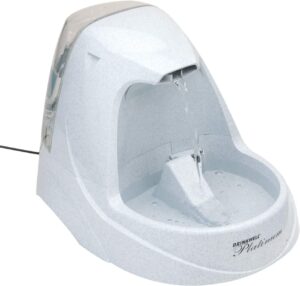
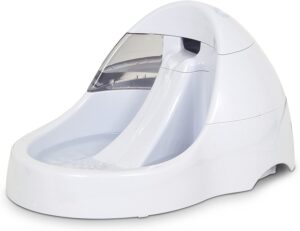


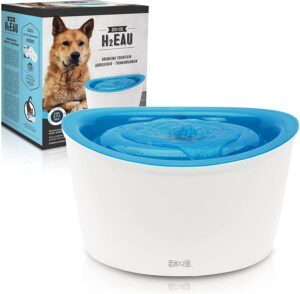
 Choosing the best water drinking fountain for your precious pet may seem like a difficult decision.
We’ve highlighted several of the most important features for you to consider before making a final decision.
Choosing the best water drinking fountain for your precious pet may seem like a difficult decision.
We’ve highlighted several of the most important features for you to consider before making a final decision.
 Traditional water bowls for pets are known as some of the dirtiest and germiest places in the home. Combat grime and bacteria by routinely replacing your dog’s or cat’s water. Each of the drinking fountains in our review features convenient filtration systems.
While many of these products include replaceable water filters made from carbon or charcoal, some products feature multi-stage filtration processes to better clean and freshen your dog’s water supply. Pay close attention to pump care and cleaning so your dog can enjoy the drinking fountain for a long time to come.
Traditional water bowls for pets are known as some of the dirtiest and germiest places in the home. Combat grime and bacteria by routinely replacing your dog’s or cat’s water. Each of the drinking fountains in our review features convenient filtration systems.
While many of these products include replaceable water filters made from carbon or charcoal, some products feature multi-stage filtration processes to better clean and freshen your dog’s water supply. Pay close attention to pump care and cleaning so your dog can enjoy the drinking fountain for a long time to come.
 The fluid capacity of your pet’s future drinking fountain is essential. A hydrated dog should drink one ounce per pound in weight per day. If you own a larger breed of dog, ranging from 40 to 100 pounds in size, a 50-ounce capacity just won’t do unless you’re prepared to change it every day, especially after a run, hike, or trip to the dog park.
Regardless of which drinking fountain you ultimately choose, the most important lesson in exploring the bestselling products is that your pets stay hydrated for optimum health and nutrition. Prevent dehydration by providing clean water at all times, even when you’re away from home.
The fluid capacity of your pet’s future drinking fountain is essential. A hydrated dog should drink one ounce per pound in weight per day. If you own a larger breed of dog, ranging from 40 to 100 pounds in size, a 50-ounce capacity just won’t do unless you’re prepared to change it every day, especially after a run, hike, or trip to the dog park.
Regardless of which drinking fountain you ultimately choose, the most important lesson in exploring the bestselling products is that your pets stay hydrated for optimum health and nutrition. Prevent dehydration by providing clean water at all times, even when you’re away from home.
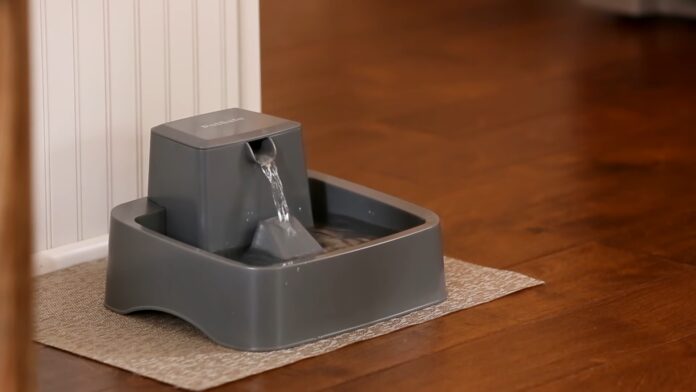 Now that we’ve learned about the design features and best uses for each bestselling water fountain for pets, we hope that our research helped you to get one step closer to choosing the ideal solution for your pet’s health and overall well-being.
Treat your loyal companion well by providing clean water at all times, especially by choosing a drinking fountain that continually circulates water to keep it fresh and clean.
Look for common signs of dehydration as you introduce your dog or cat to the new drinking system so you can prevent potential illnesses and health risks. Bacteria and the health risks of drinking unsafe water can be unsettling for any dog owner.
Remember to consider the best material for your dog’s health, your ideal level of water filtration, the perfect height for your dog, and the highest water capacity that your dog or other pets may need daily to remain healthy and hydrated. Do you think we forgot to mention any of the other bestselling products available? If so, please let us know in the comments below!
Now that we’ve learned about the design features and best uses for each bestselling water fountain for pets, we hope that our research helped you to get one step closer to choosing the ideal solution for your pet’s health and overall well-being.
Treat your loyal companion well by providing clean water at all times, especially by choosing a drinking fountain that continually circulates water to keep it fresh and clean.
Look for common signs of dehydration as you introduce your dog or cat to the new drinking system so you can prevent potential illnesses and health risks. Bacteria and the health risks of drinking unsafe water can be unsettling for any dog owner.
Remember to consider the best material for your dog’s health, your ideal level of water filtration, the perfect height for your dog, and the highest water capacity that your dog or other pets may need daily to remain healthy and hydrated. Do you think we forgot to mention any of the other bestselling products available? If so, please let us know in the comments below!

 It is important to note that almost all invisible fences are guaranteed to work with any dog irrespective of the breed or animal characteristic. Furthermore, in-ground electric fences have been endorsed by many organizations such as the American Society for The Prevention of Cruelty to Animals, Ontario Society for The Prevention of Cruelty to Animals, and several others, hence they do not go for the humane treatment of dogs.
With that being said, here are some of the best in-ground electric fences that you should put into consideration when shopping for a safe and effective pet management system.
It is important to note that almost all invisible fences are guaranteed to work with any dog irrespective of the breed or animal characteristic. Furthermore, in-ground electric fences have been endorsed by many organizations such as the American Society for The Prevention of Cruelty to Animals, Ontario Society for The Prevention of Cruelty to Animals, and several others, hence they do not go for the humane treatment of dogs.
With that being said, here are some of the best in-ground electric fences that you should put into consideration when shopping for a safe and effective pet management system.
 As a hobbyhorse of Petsafe, The Petsafe YardMax PIG00-1115 is an in ground electric fence that was designed exclusively for pets that weigh more than 5 pounds in weight.
As one of the best in-ground electric fences currently on the market, the Petsafe YardMax PIG00-1115 has been concocted with a waterproof receiver collar that can be fitted on neck sizes that range between 6 inches and 28 inches.
Furthermore, the Petsafe YardMax PIG00-1115 also features 5 adjustable static corrections with which the owner can adjust depending on the dog’s response or the amount of correction that he may deem suitable.
As a safe and effective pet management system, the Petsafe YardMax PIG00-1115 is a great in-ground electric fence that will allow you the dog owner to control and even expand your yard boundaries. With that being said, the YardMax technology is one of the key features that makes this fencing unit stand out from the rest.
With the yard max technology, dogs will not be able to run quickly through the boundary without receiving any kind of correction. Furthermore, dogs that leave the safe zone for more than fifteen minutes will still be able to reenter the compound without worrying about getting corrected.
Finally, the Yard Max technology allows the dog owner to create much more complex and smarter layouts such as the hourglass layout which can be used to isolate the front and the backyard. All in all, this product goes for 290 USD.
As a hobbyhorse of Petsafe, The Petsafe YardMax PIG00-1115 is an in ground electric fence that was designed exclusively for pets that weigh more than 5 pounds in weight.
As one of the best in-ground electric fences currently on the market, the Petsafe YardMax PIG00-1115 has been concocted with a waterproof receiver collar that can be fitted on neck sizes that range between 6 inches and 28 inches.
Furthermore, the Petsafe YardMax PIG00-1115 also features 5 adjustable static corrections with which the owner can adjust depending on the dog’s response or the amount of correction that he may deem suitable.
As a safe and effective pet management system, the Petsafe YardMax PIG00-1115 is a great in-ground electric fence that will allow you the dog owner to control and even expand your yard boundaries. With that being said, the YardMax technology is one of the key features that makes this fencing unit stand out from the rest.
With the yard max technology, dogs will not be able to run quickly through the boundary without receiving any kind of correction. Furthermore, dogs that leave the safe zone for more than fifteen minutes will still be able to reenter the compound without worrying about getting corrected.
Finally, the Yard Max technology allows the dog owner to create much more complex and smarter layouts such as the hourglass layout which can be used to isolate the front and the backyard. All in all, this product goes for 290 USD.
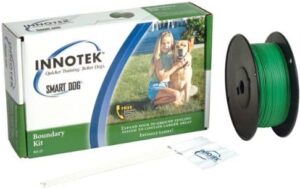 The Innotek IUC-5100 is a quality and performance driven in the ground electric fence that features up to nine levels of electric simulation together with a tone training package for dogs that are either 6 months or older. These two excellent features in turn make this product suitable for both guidance and containment purposes.
Apart from being a quality and performance product, the Innotek IU-5100 has also been tested for safety and health, meaning it is 100% safe to use on your pets. For fencing purposes, this system comes with a remote control which allows the dog owner to issue remote corrections as required.
The remote corrections can be conducted on two dogs simultaneously and each of these dogs should be 20 pounds or more. Furthermore, each purchase comes with a rechargeable waterproof receiver or
The Innotek IUC-5100 is a quality and performance driven in the ground electric fence that features up to nine levels of electric simulation together with a tone training package for dogs that are either 6 months or older. These two excellent features in turn make this product suitable for both guidance and containment purposes.
Apart from being a quality and performance product, the Innotek IU-5100 has also been tested for safety and health, meaning it is 100% safe to use on your pets. For fencing purposes, this system comes with a remote control which allows the dog owner to issue remote corrections as required.
The remote corrections can be conducted on two dogs simultaneously and each of these dogs should be 20 pounds or more. Furthermore, each purchase comes with a rechargeable waterproof receiver or  As a cost-effective confinement alternative, the SportDog SDF-100A is a reasonable price with each complete unit going for approximately 260 US Dollars.
This unit is perfect for dogs that weigh 10 pounds, or more and every purchase comes with a transmitter that covers up to 100 acres which in turn maximizes the dog play area.
If the dog owner is keen on using this unit on more than one dog, he or she can purchase additional SDF R receivers that are available at very affordable rates. Apart from the receiver, this unit also includes other features such as a waterproof collar, 100 flags, and 1000 feet of wire.
In addition, the SportDog SDF-100A also presents the dog owner with four adjustable corrections levels that include both tone and vibration.
All in all, the main highlight of the SportDog SDF-100A is the anti-linger feature which was specifically designed to prevent dogs from running down the batteries.
As a cost-effective confinement alternative, the SportDog SDF-100A is a reasonable price with each complete unit going for approximately 260 US Dollars.
This unit is perfect for dogs that weigh 10 pounds, or more and every purchase comes with a transmitter that covers up to 100 acres which in turn maximizes the dog play area.
If the dog owner is keen on using this unit on more than one dog, he or she can purchase additional SDF R receivers that are available at very affordable rates. Apart from the receiver, this unit also includes other features such as a waterproof collar, 100 flags, and 1000 feet of wire.
In addition, the SportDog SDF-100A also presents the dog owner with four adjustable corrections levels that include both tone and vibration.
All in all, the main highlight of the SportDog SDF-100A is the anti-linger feature which was specifically designed to prevent dogs from running down the batteries.
 Just like many other pet containment systems, the Perimeter Ultra PTPCC200 has been concocted with the latest technology however this unit uses a much softer approach to ensure that dogs stay within the predetermined boundaries.
Since this unit uses a much softer approach, dog owners have been presented with the chance to change the simulation of the device based on their dog’s temperament.
Furthermore, each collar features exclusive Comfort Contact cushions which use a soft rubber so as to provide a lighter alternative and solution to the common steel contacts. The Comfort Contact cushions have been recommended by many veterinarians because they play a key role in the avoidance of serious skin conditions and irritations.
Finally, this device has been concocted with a Temperature Check technology which is essential to keeping the field stable especially when outside temperature changes. This piece of technology is very important because if the temperature changes from 30F to 90F then the boundary will move up to 100% which can be extremely dangerous for your pet.
The Perimeter Ultra PTPCC200 has also been designed with the Wire CheckTM technology which is used to monitor the wire input and output automatically. This in turn ensures that the field width remains constant even if one of the boundary wires becomes damaged and will also notify you, the dog owner if there is any breach.
Just like many other pet containment systems, the Perimeter Ultra PTPCC200 has been concocted with the latest technology however this unit uses a much softer approach to ensure that dogs stay within the predetermined boundaries.
Since this unit uses a much softer approach, dog owners have been presented with the chance to change the simulation of the device based on their dog’s temperament.
Furthermore, each collar features exclusive Comfort Contact cushions which use a soft rubber so as to provide a lighter alternative and solution to the common steel contacts. The Comfort Contact cushions have been recommended by many veterinarians because they play a key role in the avoidance of serious skin conditions and irritations.
Finally, this device has been concocted with a Temperature Check technology which is essential to keeping the field stable especially when outside temperature changes. This piece of technology is very important because if the temperature changes from 30F to 90F then the boundary will move up to 100% which can be extremely dangerous for your pet.
The Perimeter Ultra PTPCC200 has also been designed with the Wire CheckTM technology which is used to monitor the wire input and output automatically. This in turn ensures that the field width remains constant even if one of the boundary wires becomes damaged and will also notify you, the dog owner if there is any breach.
 Just like the PetSafe YardMax PIG00-11115, the PetSafe Ultrasmart PIG00-13619 is also a brainchild of Petsafe International a leading manufacturer of electronic collars and containment systems.
As an in the ground electric fence, the PetSafe Ultrasmart PIG00-13619 has been engineered to keep pets safely within a predetermined yard boundary. Apart from being easy to install, this product can cover up to 1/3 acres and according to the dog owner’s preferences, additional wires can be purchased to expand the area of coverage up to 25 acres.
The PetSafe Ultrasmart PIG00-13619 features 3 adjustable levels of static correction which is a little bit lower when compared to its counterpart the PIGOO -11115. All in all, this unit can be used on dogs that weigh 8 pounds or more and should have neck sizes that range between 8 inches and 2 inches.
Just like the PetSafe YardMax PIG00-11115, the PetSafe Ultrasmart PIG00-13619 is also a brainchild of Petsafe International a leading manufacturer of electronic collars and containment systems.
As an in the ground electric fence, the PetSafe Ultrasmart PIG00-13619 has been engineered to keep pets safely within a predetermined yard boundary. Apart from being easy to install, this product can cover up to 1/3 acres and according to the dog owner’s preferences, additional wires can be purchased to expand the area of coverage up to 25 acres.
The PetSafe Ultrasmart PIG00-13619 features 3 adjustable levels of static correction which is a little bit lower when compared to its counterpart the PIGOO -11115. All in all, this unit can be used on dogs that weigh 8 pounds or more and should have neck sizes that range between 8 inches and 2 inches.
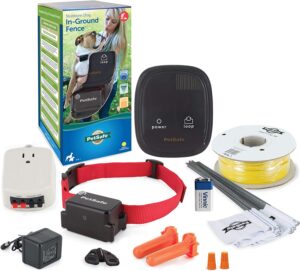 The PetSafe Stubborn PIG00-10777 is a very effective option for resistant pets and stubborn dogs. Unlike many in ground electric fences that have mild correction levels, the PetSafe Stubborn PIG00-10777 has been designed with higher intensity levels which make it ideal for hard to
 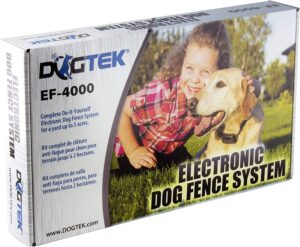 Ideal for both small-sized yards and open terrains, the Dogtek EF-4000 is a state of the art in-ground electric dog fence from DOGTEKTM. This unit comes with a total of 8 levels of static corrections. Hence, the dog owner can choose the level of correction that he or she may deem fit.
Apart from that the Dogtek EF-4000 also comes with a lightweight, fully waterproof collar that functions with one lithium battery.
Furthermore, this unit is safe and effective for dogs that weigh between 12 and 12 pounds and can cover up to five acres as long as the dog owner purchases additional fencing wire. If the dog owner has additional pets that he or she may want to use this correction unit on, additional receiver collars can be purchased at very affordable rates.
Ideal for both small-sized yards and open terrains, the Dogtek EF-4000 is a state of the art in-ground electric dog fence from DOGTEKTM. This unit comes with a total of 8 levels of static corrections. Hence, the dog owner can choose the level of correction that he or she may deem fit.
Apart from that the Dogtek EF-4000 also comes with a lightweight, fully waterproof collar that functions with one lithium battery.
Furthermore, this unit is safe and effective for dogs that weigh between 12 and 12 pounds and can cover up to five acres as long as the dog owner purchases additional fencing wire. If the dog owner has additional pets that he or she may want to use this correction unit on, additional receiver collars can be purchased at very affordable rates.

 Here are the
 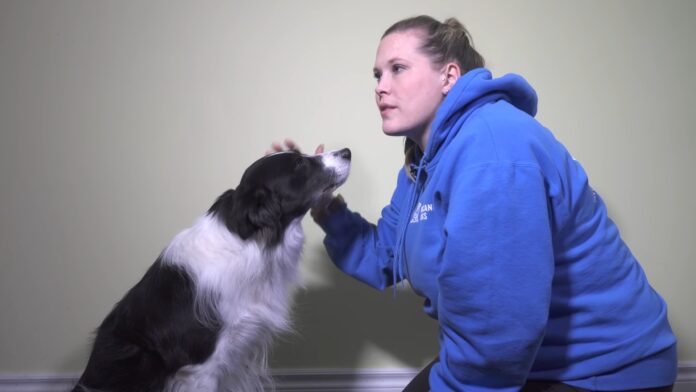 If your dog does not belong to one of the hyper dog breeds, this may be an easy solution. Dogs are easy to train, yet, they are smart enough to realize how to train us. Don’t believe me? Try imagining this situation: Your dog is chewing and
  This will benefit both you and your canine, and you will be able to focus on the pleasant sides of owning a dog.
 A great help for this are smart dog toys that allow your dog to play and work for his food. You can find these online and we’ve prepared some examples for you:
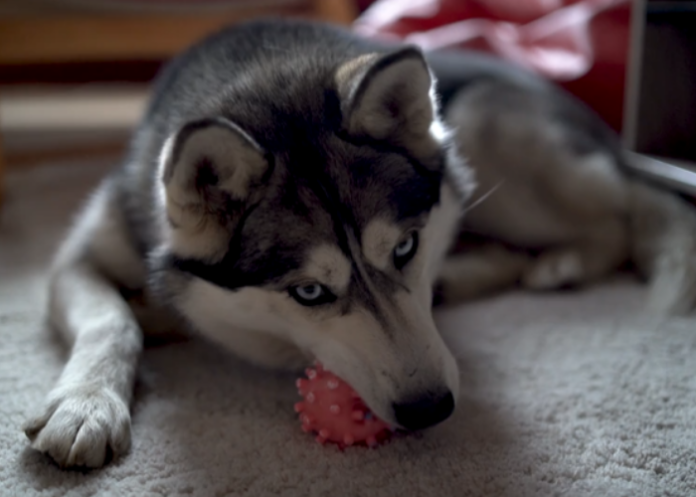 We all want a dog that obeys our commands. To achieve that, we need to equip ourselves with knowledge about how to train, tons of patience, and hard determination. Obedience training will activate him both physically and mentally, and result in a well-mannered dog.
Is there anything more to ask? However, you should not make these sessions too long or boring as your pet will lose interest and the results will not be as expected. You should train him few times a day for 10-15 minutes.
An alternative remedy is to provide your dog with natural ingredients that help to calm your dog down. You can read more about them in this article on
We all want a dog that obeys our commands. To achieve that, we need to equip ourselves with knowledge about how to train, tons of patience, and hard determination. Obedience training will activate him both physically and mentally, and result in a well-mannered dog.
Is there anything more to ask? However, you should not make these sessions too long or boring as your pet will lose interest and the results will not be as expected. You should train him few times a day for 10-15 minutes.
An alternative remedy is to provide your dog with natural ingredients that help to calm your dog down. You can read more about them in this article on 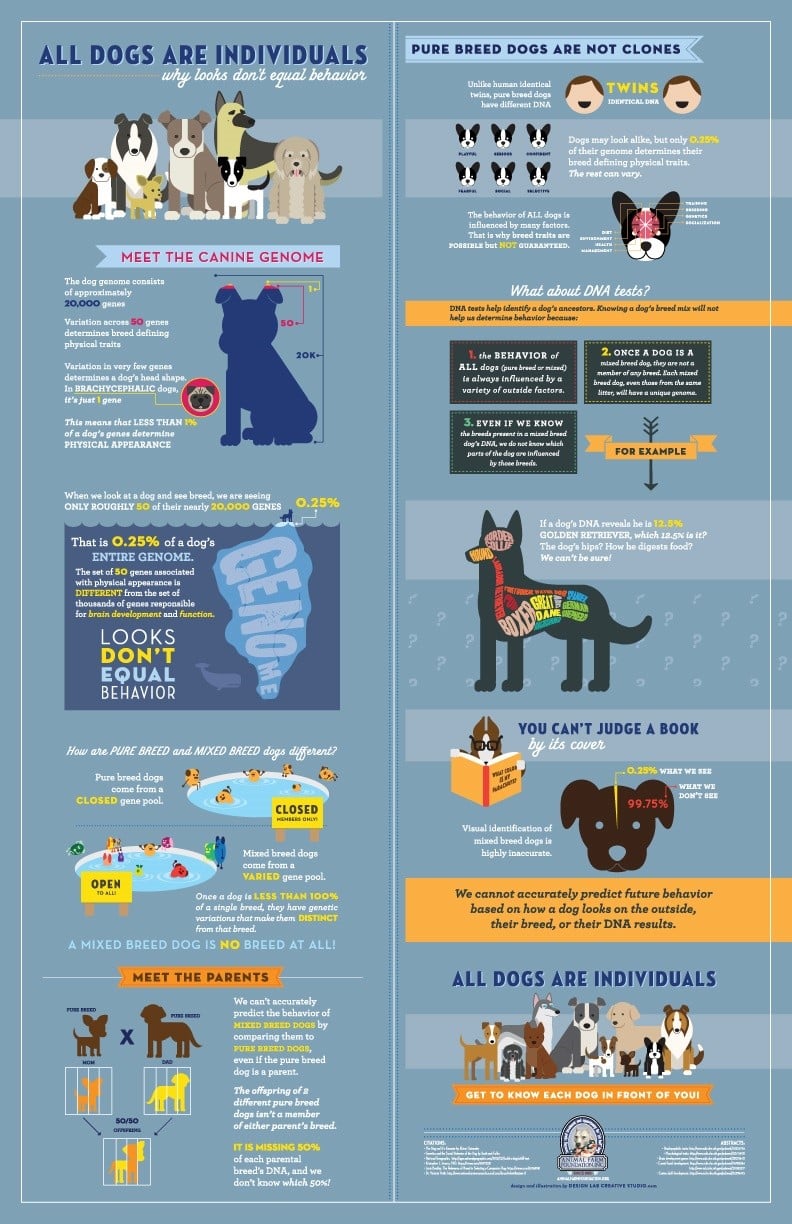 There are plenty of other methods you can employ in this great article on
 If your pup is hyperactive and it runs through the house constantly, begging for your attention and jumping all over you, then you most definitely want it to calm down somehow. Something that most dog owners are not aware of is that a hyperactive pup is bored or it lacks incentives.
Thus, before trying to treat its hyperactivity, you must make sure to eliminate causes like lack of activities and stuff to play with. A bored puppy does not need medication of any kind. To ensure that your dog’s not bored, check out the tips in this article on
If your pup is hyperactive and it runs through the house constantly, begging for your attention and jumping all over you, then you most definitely want it to calm down somehow. Something that most dog owners are not aware of is that a hyperactive pup is bored or it lacks incentives.
Thus, before trying to treat its hyperactivity, you must make sure to eliminate causes like lack of activities and stuff to play with. A bored puppy does not need medication of any kind. To ensure that your dog’s not bored, check out the tips in this article on  The answer to this question can be found in the second category of remedies, as it follows:
 The combination between exercise and the usage of toys is ideal. Moreover, playing with your puppy indoors is also a must. If it is agitated during the evening, play catch with it while you watch TV. In this way, your pet will consume its energy, but you will not consume yours.
Opting for a toy that is filled with food is a good option too. This is because a dog can play for hours with it, trying to get the food out and running out of energy. Remember not to yell at your puppy. It doesn’t understand why and its condition is not its fault anyway. You can find out more about these kinds of toys by checking out our article on
The combination between exercise and the usage of toys is ideal. Moreover, playing with your puppy indoors is also a must. If it is agitated during the evening, play catch with it while you watch TV. In this way, your pet will consume its energy, but you will not consume yours.
Opting for a toy that is filled with food is a good option too. This is because a dog can play for hours with it, trying to get the food out and running out of energy. Remember not to yell at your puppy. It doesn’t understand why and its condition is not its fault anyway. You can find out more about these kinds of toys by checking out our article on  In conclusion, anxiety in dogs can appear due to different factors and it’s of many kinds. It can be kept under control with the usage of plants, oils and supplements, but it is also manageable without them. You can look at them as adjuvants and only use them after you try to calm down your dog with your patience and the tricks listed above.
Most of all, it takes dedication and time from your side in order to cope with its problems and to help your canine friend deal with its problems as well. Taking your dog to the vet is also a really good option in case you try everything and nothing seems to have the desired effects. Try to be reasonable when it comes to time.
In conclusion, anxiety in dogs can appear due to different factors and it’s of many kinds. It can be kept under control with the usage of plants, oils and supplements, but it is also manageable without them. You can look at them as adjuvants and only use them after you try to calm down your dog with your patience and the tricks listed above.
Most of all, it takes dedication and time from your side in order to cope with its problems and to help your canine friend deal with its problems as well. Taking your dog to the vet is also a really good option in case you try everything and nothing seems to have the desired effects. Try to be reasonable when it comes to time. 
 There is a general rule that says a dog should drink between 0.6 and 1 ounces of water for every pound of body weight. However, you don’t have to waste your time calculating the necessary amount.
If your dog is healthy and has a bowl filled with water at its discretion, it will drink the correct amount, depending on its needs. Some days it might drink more and some days it might drink less.
Regardless of its behavior, it is recommended to pay attention if your dog drinks water or not. There are cases when they might exaggerate or don’t drink water at all. These are situations that should alarm you because they are usually signs of a health problem.
Tap water might be problematic for some dogs, so in order to make sure that your dog is fully healthy you should consider giving it still water. Tap water might contain excess minerals, heavy metals, or too many bacteria per ounce.
If you don’t want to buy or you cannot buy water for your dog, then you can simply boil tap water, let it get cold, and then give it to your dog. At least, in this way you avoid the problems caused by bacteria. If you have a water purifier, then you don’t need to worry about these 3 aspects. In the long run, your investment in a water purifier will pay off.
There is a general rule that says a dog should drink between 0.6 and 1 ounces of water for every pound of body weight. However, you don’t have to waste your time calculating the necessary amount.
If your dog is healthy and has a bowl filled with water at its discretion, it will drink the correct amount, depending on its needs. Some days it might drink more and some days it might drink less.
Regardless of its behavior, it is recommended to pay attention if your dog drinks water or not. There are cases when they might exaggerate or don’t drink water at all. These are situations that should alarm you because they are usually signs of a health problem.
Tap water might be problematic for some dogs, so in order to make sure that your dog is fully healthy you should consider giving it still water. Tap water might contain excess minerals, heavy metals, or too many bacteria per ounce.
If you don’t want to buy or you cannot buy water for your dog, then you can simply boil tap water, let it get cold, and then give it to your dog. At least, in this way you avoid the problems caused by bacteria. If you have a water purifier, then you don’t need to worry about these 3 aspects. In the long run, your investment in a water purifier will pay off.
 If you notice your dog drinking a lot of water, then you should start worrying unless it is a really hot summer day or in case your dog only eats dry food. This is because dogs that only eat dry food usually drink more water in order to ensure their daily needs.
A dog that eats wet food will drink less water in comparison with a dog that is on a
If you notice your dog drinking a lot of water, then you should start worrying unless it is a really hot summer day or in case your dog only eats dry food. This is because dogs that only eat dry food usually drink more water in order to ensure their daily needs.
A dog that eats wet food will drink less water in comparison with a dog that is on a  Urine tests allow the detection of excess blood sugar, lack of bile pigments, or protein deficiency. All these results are helpful when trying to determine whether or not a dog has diabetes, liver, or kidney problems.
Glucose, creatinine, and urea levels are highly important in these cases. These might not make much sense to you, but the main idea that you should remember is that a thirsty doggy might suffer from severe affection and it must be taken to the vet.
Urine tests allow the detection of excess blood sugar, lack of bile pigments, or protein deficiency. All these results are helpful when trying to determine whether or not a dog has diabetes, liver, or kidney problems.
Glucose, creatinine, and urea levels are highly important in these cases. These might not make much sense to you, but the main idea that you should remember is that a thirsty doggy might suffer from severe affection and it must be taken to the vet.
 However, if the vet can’t find anything wrong with your pooch, then you can trick it to drink water by using one or more of the following tips:
 The
The 
 In the experiments which were conducted in order to study the effects of too much water ingestion on animals, the researchers found the following physical manifestations or effects:
 A pet owner can have the best intentions and unknowingly expose their dogs to water intoxication. Since this condition is life-threatening, prevention would be the way to avoid it, and here are some things that you have to do if you don’t want your dog to catch it:
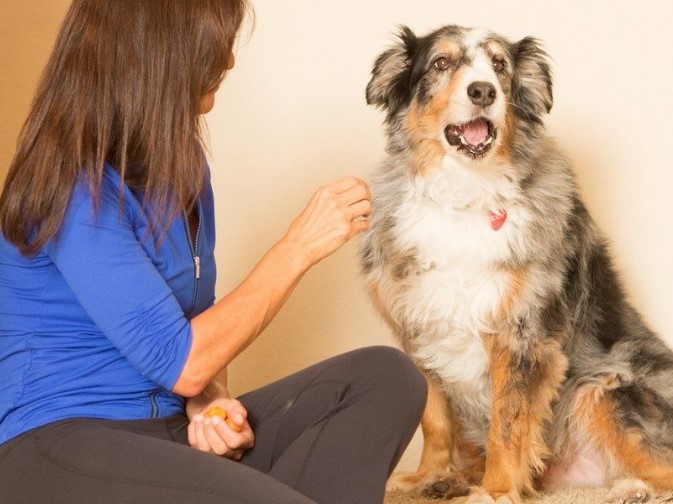 If your dog suddenly looks ill, check to see if they show the following symptoms:
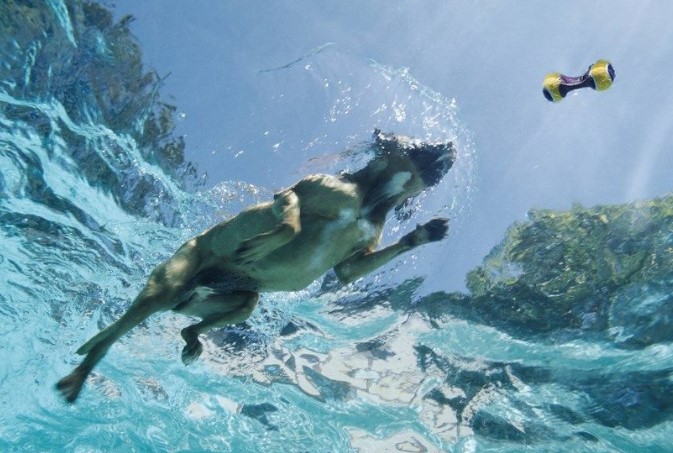 Some of the dogs which are more prone to suffer from this are the following:
 Even if your dog had already stopped ingesting water, the process of absorption still continues so it is important to administer treatment early on in order to prevent future damage to the cells.
There is not much option when it comes to treatment especially since orally administered medications have also proven to be quite futile in dealing with this condition. Since the recommended treatment is to be given intravenously, it is important to visit the nearest veterinary clinic immediately.
Here are some of the best treatments for dogs affected by water intoxication:
Even if your dog had already stopped ingesting water, the process of absorption still continues so it is important to administer treatment early on in order to prevent future damage to the cells.
There is not much option when it comes to treatment especially since orally administered medications have also proven to be quite futile in dealing with this condition. Since the recommended treatment is to be given intravenously, it is important to visit the nearest veterinary clinic immediately.
Here are some of the best treatments for dogs affected by water intoxication:
 Once your dog shows any of the early symptoms of water intoxication, it is extremely important to bring them to the vet in order to get the proper treatment. Any delay can definitely lead to your pet’s untimely death.
You may be asking, how such a harmless substance can be that deadly to a dog well this is how it affects them. If your dog had ingested large amounts of water, approximately two-thirds of their body weight, their cells will begin to absorb the excess amount of water in their body. This will lead to loss of minerals especially sodium and chloride which are necessary for muscular activity.
Hence, you will notice that at the onset of the condition, your dog will have trouble coordinating muscle movements giving him a clumsy look. This will also affect the functions of the various organs in his body including his heart and lungs.
If your dog does not receive timely treatment, the swelling will reach his brain and his nervous system. When this happens, there will be a lot of pressure inside the cranium damaging the brain most especially the old brain or the “brain stem.” If the brain stem becomes damaged, respiratory functions will cease which will eventually lead to death.
All of these can happen within a few hours especially if you have a small dog. The first symptoms may not seem that serious especially if your dog is really not a whiner if
Once your dog shows any of the early symptoms of water intoxication, it is extremely important to bring them to the vet in order to get the proper treatment. Any delay can definitely lead to your pet’s untimely death.
You may be asking, how such a harmless substance can be that deadly to a dog well this is how it affects them. If your dog had ingested large amounts of water, approximately two-thirds of their body weight, their cells will begin to absorb the excess amount of water in their body. This will lead to loss of minerals especially sodium and chloride which are necessary for muscular activity.
Hence, you will notice that at the onset of the condition, your dog will have trouble coordinating muscle movements giving him a clumsy look. This will also affect the functions of the various organs in his body including his heart and lungs.
If your dog does not receive timely treatment, the swelling will reach his brain and his nervous system. When this happens, there will be a lot of pressure inside the cranium damaging the brain most especially the old brain or the “brain stem.” If the brain stem becomes damaged, respiratory functions will cease which will eventually lead to death.
All of these can happen within a few hours especially if you have a small dog. The first symptoms may not seem that serious especially if your dog is really not a whiner if  What you need to do is to bring your pet to their vet and tell them that they had been spending some time on water when this happened. This will help your vet to diagnose the condition more properly instead of just blaming it on other types of injuries or medical condition. A lot of dogs have ended up dying since their vets were treating them for another type of disease instead of helping them regain water and sodium balance.
Water intoxication is not a very common incident when it comes to dogs and this is probably why not a lot of people really know about it. It is quite a rare event but when it does happen, it can lead to your pet’s death. Knowing what this condition really is and what causes it however, can help you avoid and treat this problem when it occurs
Remember that dogs sometimes do not know what their physical limitations are and can continue on a specific activity even when it is already harming them. So, try to restrict and supervise your dog’s actions whenever they will be engaging in an activity involving water.
What you need to do is to bring your pet to their vet and tell them that they had been spending some time on water when this happened. This will help your vet to diagnose the condition more properly instead of just blaming it on other types of injuries or medical condition. A lot of dogs have ended up dying since their vets were treating them for another type of disease instead of helping them regain water and sodium balance.
Water intoxication is not a very common incident when it comes to dogs and this is probably why not a lot of people really know about it. It is quite a rare event but when it does happen, it can lead to your pet’s death. Knowing what this condition really is and what causes it however, can help you avoid and treat this problem when it occurs
Remember that dogs sometimes do not know what their physical limitations are and can continue on a specific activity even when it is already harming them. So, try to restrict and supervise your dog’s actions whenever they will be engaging in an activity involving water. 
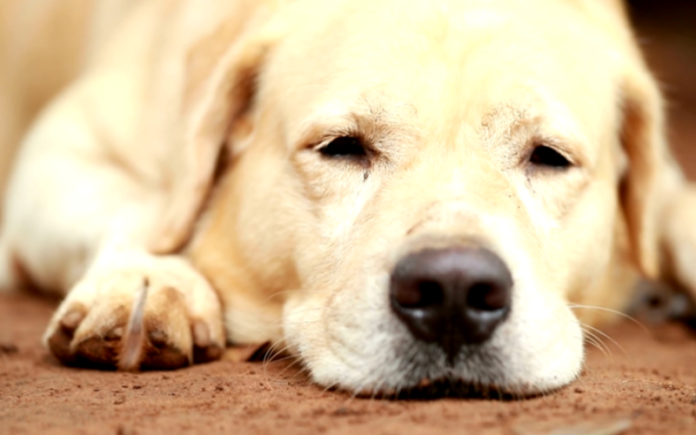 Initially, Labrador Retrievers were the ultimate fisherman’s companion as they were used to haul nets, retrieve fish and fetch ropes in the Northern Atlantic regions. As an offspring of this lineage, today’s Labrador Retrievers are equally hardworking and are currently the most popular breed in America.
This is a fact because Labrador Retrievers have been registered as the number one dog breed by the American Kennel Club. Also, it is among the few dogs that many non-dog people can easily register.
At this time and age, Labrador Retrievers are mainly used as retrievers for hunters, show competitors, search and rescue dogs, and assistance dogs, especially for the disabled and many others. The Labrador Retrievers originated from Newfoundland an island that is located on the North Eastern Coast of Canada.
Apart from being used for hunting, Labrador Retrievers are also excellent therapy dogs due to their sweet and loving nature. Also, Labrador Retrievers are also excellent search and rescue dogs especially due to their strong sense of smell and courageous nature.
However, Labrador Retrievers are not suitable candidates for being watchdogs. Many people who own this breed are all in agreement that due to the sweet nature of this breed, Labradors are likely to let strangers in or greet them with happiness.
All in all, just by looking at their muscular and athletic bodies’ one can be able to tell that the Labrador Retrievers are built for sports. Currently, Labrador Retrievers have earned their status as the breed to beat at
Initially, Labrador Retrievers were the ultimate fisherman’s companion as they were used to haul nets, retrieve fish and fetch ropes in the Northern Atlantic regions. As an offspring of this lineage, today’s Labrador Retrievers are equally hardworking and are currently the most popular breed in America.
This is a fact because Labrador Retrievers have been registered as the number one dog breed by the American Kennel Club. Also, it is among the few dogs that many non-dog people can easily register.
At this time and age, Labrador Retrievers are mainly used as retrievers for hunters, show competitors, search and rescue dogs, and assistance dogs, especially for the disabled and many others. The Labrador Retrievers originated from Newfoundland an island that is located on the North Eastern Coast of Canada.
Apart from being used for hunting, Labrador Retrievers are also excellent therapy dogs due to their sweet and loving nature. Also, Labrador Retrievers are also excellent search and rescue dogs especially due to their strong sense of smell and courageous nature.
However, Labrador Retrievers are not suitable candidates for being watchdogs. Many people who own this breed are all in agreement that due to the sweet nature of this breed, Labradors are likely to let strangers in or greet them with happiness.
All in all, just by looking at their muscular and athletic bodies’ one can be able to tell that the Labrador Retrievers are built for sports. Currently, Labrador Retrievers have earned their status as the breed to beat at  Apart from being adorable tiny digging artists, members of the
 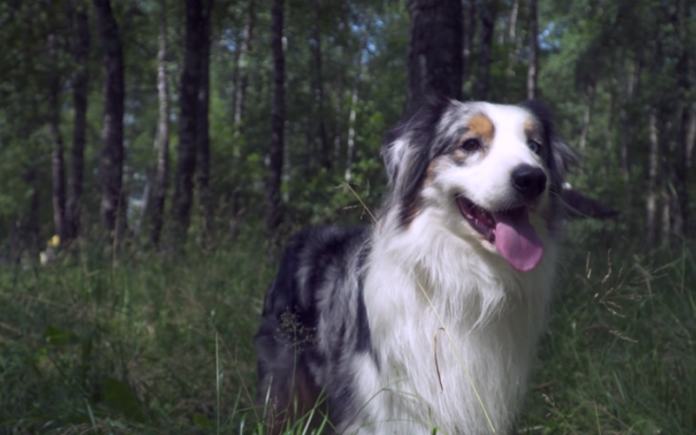 Unlike popular beliefs, the Australian Shepherd happens to originate from the western regions of the United States and not from Australia as previously thought. Originally, the Australian shepherd was exclusively bred to herd livestock hence, up to this date it remains one of the most popular working dog breeds in the United States and many other countries. The
  Just like the Australian Shepherd, the
 Originally the
  As soon as the dog becomes fully accustomed to going after the disk and bringing it back, you can now safely move to the subsequent level. After the first few stages have been successful, you can now safely try tossing the Frisbee disk over short distances probably at the park or the yard. Still, always ensure that the disk is thrown at the dog’s height. Also, it is also very important to ensure that the disk is not thrown directly toward the dog so as to avoid any injuries.
Retrieving the disk is the next step that you will be required to teach the pet. When teaching your dog how to retrieve a disk properly, you should select a place where he or she will be not at danger especially when running after the Frisbee disk. The most suitable places are usually parks or any area that is properly fenced. During these stages, training
As soon as the dog becomes fully accustomed to going after the disk and bringing it back, you can now safely move to the subsequent level. After the first few stages have been successful, you can now safely try tossing the Frisbee disk over short distances probably at the park or the yard. Still, always ensure that the disk is thrown at the dog’s height. Also, it is also very important to ensure that the disk is not thrown directly toward the dog so as to avoid any injuries.
Retrieving the disk is the next step that you will be required to teach the pet. When teaching your dog how to retrieve a disk properly, you should select a place where he or she will be not at danger especially when running after the Frisbee disk. The most suitable places are usually parks or any area that is properly fenced. During these stages, training 
 Given that most pet parents are pre-occupied with a lot of things like work and family matters, their dogs lose the opportunity to have exercise. Also, a common misconception among pet owners is that if a dog can roam around the yard, it is getting enough exercise. Please remember that exercise is not just about movement; it involves holistic stimulation for a dog in both the physical and mental aspects.
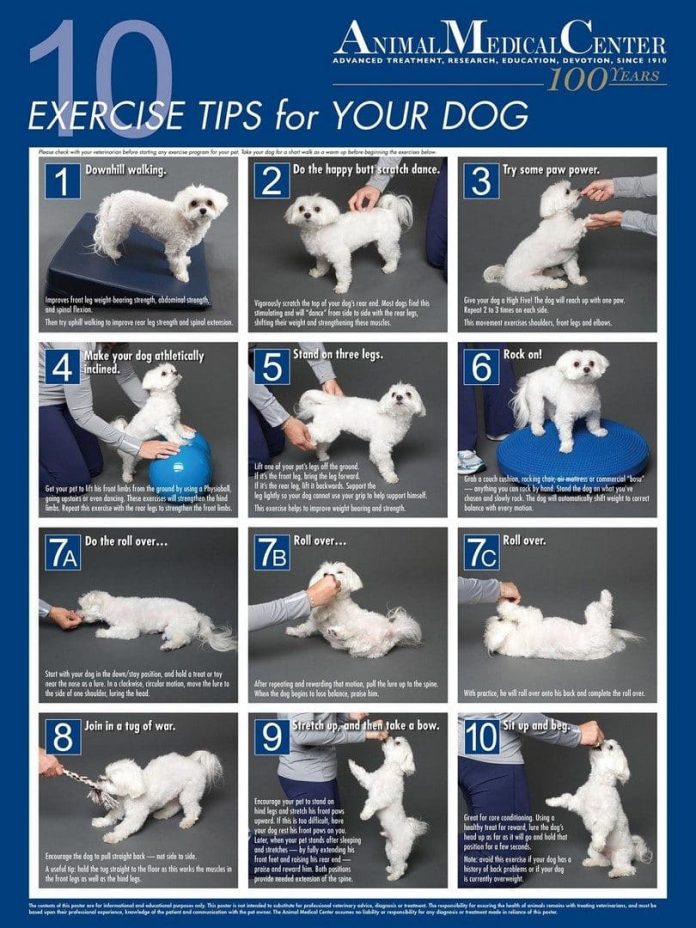 The following are the primary considerations in preparing an exercise and play routine:
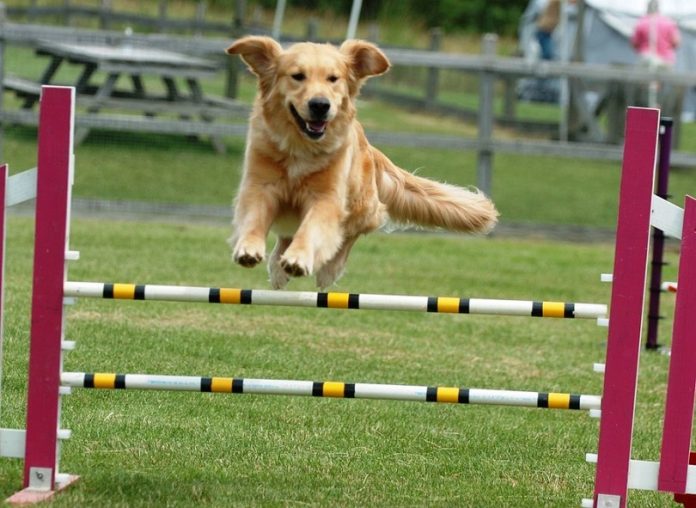 Remember: Do not feed your dog before engaging in any level of exercise. Feeding your pet before any activity may increase its risk of developing bloat, a conditioning in which the
 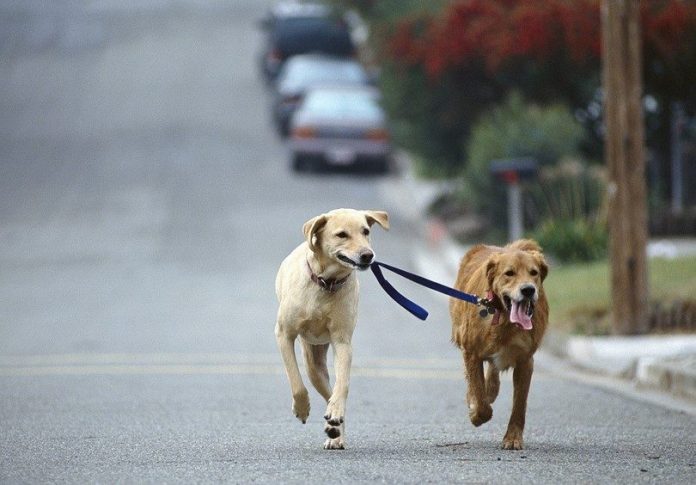 Joggers can train their dogs to catch up to their pace. However, this is generally recommended for larger dogs because jogging has a significantly faster pace that toy dogs and smaller breeds may not be able to catch up with. Because of their short legs, one human step may need three to five toy dog steps, so just imagine the amount of energy needed for the smaller dogs just to catch up.
 Just remember that dogs should have access to clean drinking water, and their eyes and ears should be cleaned afterward to avoid infection. Also, for safety precautions, always observe your dog at a close distance if you will not be swimming with it.

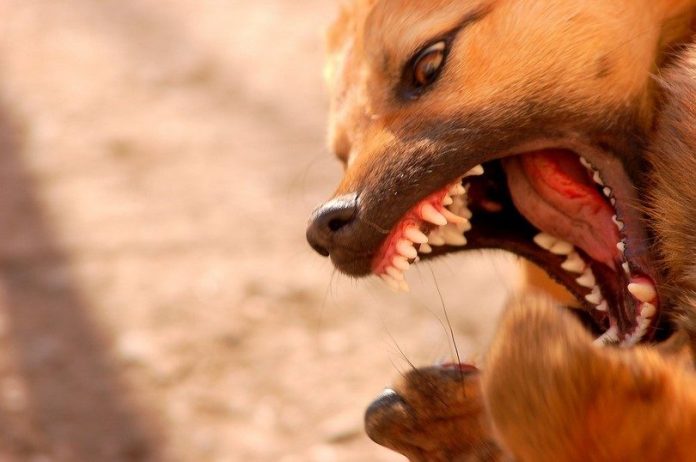 Some pet owners are taken completely by surprise when their dog flies off the handle out of the blue with the intention to bite another pet or a person who is passing by. In order to control it, you need to be able to identify the body language. Aggression can be spotted through certain behavior. Though dogs may skip a step or two, these sequences can help you prevent an imminent attack:
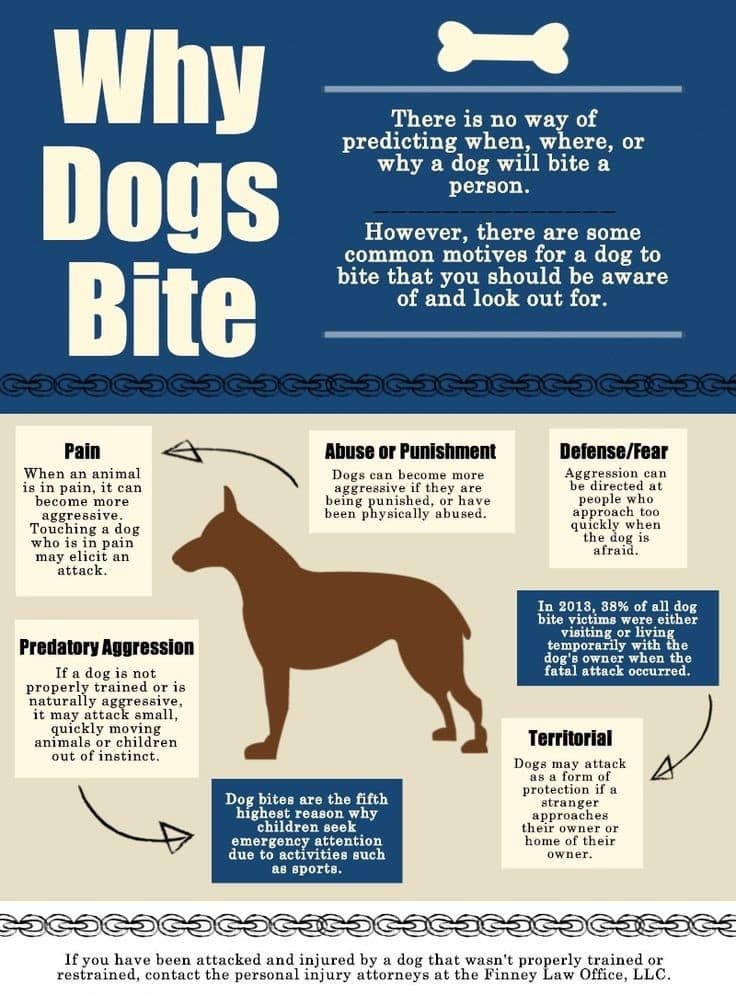 Based on these elements, you can identify 11 major types of aggression:
 If you do not put great emphasis on a dog that passes near you, neither will your pet. Avoidance can be a strong weapon, especially if you know that the other pet tends to be aggressive and starts to growl and bark. If the dog feels trapped between you and the growling one, it will find no other choice but to respond in the same manner.
If you create the adequate space, your pet will feel safer and in control of the situation. It is also a good idea to try to avoid intense eye contact with other dogs that pass by. If you do not allow this negative behavior and correct it whenever is needed, you will physically engage it towards a healthy way to respond to hostility.
You can also take extra measures in preventing your dog from injuring another dog, if there’s no way you can really avoid a confrontation. Please take a look at our article on the
If you do not put great emphasis on a dog that passes near you, neither will your pet. Avoidance can be a strong weapon, especially if you know that the other pet tends to be aggressive and starts to growl and bark. If the dog feels trapped between you and the growling one, it will find no other choice but to respond in the same manner.
If you create the adequate space, your pet will feel safer and in control of the situation. It is also a good idea to try to avoid intense eye contact with other dogs that pass by. If you do not allow this negative behavior and correct it whenever is needed, you will physically engage it towards a healthy way to respond to hostility.
You can also take extra measures in preventing your dog from injuring another dog, if there’s no way you can really avoid a confrontation. Please take a look at our article on the  Though genetics plays a major role in the tendency of a dog towards aggression, the environment where you raise it also has a lot to do. In order to prevent this from happening it is important to respect the boundaries of your dog. To be more exact, you should avoid pushing it pass the toleration point. At the same time, it is important to encourage a healthy behavior from a young age:
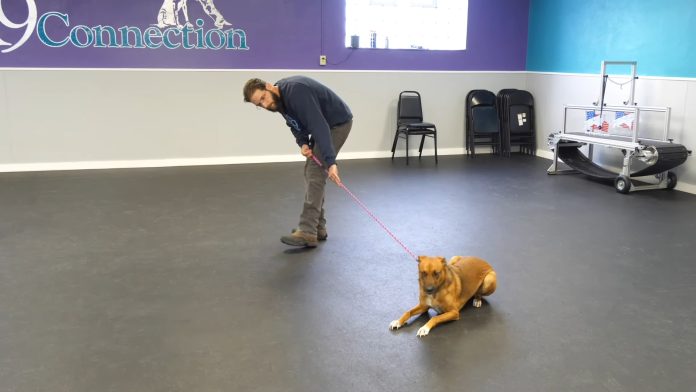 Fear aggression is defined as aggression that is produced because of fear. For some people, this can be quite confusing since fear often will push a dog to flee and not to fight. So what causes a dog to become aggressive when in fact, what they want is to run away? In order to understand this, one should also take the animal’s physiological make-up.
When a dog experiences fear, their body’s hypothalamus is also triggered which is connected to their fight-or-flight mechanism: the sympathetic nervous system. Hence, a dog can react either by running away or by fighting the perceived threat when they are overcome with fear.
It is also important to note that when a dog is experiencing fear, its
Fear aggression is defined as aggression that is produced because of fear. For some people, this can be quite confusing since fear often will push a dog to flee and not to fight. So what causes a dog to become aggressive when in fact, what they want is to run away? In order to understand this, one should also take the animal’s physiological make-up.
When a dog experiences fear, their body’s hypothalamus is also triggered which is connected to their fight-or-flight mechanism: the sympathetic nervous system. Hence, a dog can react either by running away or by fighting the perceived threat when they are overcome with fear.
It is also important to note that when a dog is experiencing fear, its 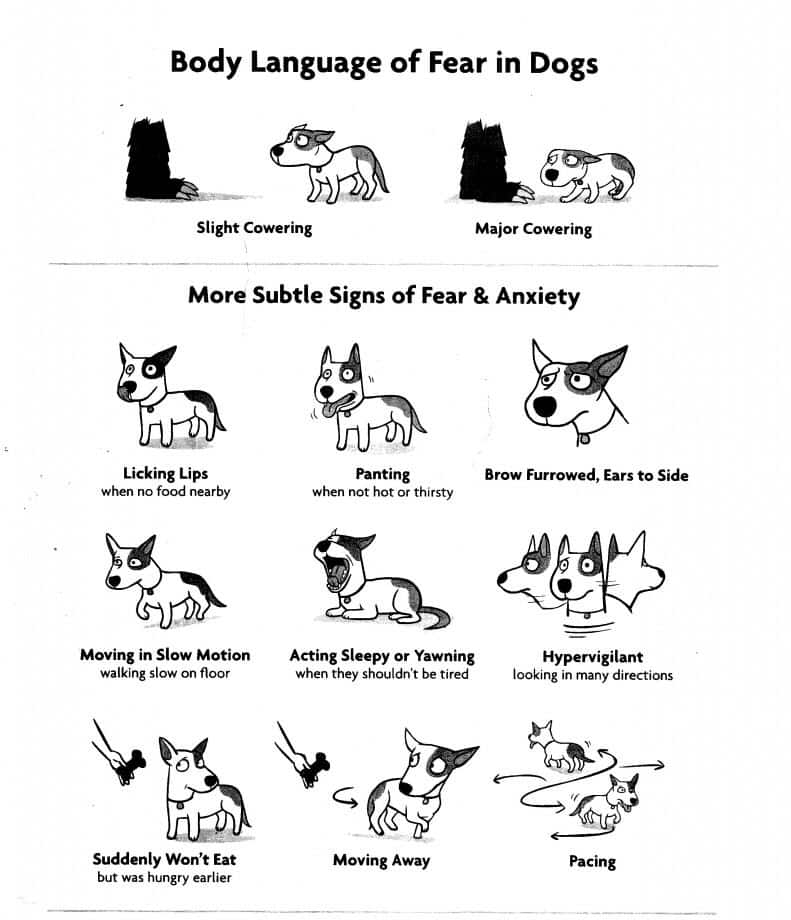 Hence, a dog will act more aggressively and forcefully even when what they are actually feeling inside is fear for their safety and well-being. When this happens, people will equate that fearfulness with uncontrollable aggression and try to suppress that behavior by physical punishments which in turn add to the stress that the dog is already experiencing.
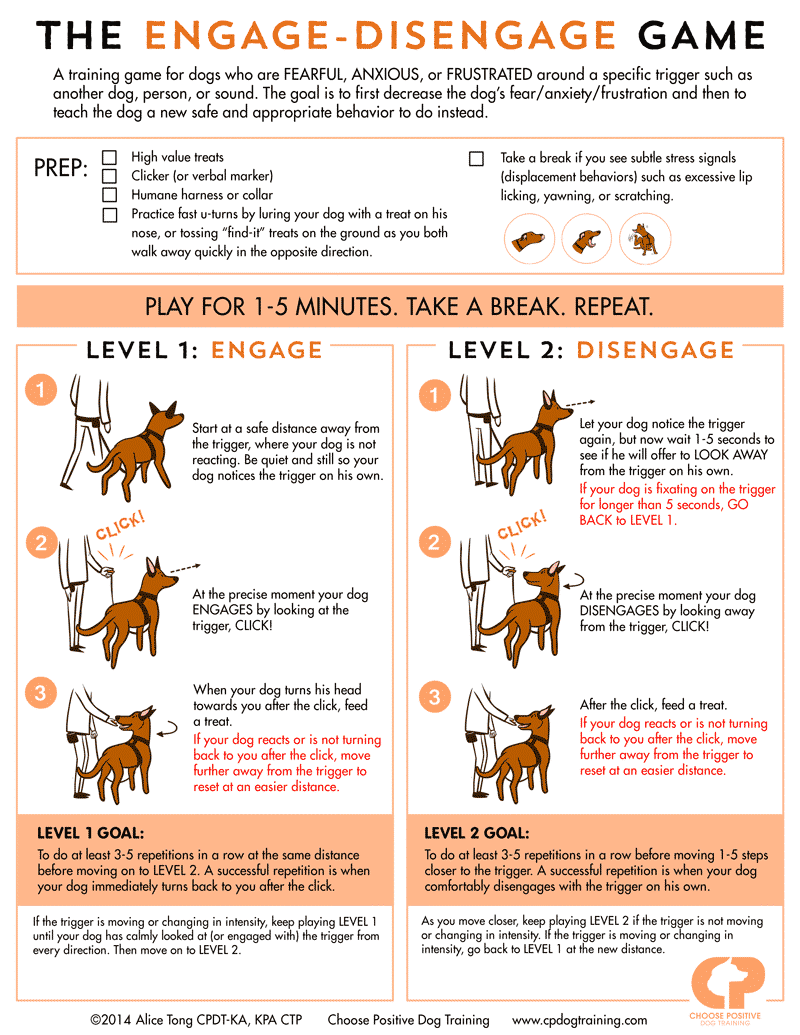
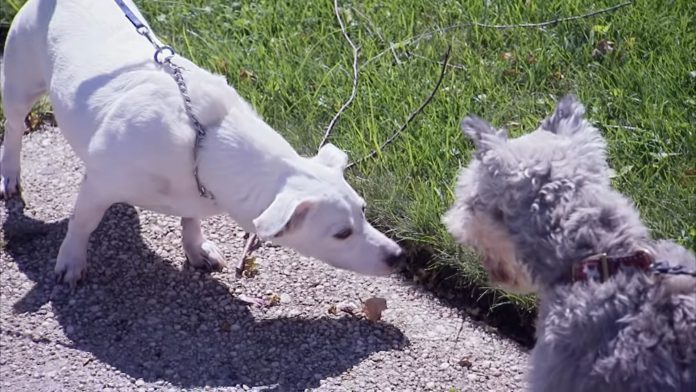 Here are some tips and information on