Home Blog

15 Best Indoor Dog Potty 2022: Top Easy to Clean Picks

Best Indoor Potty for Dogs

Irrespective of the fact that many dogs have been trained to relieve themselves outside, it usually takes some exertion to train your pet to let go in an indoor potty area such as Pee Pee pads, newspapers, and turf box and litter pads.

The use of indoor potties is mostly practiced by individuals who have small-sized dogs and individuals who work very long hours, hence will not always be there for their dogs especially when they require bathroom breaks.

Additionally, indoor potties can also be a suitable alternative for dog owners who cannot get outside due to health issues or maybe living in a high-rise.

All in all, there are several indoor potty alternatives that anyone who might be interested in having their pets let go inside the house can use. The first alternative is the pee pad which is widely used by many dog owners.

Despite the Pee pads lower initial cost, the accumulative cost is usually what makes this product more expensive than a customized indoor potty. The second alternative is the newspaper, which is free and also environmentally friendly but the floor is always going to require a little bit of extra cleaning after the dog has relieved himself or herself.
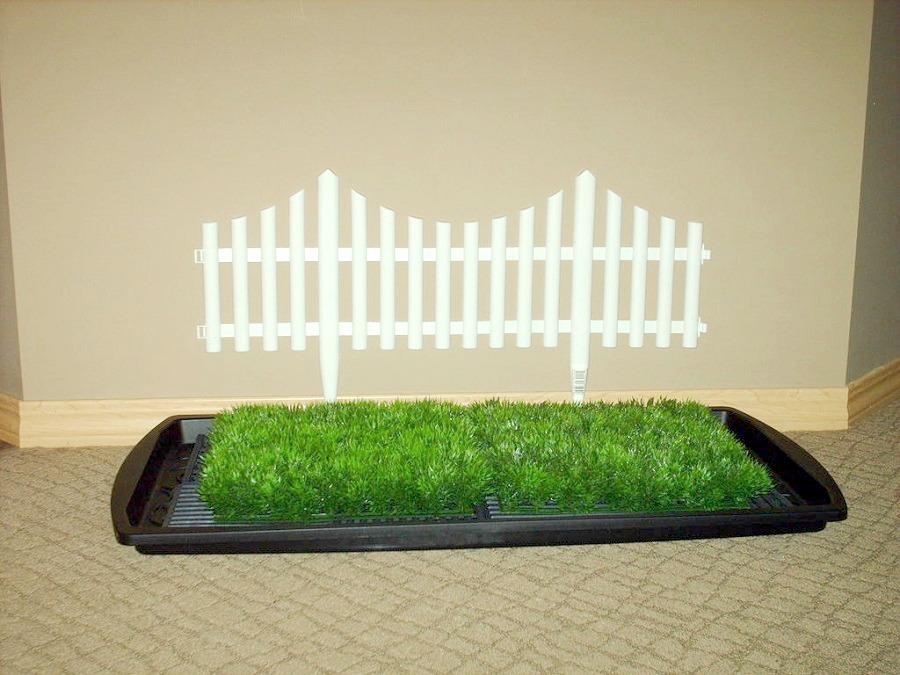
Indoor Dog Potty

Customized Indoor potties are the best and most reliable solution for any dog owner who is going to allow his or her pet to let go inside the house.

There are several indoor potty products that are currently on the market, and each of these products has its unique feature. All in all here is a breakdown of some of the best indoor potty products that every dog owner should know.

Apartment Dog Potty: Indoor Dog Potty Designs That Are Ideal for Apartments

1. Paw Prints Dog Potty Patch

Paw Prints Dog Potty Patch


The Paw Prints Potty Patch is ideal for small and medium-sized dogs and has been engineered in the shape of a bone. This potty measures 27 inches by 17 inches and has been concocted with artificial grass that can drain liquids through a plastic-looking tray liner that can be rinsed after every few days.

One key feature that makes this tray quite outstanding is the grass pad that has been elevated away from the tray liner so that the grass will stay dry.

The Paw Prints Potty Patch is for people who are looking for something cuter than the standard bathroom potty. The Potty’s sleek design will allow you the user to carry this Potty with much ease even when going to visit a neighbor since it is very light and thin. If you have a larger dog, then you can look for another alternative instead of combining several of these potties together.

Pros
  • Sleek Design
  • Dry and comfortable
  • Easy to clean
  • Adds aesthetic value to the house
Cons
  • Can be a little bit messy
  • May smell bad if not washed properly


Customer reviews

Most dog owners who purchased this product were extremely pleased because they were now able to save a little bit of cash instead of purchasing puppy pads. Apart from that, many customers were also happy with how easy it was to clean this product and how it can be placed in the house without reducing the aesthetic value.

However, there were those customers who complained about how this product cannot be used for large-sized dogs. All in all, the Paw Prints Dog Potty Parch goes for 36 US dollars.

If you think that this product could be useful for you, then you can buy it from Amazon.

2. The Porch Potty Grass Litter Box

The Porch Potty Grass Litter Box


Designed with a state of the art technology, the Porch Potty Grass Litter Box is suitable for both in-house and patio use. Unlike many other small sized indoor potties, the Porch Potty Grass Litter box measures 2 feet by 4 feet hence it is ideal for bigger dogs or those dogs that like to walk around before relieving themselves.

Furthermore, the Porch Potty Grass Litter Box has been designed with a high quality resin frame that surrounds either a high quality artificial grass or a fresh patch of grass that not only looks great but also feels great. For those who will purchase this product, you can always choose to install a drain container or a drain hose and then use the sprinkler system from Porch Potty system or a manual rinse.

The Porch potty grass litter box

Also, before rinsing this indoor potty, you are going to be required to pick up any solids then followed by pouring fresh water over the top and finally allowing the potty to drain by itself. During the cleaning process no harsh chemicals or soap is required, only clean water several days per week.

Pros
  • Easy to clean
  • Great design and high-quality materials
  • High-quality artificial grass
  • No smell or flies
  • Ideal for dogs of all sizes, both large and small
  • Can be placed on a patio without reducing the aesthetic value
Cons
  • A little bit expensive
  • Can be used by large sized dogs however they cannot sniff it or circle it.


Customer reviews

Most customers who purchased the Porch Potty Grass Litter Box were extremely pleased with the product especially because it has been designed with high-quality materials. The built and the sturdiness of the frame together with the general design of the product is what got most customers extremely happy with the purchase they made.

If you interested in this product you can buy it from Amazon.

3. Piddle Place Pet Relief System
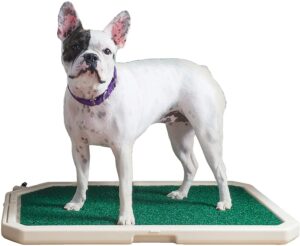
PetSafe Piddle Place Indoor Dog Potty


The Piddle Place Pet Relief system was exclusively designed to make the dog owners hands cleaner and ensure all the potential odors are contained. This pet relief system comes with a fully closed chamber that has been concocted with a drain valve system that will ensure the dog owner does not come into contact with the pet’s waste.

The Piddle Place indoor potty can be drained periodically by taking the waste and dumping all the fluids in a toilet about once every week followed by rinsing the Indoor Potty.

Furthermore, the Piddle Place Pet Relief system is very easy to carry and also exceedingly compact for long and short distance journeys.

Piddle place pet relief system

The indoor potty’s completely enclosed design will ensure that this product remains odor free, and also it can be cleaned very easily. The animal excrete, or waste is collected then stored in the potty’s plastic container so that it can be easily flushed whenever the dog owner feels the need to.

Pros
  • Easy to carry
  • Can be carried for both short and long journeys
  • Vet approved
  • Odor free due to the exclusive Piddle Place maintenance products

Customer reviews

A majority of the customers who purchased this product were extremely contended with the product and gave positive reviews. Unlike many others indoor potties, the Piddle Place Pet Relief System odor free nature was a bonus to the already well designed self-relief system. This product goes for around 95 US Dollars which is a little bit higher compared to many other indoor potties.

Like this great product? Then you can buy it from Amazon.

3. The Ugodog Potty System
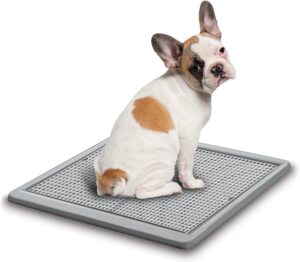
The Ugodog Potty System


Unlike some self-relief products that employ the use of turf, the UGODOG Potty System has been engineered to use just a shell and grate. This Indoor Potty System has two grates that not only fit together side by side but also are very easy to lift and also clean.

According to the product manufacturers, grating was preferred over grass because the dog will not step on the urine and leave unwanted urine tracks in the house.

Furthermore, for those dog owners who might be worried about the grating having unwanted effects on the dog’s paws, the design of the UGODOG is in such a manner that it can cushion the pet’s paws by the using convex beams.

With that being said, the UGODOG Potty System is suitable for both small sized and large sized dogs. For those who might want to make the cleaning process much easier, and then you can employ the use of newspapers in between the grate and the pan.

The UGODOG potty system

If you are going to purchase this product, then it is important to conduct some in-house training before the dog becomes fully accustomed to using this Potty System. Every purchase comes with training instructions and also the company’s contact address in case the pet owner is going to require some additional guidance concerning the product or the purchase made.

Pros
  • Easy to clean
  • Great Design
  • Can be used by both large and small sized dogs
  • Environmentally friendly
Cons
  • No replacements for the grates.


Customer reviews

Apart from the pocket-friendly purchase price of the UGODOG Potty system, many customers were also exceedingly contented with how easy it was to clean this product. Nonetheless, there were those customers who complained about the lack of replacements for the grates.

4. The Rascal Dog Litter Box Little Squirt
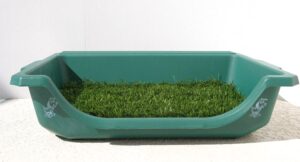
The Rascal Dog Litter Box Little Squirt


The Rascal Dog Litter has been designed for small sized dogs especially those that weigh less than 8 pounds. Contrived with the state of the art features, the Rascal Dog Litter comes with a patch of fresh looking plastic grass that has been neatly contained in a well-designed plastic container that has raised sides.

The reason why this indoor potty has been engineered with raised sides is so that while the dog is relieving his or her self, the splattering is kept at a minimum while the mess is contained in the litter box.

Apart from that the grass can be washed and even reused although the dog owner must be a little bit diligent in ensuring that the little squirt box is kept clean.

The Rascal dog litter box little squirt

Another import feature that makes this indoor potty stand out from the rest is the low entrance that makes it very easy for small sized dogs to enter into the tray and leave without any difficulties. All in all, this litter box is exceedingly light weight, very easy to clean and small enough such that the dog owner can travel with it whenever he or she feels the need to.

Pros
  • Has elevated sides to ensure that the mess is maintained in the box
  • Easy to clean
  • Comes with a laundry bag for washing the grass pad.
  • Has a low entrance for a much easier access
  • The grass does not stain and has a natural scent to attract the dog.
Cons
  • If not washed correctly, the grass may hold the urine smell for a long time.


Customer reviews

A huge number of dog owners who purchased this product were happy especially with the elevated sides that ensured their pets did not miss the grass. Also, they appreciated how easy it is to clean and empty the dog potty and how easy it is relocated and move with the potty.

Owners who purchased this product also pointed the fact that the grass that has been fitted in the Rascal Dog Litter Box was very realistic and was filled with a natural smell that attracted the dogs.

All in all, the only shortcoming of this litter box is that it can only be used for small sized dogs especially those that weigh less than 8 pounds. The Rascal Dog Litter Box goes for 27 US Dollars.

5. Klean Paws Indoor Potties

Klean Paws Indoor Potties


Just like the Rascal Indoor Potty, the Klean Paws Indoor Potties is a very great dog toilet and has been exclusively designed for small sized dogs. The key feature of this indoor potty is the perforated plastic grate that has an easy snap on the tray that in turn allows the pee to fall into the tray.

As a precautionary measure, you can also choose to insert a newspaper or training pad beneath it. By doing this, there will be very little to clean since you are going to throw the newspaper or pad after it has been filled and then rinse the tray and grate whenever you feel it is needed.

Apart from that the Klean Paws Indoor Potty has a non-skid bottom that in turn ensures that the toilet stays in its place at all times.

Klean Paws Indoor Potty

All in all, the Klean Paws Indoor Potty is very simple and effective. However, it is only suitable for small sized dogs.

Pros
  • Easy to use and clean
  • Ideal for small sized dogs
  • Very affordable
  • Ensures that your pets feet are always dry at all times.
Cons
  • Only suitable for small sized dogs.


Customer feedback

Most customers who purchased this product expressed their satisfaction with how easy it was for their pets to use the Klean Paw Indoor Potties and also how easy it was to clean this product. There are also those customers who were extremely happy with the buying price of the product since it did offer value for their money.

If you interested you can buy it from Amazon.

5. Shake Dog Potty

Shake Dog Potty Relief System


As an award-winning dog potty, the shake dog potty is ideal for medium sized dogs that weigh less than 40 pounds. In the year 2014 it won the best product design and also the Red Dot Awards and also the Pet Business at the 2014 Industry Recognition Award.

One of the most notable features of the Shake Dog Potty is that its design makes it very easier to clean. For the liquid messes, the dog owner is only going to fill the potty with water, shake then discard it away.

However, for solid messes the owner will be required to collect the poop then throw it away in the garbage or toilet like all the other potties. Apart from that the Shake Dog Potty has also been treated with an ultra-fresh antimicrobial protections so that it can be able to reduce or eliminate the odors emanating from the potty.

Another key feature is the design that directs all the liquids into a sealed reservoir thus eliminating the risks of any leaks from occurring. The state of the art design also makes this product very easier to not only fold but also to transport whenever the dog owner needs to go.

Pros
  • Easy to clean
  • Have no leaks
  • Has a high-quality design
Cons
  • Cannot be used for dogs that weigh more than 40 pounds.


Customer reviews

The stylish design and the easy to clean nature is what made many customers more contended about this product than any other product. Also, other customers were extremely happy with the overall design that can be closed for transportation purposes or once the dog has let go.
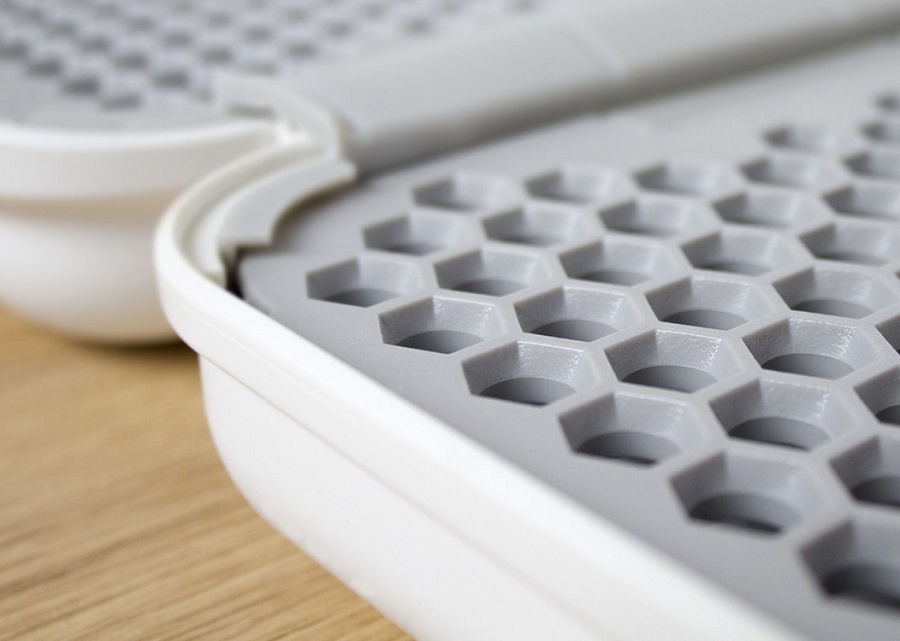
Shake dog potty

However, there were other customers who were a little bit unsatisfied with the product because it cannot be used for dogs that weigh more than 40 pounds.

In Conclusion

Apart from purchasing an indoor potty, it is also very important to ensure that the pet undergoes some extensive indoor potty training so that he or she may become fully accustomed to using the indoor potty.

It is also important to note that once you train your pet to relieve himself or herself inside the house it is going to be very difficult to make him go outside.

When conducting the training sessions, you will need to be very consistent so that you will not confuse your pet about which area is his or her bathroom. With that being said, your pet is still going to need unlimited access to the sun and plenty of exercises just like any other dog.
Cherry Eye in Dogs: Causes, Symptoms & Home Remedies

How to Treat Cherry Eyes in Dogs

It is quite obvious in many ways how different our pooches are to us. They have four legs, we have two. They have a happily wagging tail, we don’t. But there are other ways in which they differ from us that are less obvious.

One of these is hidden away out of view when healthy. It is a tear gland connected to a third eyelid. It is this tear gland that is responsible for the condition known as cherry eye in dogs.

It is unsightly, looks painful and if left untreated can cause complications. However if you know what to do and can do it, it doesn’t need to be a problem.

WHAT IS CHERRY EYE?

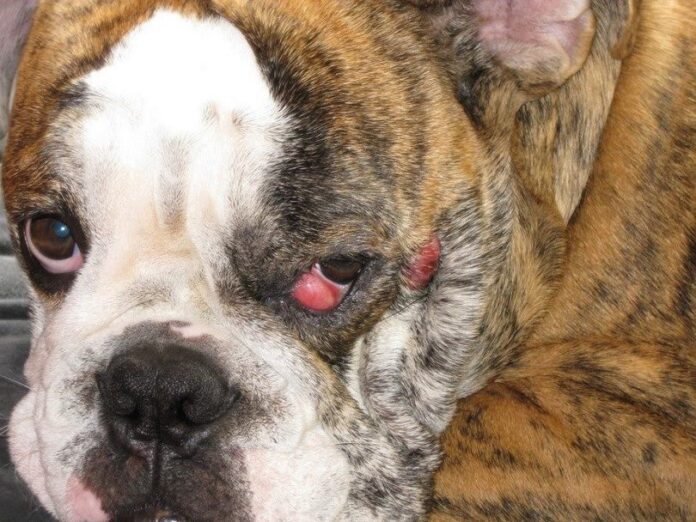
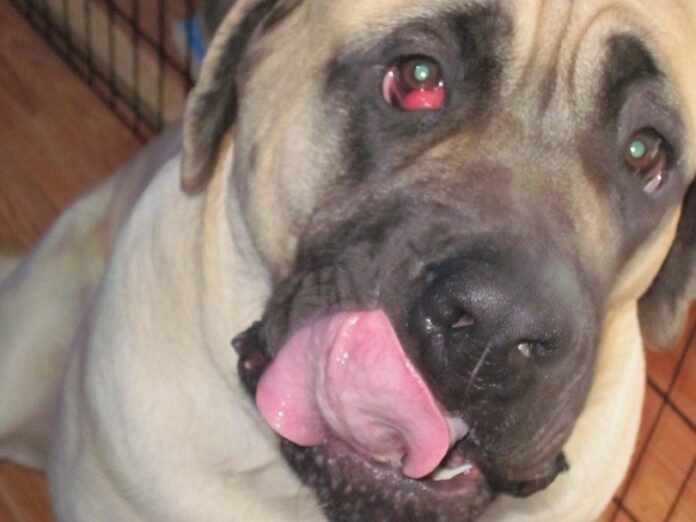
This is a condition which causes a dog’s tear gland to protrude from the eye socket. It is easily spotted and will appear as a red mass protruding from the corner of the eye nearest your dog’s nose. It can affect one or both eyes and can be recurrent.

Located underneath the nictitating membrane, commonly known as the third eyelid which protects a dog’s eyes from the wind, dust and other foreign objects this tear gland serves a very important function and that is to provide adequate lubrication of the cornea.

Cherry eye

Thought to be responsible for between 30 – 50% of the total moisture in a dog’s eye this tear gland plays a vital part in the health of your dog’s eyes. The protrusion of this gland results in none or partial lubrication and can end with your dog developing a condition called keratocon junctivitis sicca, dry eye in simple terms.

WHAT ARE THE SYMPTOMS?

Symptoms that show your dog has this condition include:

  • An oval mass protruding from the dog’s eyelid nearest his / her nose
  • Swelling
  • Possible irritation
  • Red, thickened tissue
  • Dry eyes

It is believed that the condition is not painful for your dog and that in all likelihood he / she will carry on as normal.

Your dog will likely show no signs of distress or the condition other than the visible protrusion.

Be aware that these symptoms appear similar to conjunctivitis. To learn the difference, you should check out this article on conjunctivitis in dogs.

WHAT CAUSES CHERRY EYE?

The main cause remains unknown but it is thought that it may be a congenital weakness of the glands attachment in the dog’s eye. It is also entirely possible that it is an inherited condition.

Many dog owners report that in the moments before their pooch had a prolapse of the tear gland that there were certain events. These include:

  • Over excitement
  • Fear
  • Shock / surprise

This eye condition also seems to be more common in certain breeds of dog such as the Boston Terrier, Bloodhound, Beagle, Bulldog, Bull Terrier, Lhaso Apso, Cocker Spaniel, Saint Bernard and Shar – Pei.

Bulldog with cherry eyes

Breeds with shorter muzzles along with teacup and toy varieties are also at greater risk as are dogs under two years old. It may be worth noting here that all pedigree dogs may be more prone to this condition than Heinz 57 varieties due to selective breeding.

Treatment: Home or Away?

It is of highest importance to treat this condition as soon as possible as it is more severe and won’t go on it self like other conditions like fast breathing or diarrhea. Leaving the condition untreated WILL lead to keratocon conjunctivitis sicca (dry eye) which WILL if un-treated inevitably lead to blindness. To learn how to properly treat and prevent dry eye, check out this article on eye infections in dogs.

Some vets and owners will recommend that you take your dog straight to the clinic if they develop this illness. There they may receive topical anti-inflammatory drugs which reduce swelling, or it may be suggested that your dog have corrective surgery. There are two main types of surgery:

  1. The tear gland is stitched back into place. This surgery is NOT 100% effective and a prolapse may occur again.
  2. The third eyelid is completely removed. Whilst this surgery will cure your dog’s cherry eye, it will also remove your dog’s natural protection from wind, dirt et cetera and cause dry eye and its probable consequences. Your dog would need to have eye drops used on his / her eyes every day for the rest of their lives.

As with humans there are always possible complications that can come from surgery and it is an invasive process where there may actually be no need. Many owners have reported huge success from using a home treatment to correct this eye problem in their dogs.

What Are the Home Treatments?

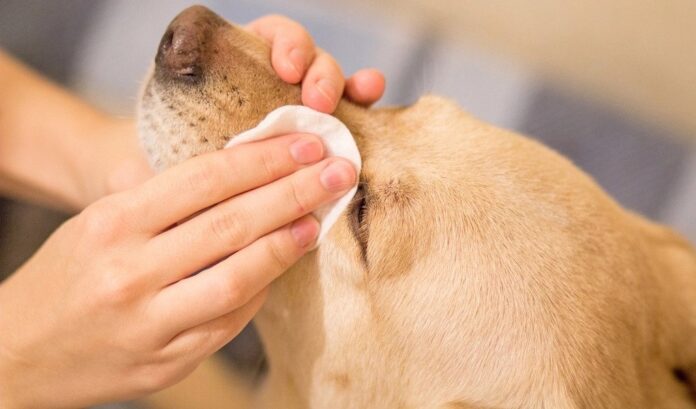
home treatment

There are a couple of successful ways to treat your dog’s eye condition yourself.  They are simple, efficient and can be applied in a highly timely manner. Remember the quicker you treat this problem, the less chance of permanent damage to your dog’s eye.

The first of the proven home methods to cure the eye condition involves nothing more than resting your dog on its back! What could be easier?

INSTRUCTIONS – THE ROLLOVER

On discovery of your dog’s third lid infection:

  1. Do not panic, act in a calm manner. It may look unsightly, painful and more serious than it is, but you CAN deal with this problem as long as you remain calm.
  2. Calm your dog into a relaxed state. Whatever methods you need to use to calm your dog employ them now. Back rub, soothing talk, ear massage, kisses etcetera: whatever works for you and your dog.
  3. Instruct your dog to lie down ensuring they remain in their calm state.
  4. Gently roll your dog onto their back and let them stay there for a few minutes. Your dog really needs to close his / her eyes for this to work so if you know a way to get them to do so use it now.
  5. Roll your dog back over so he / she open their eyes.

Hopefully when your dog opens their eyes the problem will have rectified and popped back in. This may not be a permanent solution and your dog may have another prolapse. You can however use this method if your dog relapses every so often. If this method hasn’t been successful you could try again over the next few days or move on to the more effective second method.
The second and probably most successful DIY treatment for cherry eye has a few variations on the tools to be used but is essentially the same process every time.

Instructions – The Massage

On discovery of your dog’s eye condition:

  1. Do not panic, act in a calm manner. The problem may look unsightly, painful and more serious than it is, but you CAN deal with this problem as long as you remain calm.
  2. Calm your dog into a relaxed state. This method will not work if your dog is agitated at all so do whatever it takes to relax them fully. Whatever methods you need to use to calm your dog employ them now. Back rub, soothing talk, ear massage, kisses etcetera: whatever works for you and your dog.
  3. Instruct your dog into a laid down position. Ensure you have good access to the eye that shows signs of this dreadful condition.
  4. Place a warm cloth over the eye for a few minutes. Another method is to use ice at this point. If this is the route you choose please ensure the ice is well wrapped in a cloth. Do not allow the ice itself to make contact with your dog’s eye.
  5. Keep your dog calm whilst the cloth is in place. The warm cloth at this point stimulates tear production which will lubricate the eye. This is extremely important for this method so rub their belly, ears, talk soothingly: whatever it takes to keep them calm and still.
  6. Slowly massage the area where the gland has protruded. Use as little pressure as possible. Keep your dog as calm as possible.
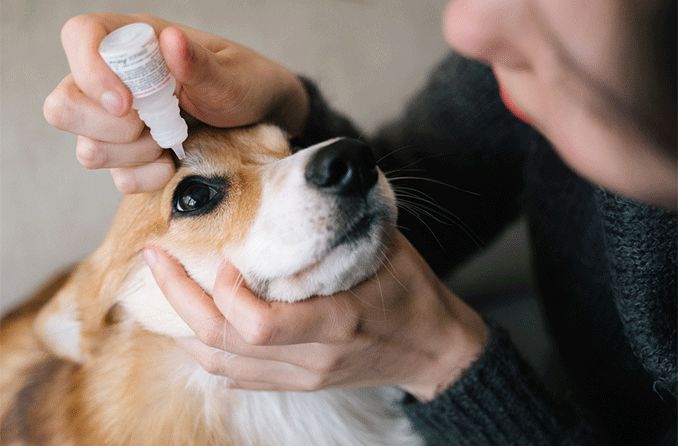
  7. Remove the warm cloth checking to see if the eye looks lubricated. If there are no tears in your dog’s eye or it does not look sufficiently lubricated place some eye drops carefully into your dog’s eye. This will create the slippery surface you need for the next step.
  8. Very gently move your thumb over your dog’s eyelid using the most feather light of touches. Move from the centre of the eye towards the corner nearest the nose.Your dog’s eye needs to be closed for this step. If there is resistance to closing the eye, you may need to enlist someone’s help to calm your dog whilst you hold the eye shut and complete the thumb movements.
  9. Repeat step seven several times until you feel the protrusion suck back into place.
  10. Massage the eye a little more.

If you’re looking for other ways to keep your dog from being excitable, it would be a good idea to check out how to calm down a dog.
This step is optional but will just give the tear gland a little time to settle back in place before your dog is up and around again. This may prevent the gland popping straight back out in the next few minutes or hours.

As with the first method the success of this does not guarantee your dog will not suffer from further occurrences of the problem. It does however mean that you will not have to put your do through invasive surgery or wait the time that it takes for anti-inflammatory drugs to work.

If your attempt to correct cherry eye fails first time it would be worth retrying again over the next few days. Please note though that if you are unsuccessful for more than a week you should consult your vet. The longer left uncorrected, the more chance there is of permanent damage.

How Do You Prevent / Lessen the Chance of Recurrence of Cherry Eye?

As with anything prevention is always better than cure. In order to prevent something though we need to know what causes it. Since there is no known cause of cherry eye though, only supposition, we cannot act to prevent it with any guarantee of success.

It is however entirely possible that the prolapse of the tear gland could indicate weakness in a dogs connective tissue. Therefore it may help to feed your dog a food, supplement or treats that enhances tissue connective strength.

Keeping your dog’s eyes well lubricated could also aid in the prevention of cherry eye reoccurrence. If you feel your dog’s eyes are dry or not quite lubricated enough visit your local pet store and invest in some good quality eye drops.

dog-eye-drops

There are also various remedies that a vet will recommend after cherry eye surgery to stitch the gland back in, that could act as a preventative after a home treatment:

  • Bilberries – these contain anthocyanoside flavoids which may (research has been limited) provide structural support for the retina, cornea and other constituents of the eye.
  • Chrysanthemum – widely used in China to treat inflammation of the eyes, dry eye, weeping eyes and blurred vision.
  • Rehmannia – rich in amino acids and vitamins A, B and C, this has anti-inflammatory properties.
  • Lycium fruit – Long used in China to support eye health, this is a herb containing b-carotene, amino acids, as well as vitamins B and C.

And finally but not at all easy, try not to allow your dog to get surprised, shocked, startled or too excited. Many owners report these kinds of events as the moment their dogs develop a case of this eye condition for the first time or a reoccurrence of the problem.

Undoubtedly more research is obviously needed into the causes, prevention and treatment of third eye lid infection in dogs, and hopefully one day there will be more successful preventions than cures.

But in the meantime it is always good to know that we ourselves, caring, responsible and loving dog owners can always act quickly and successfully in treating and curing our beloved pooch’s eye problem.

How to Teach a Dog to Stay, Sit or Come When Asked – Dog Obedience Training Basics

How to Teach a Dog to Stay, Sit or Come When Asked - Dog Obedience Training Basics

Teaching your little canine friend how to stay represents the basics of dog obedience training along with other basic commands like “come” and “sit”. Of course, you may continue your dog’s education and train them how to fetch the morning newspaper or to roll on their back.

You just have to realize that training your dog to listen and respond to your commands is of paramount importance for creating a happy and healthy owner-dog relationship as well as a socially compatible pet.

Basic obedience training is important for absolutely every dog regardless of breed, size and gender. It should start as early as possible and continue as long as necessary. In the following lines, we are providing practical information on how to teach a dog to stay, sit, come or listen to other basic commands.

Train Your Dog to Come When Called

The very first command a household dog must master is to come when called by its owner. Every pet dog must obey to the “come” command at any time and under any circumstances. Some dogs even seem to learn the command without any specific training.

If this is your case, you still will need to train your dog to come to you when called. Why? Because you must be sure that your dog will obey the command every time and not only when he or she decides and this is achieved only through targeted obedience training.

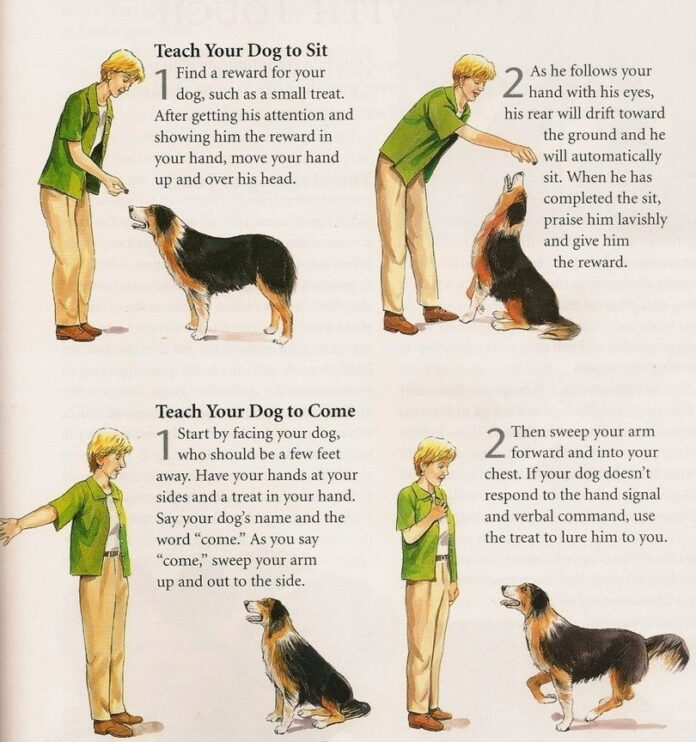
The following guidelines will show you how to train your dog to come:

  • Choose the right time of the day. Typically this would be between meals when your dog is at it hungry (you must not let your pet starve!)
  • Start with small distances. The very first training session must be held inside – fewer things to distract your pet and small distances.
  • Get a dog treat or a tiny bit of his or her favorite food and stand several feet away from your pet.
  • Say “Come!” or “Come here!” loud and clear and wave the treat in front of your dog.
  • Reward your pal as soon as they arrive.
  • Once your pet responds quickly to your command, do the same outside – again, select a calm, quiet place.
  • When you notice that your dog responds to the command every time, start rewarding him or her only occasionally.

If done correctly, you will never have to worry about how to train your dog to come when asked again. However, almost all dogs seem to “forget” what they have learned rather quickly.

As surprising as it may sound, failing to perform at certain command is rarely your dog’s fault; it is often the owner who unconsciously sabotages their pet’s training. Common mistakes that can ruin the “come when asked” command include:

  • Calling your dog to come only when you need to put their leash back on.
  • Letting your dog neglect your command.
  • Punish your dog when they finally respond to the command.
  • Calling your dog to punish them for something else.

As you can see, all of the above situations provoke negative associations in your pet – soon your dog will figure out that the outcome of obeying the “Come!” command is not in their favor. In order to retain the results of the training, try to avoid the above situations.

Teaching Your Dog to Stay

Teaching Your Dog to Stay

After your dog has mastered the “come” command, it is time to move to the next very important obedience command – the “stay” cue. Not many dog owners actually try to teach their dogs to retain their position on command although it might be very useful in certain situations. Additionally, this is a great basis for teaching your dog more obedience tricks, for example, to wait for permission before going out an open door, i.e. a car door, your apartment door, etc.

So, how to teach your dog to stay? These are the main steps that you need to follow:

  • First and foremost, think of a release command – a word or a phrase that will mark the end of the “stay” command. You can go for any word but it is recommended to stick to short, easy-to-distinguish words and/or phrases such as “Done”, “OK”, “YES” and so on.
  • Call your dog and give the appropriate command for the position you want your pet to maintain. It’s good to choose a position that’s comfortable for your four-legged friends, such as down or sit. Let’s assume you will ask your dog to sit.
  • Once your dog sits, wait a little bit (several seconds), reward your pet and pronounce the release command – at this point, you should encourage your dog to get up.
  • Repeat the same slowly increasing the time between the “sit” command, the reward, and the release command. Once your pet starts holding its position for longer, try moving away from him or her – preferably stepping backward rather than walking away. Try a step or two, reward your pet and give the release cue.
  • Increase the distance between you and your pet gradually until you are satisfied with the results.
  • Opt for short but regular training sessions. Most dogs tend to get tired quickly when learning new tricks. A pet that becomes suddenly distracted without an obvious reason or a pet that starts making mistakes are signs of a tired pet. If you notice these signs in your dog during a training session, take a break and continue later.

The success of your training session will depend not only on your teaching technique but on the predisposition of your pet and the distractions around them. It is best to train your dog only when he or she is relaxed and well exercised, i.e. after a long walk. Also, start inside – pick a room free of distracting noises, smells, or items so that your dog can fully focus on your commands.

How to Teach Your Dog to Sit?

How to Teach Your Dog to Sit

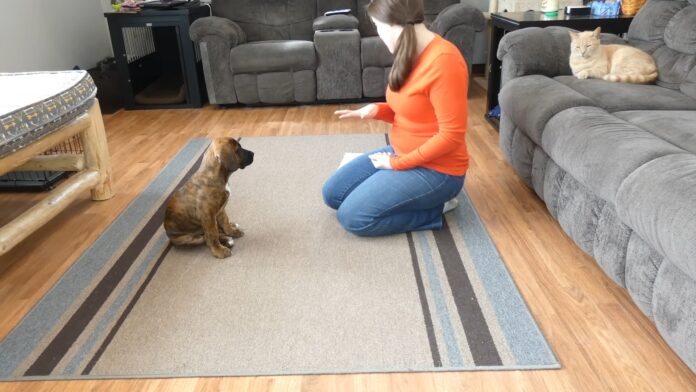
After you have trained your little pal to come to you when asked, it is time to train him or her to sit on command. Teaching a dog to sit may be a bit challenging, especially if you have never done it before.

Here are several tips that explain how to teach a dog to sit:

  • Get a dog treat in your hand and call your dog.
  • Hold the treat in front of your pet’s nose, approximately 1-2 inches away. The best way to hold it is between your index finger and thumb.
  • Start moving the treat above your dog’s nose, towards the top of its head. Your dog will try to follow the treat with their nose – the higher the nose of your little friend goes, the lower his or her bottom will drop!
  • When you notice your dog’s bottom is very close to the floor or maybe touching it says “Sit” – loud and clear, and give them the treat.
  • Ask your dog to stand up again and repeat the exercise.
  • Once your dog masters the command, repeat the same but without a treat in your hand: ask your dog to come, place your hand around an inch in front of your dog’s nose, and start moving it slowly towards the top of his or her head while pronouncing the command.
  • The final step is to teach your dog to sit on verbal command only. Start giving the command first and then placing your hand in front of your dog’s nose. If the training has been successful so far, your dog will sit just upon hearing the command and seeing your hand in front of them. Start pulling away your hand gradually. After a few training sessions, your dog will sit on command without you moving your hand at all.

Teaching your dog how to sit may require several training sessions.

Dog training

Some dogs learn very quickly, others need more time. Here are several extra tips that may prove effective if your pooch is stubborn:

  • Keep your fingers at the right distance in front of your dog’s nose: if the treat is too far away, your pet will try to walk or jump to get the treat.
  • It is possible that your dog will back up when you start moving the treat above your dog’s nose – some dogs do that, instead of raising their heads! To avoid this, choose a place that would limit the space behind your dog – a wall, piece of furniture, etc.
  • Reward your dog after he or she has mastered the command just remember to keep the treats in your pocket or anywhere else where your dog cannot see them.
  • Be very patient – if your dog cannot figure out what is required of them, take a break and try again.

Another great trick you can teach your dog is how to roll over. Please read our article detailing the steps needed to teach your dog to roll over.

What Are the General Rules to Follow?

What Are the General Rules to Follow

Although there are various training programs designed to help you teach your dog to come when asked, sit or stay, there are several general rules every dog owner must follow.

Stay positive throughout the training session

Dogs have very strong instincts and intuition and can detect your general predisposition and mood. Even if you don’t feel particularly nervous, your dog will sense your anxiety and will become nervous too. Just the same – they can feel if you are happy and relaxed. Last but not least, a training session must be a fun and positive experience both for you and your pet.

Be very patient and try not to loose your temper

Some dogs are really fast learners – Golden and Labrador Retrievers, Collies, and Poodles for instance respond faster to training and tend to remember more “tricks”. Other breeds require more work to master basic obedience commands – Afghan and Basset Hounds, Bulldogs, Pekingese, and Chow Chow dogs for instance can give their guardians a real hard time training them.

Puppies and young dogs are generally harder to train as they get excited easily and do not always listen to you. Whatever the case try not to lose your temper. The worst thing you can do is start shouting at your pet or acting in a rude manner.

Give short, precise commands in confident, calm voice

Dogs have very good hearing – they can recognize different sounds even if you talk in a low, composed manner. They can remember a lot too. On the other hand, they are not humans – long, complicated commands will only confuse your pet and he or she is likely not to respond in the desired way. Stick to short words and always use the same commands for the same action.

Stick to positive reinforcement methods
  • Modern dog training trends employ positive reinforcement (good behavior is rewarded, unwanted behavior is not), while older techniques included harsher methods. Of course, it is up to you to decide which dog training techniques to use, although dog trainers nowadays advise in favor of reward-based dog training.
Do not over-prize your pet

There is a very fine line between using rewards in dog training and spoiling your dog. Moreover, there are various rewarding methods you can use to make your dog deliver that good behavior again and again. Use different types of incentives (food, tasty treats, toys, verbal and physical) but try to not overdo things.

Get your pet’s health checked

Take your pet to the vet if you notice he or she consistently experiences learning difficulties. Sometimes training problems are not directly connected to the training methods you use or to the intelligence of your dog. It may be a hearing or eyesight problem you are unaware of that prevents your four-legged friend to respond to your commands.

Training is not a one-off task

You need to constantly train your pet – reinforce commands your dog has mastered already and never leave unwanted behavior uncorrected. Just like humans, dogs tend to stick to behavior patterns they feel most comfortable and these are not always the ones you would appreciate. In this respect, being a dog owner is pretty similar to being a parent – it’s a full-time job, 24/7, 365 days a year.

Don’t let training be the only time you spend with your dog

It is not a coincidence that dogs are known to be humans best friends. Try to spend quality time with your dog beside any training sessions. Take your dog on a long walk, play a game or just cuddle for some time – these activities will strengthen the bond between you.

All of these tips should be considered, no matter what you’re teaching your dog. You can learn more about other things to teach your dog in our article about basic obedience training.

Easiest and Most Difficult Dog Breeds to Train

While some dog owners ponder how to teach their dog to sit, others have never experienced even the slightest problem during their dogs’ training. Is it true that some dog breeds are naturally easier to train than others?

Although this topic is highly controversial, there are dog breeds that seem to learn faster. The top three fast-learners include:

  • Golden Retrievers. Obedient in nature, a Golden Retriever will effortlessly make it to the top of any “easy to train” dog list. Dogs from this breed enjoy being trained and appreciate all types of obedience training games.
  • Border Collies. Known to be among the most intelligent dog breeds, Border Collies are always interested in what you can teach them.
  • Doberman Pinschers. Intimidating as a Doberman Pinscher can be, it is also an excellent learner. Dobermans are very intelligent and always attentive to what is going on around them.

There are plenty of other dog breeds that are easy to train as well. Here’s a great article on the smartest dog breeds.

Although there might not be a direct link between your dog’s intelligence and training effectiveness, certain dog breeds have proved to be very difficult to train.

You may find training particularly challenging if you are dealing with dogs from the following three breeds:

  • Beagles: Being hunting dogs, Beagles are easily distracted. If you own one, you probably noticed that your little pal cannot resist the urge to look for new scents and follow them.
  • Bulldogs: These cute wrinkled friends prefer to sleep, eat and.. sleep again. Most of the time a Bulldog is happy just to sit and observe. Motivation is the key – find rewards that your pet really enjoys.
  • Chow Chows: Very lovable and hug-gable, Chow Chow dogs tend to be very dominant as well. Most training problems you may encounter stem from that dominance – be very assertive and firm while training a dog from that breed.

Dogs are very social animals who enjoy being around people. Surprising as it sounds, dogs prefer to have rules – rules and boundaries give them a sense of stability and security. On the other hand, dog owners prefer to have balanced and well-trained dogs.

It is a natural win-win situation that you only need to reinforce through correct dog training in order to create a happy, rewarding relationship with your pet for a lifetime. Although dogs learn at different rates, every dog can master at least the basic obedience commands.

Surrounded by a loving and stable environment and provided with assertive, calm leadership, every dog will easily learn to listen and respond to every command you give him or her. There are various ways to train a dog to come, sit, heel, or fetch. Regardless of the breed and the training method you have chosen, remember to be positive and consistent in your training; always.

Identifying False Pregnancy in Dogs And What You Can Do About It

False Pregnancy In Dogs

You have a female dog in the house and she is not yet spayed. Suddenly she starts acting lethargic and nauseous. She has gained weight, is exhibiting mammary enlargement and even started producing milk.

By the looks of it, she really does seem pregnant. But then she has never been out of your sight and you know she hasn’t been in contact with a male dog. What is happening?! Relax and breathe.

If indeed she has stayed within your property all this time, then she might just be experiencing Pseudocyesis.

Most commonly known as false pregnancy in dogs, this condition is actually not that uncommon in intact or unsprayed female dogs. Understanding this condition fully leads to better resolution of the whole situation.

How to Know if a Dog Is Experiencing False Pregnancy?

When a female dog is having phantom pregnancy, the symptoms she displays are more or less similar to what an actually pregnant dog would show.

Identify a false pregnancy in dogs

Chances are high that it is pseudopregnancy if you are sure that your pet has not been in close contact with intact male dogs but she exhibits a lot of the following signs:

Physical changes

  • Weight fluctuations (there might be weight loss due to lack of appetite or weight gain due to sudden increase in appetite)
  • Abdominal distention, enlargement or swelling
  • Mammary glands enlargement
  • Mammary glands secretion (can look like water or brownish fluid)
  • Milk production
  • Vomiting
  • General lack of energy, lethargy
  • Mucoid vaginal discharge
  • Appearing as if she is going into labor

Behavioral changes

  • Aggression (the dog will be grumpy towards you or other dogs in the house)
  • Depression (suddenly becomes withdrawn or clingy)
  • Restlessness (there might be lots of whining involved too)
  • Anxiety
  • Nesting behavior (watch out for your dog tearing up paper or a blanket and making a nest somewhere in the house which she thinks is safe and comfortable)
  • Digging (often combined with the nesting behavior)
  • Mothering (she might latch onto a stuffed toy, shoe or other items and literally mother these objects)
  • Self-nursing activity

As can be seen on this list, pseudocyesis can be tough to distinguish from real pregnancy in dogs and it can be quite stressful dealing with the whole matter.

After all, although you are fully committed to your pet right now, you might just not be ready to have a whole litter on your hands.

Dog anxiety

This is why all dog owners are highly advised to be vigilant when their intact dogs are in heat. Determining a phantom pregnancy can be done more decisively if you are sure that your pet has not bred.

What Causes Pseudopregnancy in Dogs?

Pseudocyesis is basically a condition triggered by hormonal fluctuations in female dogs.

What happens is that when they undergo estrus, otherwise known as being in heat, their progesterone levels increase considerably and this could go on for as long as the heat cycle lasts.

Now once that is over, progesterone levels decrease but another hormone, prolactin, is produced more in the dogs’ bodies. When this happens, a hormonal imbalance can occur.

This disparity can result to physiological changes in the dogs’ bodies, which can make them think they are pregnant and would then result to them exhibiting behaviors common to expectant dogs.

Dog at vet checking false pregnancy

This is not that rare a condition and often happens about 4 to 6 weeks after a female dog’s heat cycle.

The pregnancy symptoms can go for several months and can be so convincing that even expert breeders can be fooled. So if your dog shows signs of pregnancy but you are convinced she has not bred, it is best to check with your veterinarian just to confirm things.

If the situation is indeed false pregnancy, the symptoms can be waited out as they often disappear on their own. However, if this persists, then it is best to talk to your vet and come up with the most appropriate solution for your dog.

Other causes

There are times when regular hormonal imbalance is not the cause of the dog false pregnancy. It could be any or a combination of the following:

Hypothyroidism – a dysfunction in a dog’s thyroids can lead to blood changes which may then result to the overproduction of prolactin. As outlined above, a hormonal imbalance may occur and lead to false pregnancy.

It is worth knowing that there are several dog breeds predisposed to hypothyroidism. These include Mastiffs, Rottweilers, Dalmatians, Siberian Huskies, American Staffordshire Terriers, Malteses, Border Collies, Chinese Shar-Peis, Weimaraners and Bernese Mountain Dogs. If you own any of these breeds, canine hypothyroidism may be something you want to know more about and prepare for.

Mastitis – also known as inflammation of the mammary glands, this is a condition wherein a female dog’s milk ducts get infected.

Symptoms can include swelling. Although this often happens to dogs that are actually pregnant and are lactating, the reverse can be true – meaning when there is an infection, the swelling of the mammary glands might lead your dog to think she’s pregnant and she might even lactate.

Mastitis at dogs

Cancer of the mammary gland – any tumor growing in the mammary gland can lead to inflammation and swelling similar to mastitis.

Same as above, your pet may think she is pregnant, which can result to her exhibiting other symptoms.

Abdominal enlargement – there are various reasons why this could happen, among which are: organ swelling, uterus infection or fluid accumulation.

At first it might seem that indeed your dog is pregnant because her stomach is enlarging. She might think this is so as well, and once again might display pregnancy signs.

With these causes, it really is best to see a veterinarian if your dog starts showing phantom pregnancy signs.

Although a simple hormonal imbalance can go away on its own, the other underlying causes above can be very serious and would require immediate attention.

Another important thing to remember is that pseudopregnancy can occur after a female dog has been spayed.

If the spaying was done within the heat cycle when progesterone levels were high, the sudden physical change can lead to the hormonal imbalance behind false pregnancies in dog.

So it might be best to confirm with your vet if your dog is in heat or not and if she is, then go through with the spaying after the reproductive cycle. Verifying a dog’s ovulation is easily done through testing progesterone levels.

What Are the Diagnostic Procedures Needed?

The first step is to set an appointment with a trusted vet to have your dog checked. Prepare the details of your pet’s health history. Compile as much information as you can because every little bit of detail is helpful to the vet.

Your dog’s recent behavioral and physical conduct will then be checked as thoroughly as possible. Expect that she will undergo several lab tests including a complete blood count test. Her biochemistry profile will also be checked and a urinalysis is most likely going to be scheduled.

If it is false pregnancy, the tests will often come back showing regular results unless there are other underlying causes such as those outlined above.

Dog abdominal x-ray imaging

To further confirm that it is indeed pseudopregnancy, your vet might request abdominal x-ray imaging and an ultrasound to be done just to make sure there are not any puppies developing.

Radiographs may also be scheduled in order to rule out any chances of your dog suffering from Pyometra, a serious condition that requires immediate action. This disease is basically a build-up of pus inside the dog’s uterus accompanied by severe infection.

Although this illness is not common, if early treatment is not given then the condition can be life-threatening.

Once your vet conclusively rules out any other illnesses and identifies that the condition is indeed false pregnancy, effective treatment can then be carried out.

What Treatments Are Required?

Experts advise that if the symptoms are mild, then owners should just wait things out as the condition will resolve itself in two to three weeks. It is not advisable use warm compresses to mitigate milk production or breast secretions.

It is not a good idea to wrap your dog as well even if you are just trying to minimize the messy effects of lactation. All that these will do is stimulate the mammary glands, which could lead to further inflammation, increased secretion and other complications.

Your dog might become grumpier too because of the discomfort. If your dog licks her breasts constantly, over stimulation could also happen and so it is advised to use an Elizabethan collar on her.

Aside from this, your veterinarian might suggest the use of diuretics (example: Furosemide) and mild sedatives to speed up the recovery process.

To minimize lactation, it can help to decrease your dog’s water and food intake. This can be done by not feeding your dog for 6-10 hours for several nights. This might sound cruel but the lack of food and water will indeed help suppress the lactation process.

Of course, this can be dangerous for your pet if not done right so it is best to seek guidance from the veterinarian when implementing this.

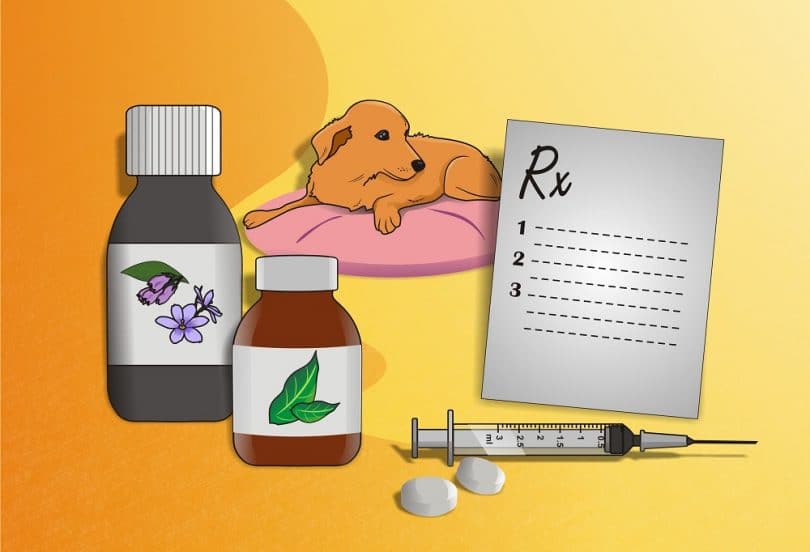
False pregnancy medicine

When nesting and mothering behaviors are severe, vets advise to remove the puppy-substitute objects from your dog’s presence. This might lead to more discomfort for your pet but this will hasten the end of the false pregnancy.

Drug therapy may also be suggested by the vet. This involves the use of Bromocriptine (such as Parlodel® and Sandox®), which is a drug used to decrease milk production.

This can be bought from a compounding pharmacy at a relatively reasonable price. The medicine is usually given to your dog for one to two weeks or until the lactation process stops.

A common side effect of this drug is an upset stomach so this is something you need to be prepared for. It must be noted however that this drug has faced many issues in the US despite its wide use in other countries because it can cause abortion in pregnant animals. That is why it must be used with care.

Then there is Cabergoline, another drug that can help speed up the cessation of false pregnancies in dogs. It has fewer side effects but tends to be more expensive than Bromocriptine.

Testosterone and Mibolerone drugs may also be used but each have their own negative side effects and so their use should be carefully assessed by the veterinarian.

Natural supplements may be used as well to help your dog deal with her condition, which can be highly stressful especially if the symptoms are quite severe.

Finally, it is advisable to have your pet spayed about a month after she experienced false pregnancy.

It is not a good idea to have her spayed while she is still in the grips of the condition because this will just cause further stress and does little to relieve the whole situation.

Preventing and dealing with pseudopregnancy in dogs

Spaying as early as possible is the best way to prevent false pregnancy in dogs. Minding your pet’s overall health will go a long way as well.

She should not be subjected to unhealthy diets and living conditions which might lead to problems with the mammary glands and uterus.

Balanced diet plan

When pseudocyesis does occur, it is best to stay calm, patient and understanding.

Pregnancy, real or otherwise, is a stressful condition for any creature and if the humans in the house are anxious, your dog’s stress levels will just increase. So stay grounded and proceed with care and proper guidance from your veterinarian.

If there are children in the house, do your best to keep them aware and instruct them on what to do so as not to aggravate the whole situation.

In Conclusion

Phantom pregnancy is one of the things owners of female dogs will potentially come across. Often it is not a life-threatening situation and can be weathered out.

There might be underlying causes however which need more attention. So as a whole, a veterinarian’s advice is still valuable and best sought when the situation demands it.

The Most Important Question: Can Puppies Eat Adult Dog Food?

Can Puppies Eat Adult Dog Food

You may be wondering what to feed your new puppy right after you bring him home and one of the options that came to your mind is adult dog food.

Besides, it is dog food so why not? Well, the problem is puppies need more nutrients than adult dogs and the bite size of these foods may not yet be suitable for their little mouths.

Yes, it may be a lot cheaper to just buy adult dog food especially if you already have another dog to feed. It would definitely be a good way to cut costs but your puppy may not be getting what he or she needs.

Would you sacrifice your puppy’s future health by giving him less than optimal types of dog food?

As a pet owner, you need to understand that a growing puppy’s needs are not the same as that of a fully grown or adult dog. Their bodies need all the nutrients that they can get to develop tissues, organs, muscles, and bones in order to reach their adult size.

Together with this need comes the requirement for greater energy sources which is why you need to supply a greater amount of calories.

Aside from that, you also need to take into consideration the fact that they have weaker teeth, jaws, and stomach so what you may be feeding your grown up dog may not be suitable for them.

Here are a few other things to consider to help you decide which types of food to feed your puppy.

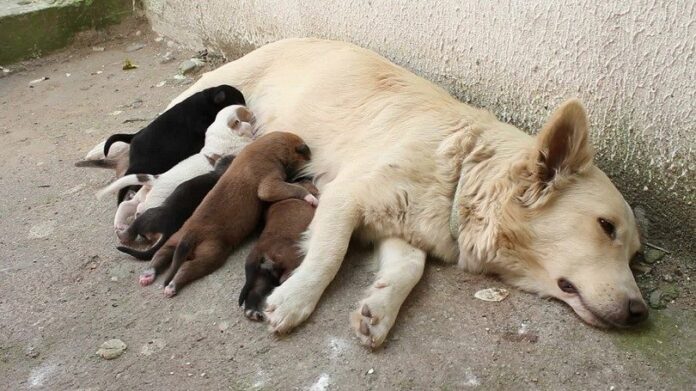
Puppies Need Their Mother’s Milk up to 8 Weeks

A puppy’s mother will be its best source of nutrition until they reach the age of eight weeks or two months. The mother supplies not only warmth and hygiene needs for the puppies, but also one of their most important needs – antibodies.

Just like in humans, a mother’s milk contains essential components which cannot be replicated by commercially prepared formula milk.

They have the right amount of carbohydrates, protein, vitamins, and minerals that they need to grow as well as essential nutrients such as DHA that helps in their brain development.

Puppies need mothers milk

If however, the puppies have been orphaned or are abandoned by their mother, then the next best thing would be replacement milks which can be bought from your local pet store. You can start feeding them some puppy food mashed in some warm replacement milk or water once they are three (3) to four (4) weeks old. You can also give them some mashed steamed vegetables and some meat, just make sure that they are soft enough for them to eat.

Different Puppies Require Different Amounts of Food

Not all puppies require the same amount of food every day. Some of the important things to consider when feeding them is their breed and their estimated size once they become full grown adults.

A smaller breed will require smaller feedings whereas a larger breed will require a greater amount of food to support their growth.

For example, toy breeds such as Pomeranians will only need about a tablespoon of puppy food per meal when they turn eight weeks old whereas a giant breed, such as a Labrador will need one-half cup per meal.

Smaller breeds will also require more frequent feeding since they metabolize food faster than larger breeds. Their smaller stomach also means that they can only eat limited amounts of food per meal hence the need for more frequent feeding.

If you have a large breed puppy, then you may also need to limit their intake of calories and minerals to avoid bone and joint problems when they grow up.

Different dog bredds

Here is a simple guide on how much to feed your puppy per day depending on their breed:

  • Toy breeds – ¼ to ¾ cup
  • Small breeds – ¾ to 1 cup
  • Medium breeds – 1 to 2 cups
  • Large breeds – 2 to 2 ½ cups
  • Giant breeds – 2 to 4 cups

Different Breeds Mature at Different Time Periods

Another thing to consider is when can you consider your dog to be still a puppy? You need to understand that dogs will have different time periods of maturing into an adult dog. The general rule is that the smaller the breed, the faster will it mature. This is quite easy to determine with a pure-bred puppy but if you have a mixed breed, then you may have to talk to your breeder or your vet in order to determine how large they will be when they become adults. Below is a guide on how you can determine the average length of time that it will take for your puppy to grow up.

This will help you know when to switch from puppy food to dog food as well:

  • Small or toy breeds. This group includes Chihuahuas, toy poodles, Yorkshire Terriers, miniature Dachshund, Pekinese, Jack Russell, toy poodles, and Pomeranians. These types of puppies will typically take from nine to twelve months to get fully-developed bodies.
  • Medium-size breeds.  Bull Terriers, Springer Spaniels, Basset Hounds, Cocker Spaniels, and Beagles belong to this group. It will take about 12 to 14 months for these puppies to become adult dogs.
  • Large breeds. This group includes German Shepherds, Labrador or Golden Retrievers, Boxers, and Collies to name a few. If you have puppies in these breeds then you will generally have to wait for 12 to 16 months for them to grow into adult dogs.
  • Giant breeds. Mastiffs, Great Danes, St. Bernard, Malamute, and Pyrenees are just some of the breeds that belong to this group. These dogs take 18 to 24 months to mature so be careful not to give them adult dog food before these periods as it can greatly affect their bone and muscle formation. They may look big but they are still puppies inside.

Puppy Food Is Different From Adult Dog Food

The difference between puppy food and adult dog food lies in the fact that they have different biological needs. Puppies generally tend to require more nutrients than their adult counterparts due to the fact they need more materials to turn their bodies into fully-developed adult dogs. Hence, they require more protein, micro nutrients such as vitamins and minerals, as well as carbohydrates for their source of energy.

You will be able to notice that puppies generally are a lot more active than adult dogs since it helps to develop their muscles and bones. This is the reason why pet food manufacturers add more dietary nutrient amounts to puppy food than to adult dog food. You can see this especially in premium dog foods where they add up to 30% more protein to aid in the growing puppy’s needs.

Puppy in food bowl

Another significant difference, if you are feeding dry kibble, is its size and texture. Puppy foods are intended for smaller mouths than adult dog food. They are also softer compared to adult dog foods which an older dog can chew down very easily. Giving puppies foods that are intended for full grown dogs can cause damage to their jaws, teeth, and overall health.

Your puppy will have to work harder to chew down these foods and this can lead to dislocated jaws, broken baby teeth, and developmental problems. This is especially true since adult dog food contains lesser protein and calories that are meant to complement their dietary needs.

So as you can see, there are a lot of problems when it comes to feeding puppies with adult dog food.

Not only will you be putting their health at risk, you will also make it harder for them to eat their food. Remember that these are just puppies and are not fully-developed yet.

What Adult Dog Food Cannot Give to Your Puppy?

This applies from small to large breeds of dogs and does not apply for giant breeds since they have lower mineral content needs. But, in terms of an average puppy, you will need up to 1.5% of calcium per day for their food.

This is hard to come by especially since most adult dog foods will provide more or less of this amount.

The problem with giving more calcium is that it contributes to the excessive formation of bone materials while giving less contributes to poor bone structure.

This can both lead to significant health problems once they become mature dogs.

Giant breeds on the other hand, require a specific balance of calcium and phosphorus in their diets.

A slower growth pace through fewer calories and nutritional content is recommended for them in order to prevent joint problems.

These breeds are more prone to muscular and skeletal problems when they mature which is why they need a specialized diet for growing up.

You Can Use Homemade Food Together With Puppy Food

Giving your puppy natural and wholesome foods early on will help provide a good base for their health as well as help them get used to wholesome foods.

Puppies can be fed with homemade food from The best way to prepare homemade foods for puppies is to boil them until soft and then mash them with warm water or milk.

Toxic food for dogs

Don’t add salt, sugar, and other spices as this can cause some health risks for the developing puppy. You can use small pieces of meat such as chicken or lamb as well as boiled carrots, peas, potatoes, rice, cabbages and eggs but make sure not to use too much veggie as this can cause an upset stomach even indigestion.

Caveat should be taken here as there are foods that you may consider to be perfectly fine for humans but are actually extremely harmful for dogs, namely:

  • Onions
  • Garlic
  • Chocolate
  • Grapes
  • Raisins
  • Macadamia Nuts
  • Cooked Chicken Bones
  • Small Bones (These can be accidentally swallowed.)
  • Coffee
  • Tea
  • Raw Bread Dough
  • Fruits with Stones
  • Fish with Bones
  • Mushrooms
  • Candies (Especially those with Xylitol.)
  • Tomatoes
  • Corn or Corn Cobs

How Often Should You Feed Your Puppy?

Puppies have smaller stomachs so this means that you would need to feed them more often but in smaller portions. The amount that you would need to feed your dog will depend on their breed.  Average puppies will need about 22 to 29% protein and 8 to 14% fat.

Large breeds will need 23 to 25% protein and 12 to 15% fat.  Their caloric needs will often be twice as that of an adult of the same breed. The younger your puppy is, the more frequent will you have to feed them. You will also need to feed them at regular intervals so they will learn your feeding schedules. This is the best start in house-training a puppy.

Here is a simple guide on how to feed your puppy as they grow to mature dogs:

  • Birth to weaning. This can vary depending on the availability of milk from the mother. If the pup is orphaned, you will have to feed them with replacement milk every two hours or every time they cry until they are ready for whole foods which is about at three weeks. Once they can eat mushy foods, you will have to feed them up to 6 times each day but make sure to determine the proper daily food portion first. You can then divide that into the number of feeding times per day.
  • Eight weeks to six months. During this period, you can feed your puppy up to four times daily. The more difficult periods would be starting from 3 months onwards when your puppy begins to shed their baby teeth and grow the permanent ones.
  • Six months to adulthood. Puppies of different breeds will grow into adulthood in different times so it is important to know that before transitioning into an adult dog food. But, from six months onwards, you can feed your puppy up to three times only. You can time them before or after your meals so they will learn your own schedule. Once they are full-grown, you will only have to feed them twice.

Other Factors to Consider

dog food

Try to buy puppy foods that contain named meat as its first ingredient in the back label; this will assure that your puppy is getting a high quality protein which is necessary for their growth.

Although some brands would say that they meet the American Association of Feed Control Officials you need to understand that pet foods can earn this even when they supply only the minimum requirements.

Variety and the availability of fresh wholesome foods will be the key to your pet’s health as they grow.

Never depend on one single product for your puppy’s food especially since not giving variations can often cause allergic reactions to specific foods. Aside from the above-mentioned factors, you also need to consider other health and lifestyle needs of your pet puppy.

First and foremost, you have to supply them with fresh and clean water. You can either set a schedule on when to give them this or you can have it available to them through automatic feeders.

Next, you will also need to give your puppy some supplements as prescribed by your veterinarian. Never try to do this by yourself. Third, never try to give your puppy a lot of food at a single serve.

This can cause them to regurgitate their food or it can even lead to bloating where the intestines twist and become sealed off. Fourth, don’t feed your puppy immediately before travelling or playing.

This can either cause nausea or stomach upsets. Fifth, don’t engage your puppy in exercises. A few minutes of play is sufficient for their growing bones and muscles.

Remember that their bodies are not fully formed yet and any hard physical activity can greatly damage their joints or organs.

Aside from these, you also need to take note that puppies are still on their growth period and so will require a lot more sleeping than most dogs.

It would be best if you can place them in an area of the house where they will be least disturbed and safe from falling or from other pets that may cause them harm.

Keep them away from toxic products such as cleaning substances and electrical parts to avoid the risks of being poisoned or electrocuted.

Puppies sleeping

Feeding your puppy is a very important step in raising him as it provides the foundation o his future health.

It is important to take several factors in doing so namely: their age, breed, availability of milk from the mother, as well as their nutritional needs for their specific life stage.

Adult dog food is definitely not the best type of food to give them while they are yet puppies since it lacks the necessary amount of calories and nutrients that their developing bodies need.

Puppies can also injure their teeth and mouth when eating adult dog food which is harder and larger than puppy kibbles. It would be best to wait for the right time when you can give them this type of food for them.

African Dog Breeds: 10 Purebloods From the Land of Pyramids

African Dog Breeds

Aren’t you curious to know which dog breeds originated from which continent? Knowing your dog’s history might prove to be a very valuable insight.

You’ll know his temperament, his general characteristics and that will make him easier to train.

Besides, if you’re interested in African dog breeds and adopting a dog with this genetic inheritance, we’re going to take you through the 10 most famous dogs of African descent.

While it may have been believed that most of these African breeds date back to Antiquity because of the semblance with dogs depicted in various Egyptian hieroglyphs, DNA testing has shown that only the Basenji is an Ancient African Dog, while the other breeds are much newer.

Disregarding their age, all these dogs are fun, smart and cute! Below we’ll give you some info on these pureblood African Dogs, so you can decide which one to adopt.

#1 The Boerboel

Bred initially as a farm dog in the 17th century, this dog’s duty was to protect his surroundings and be able to track down the prey hunted by humans. He’s a well-built, strong and courageous dog.

His breeding renders him very protective, willing to do anything to protect his family, but he’s likewise calm and confident, not aggressive.

The Boerboel’s life span is about 10 to 12 years, and both the male and female grow to about 70-90kg, reaching a height of 64–70 cm (the male) and 59–65 cm (the female).

This dog may have many qualities, but he’s definitely not the dog you want to get if you’ve never had one before. The reason is that he demands very much attention from your part, early obedience training and daily exercise.

You can play with him in a fenced yard or somewhere in the great outdoors – this is not an adaptable breed to live indoors or in an apartment – and choose from different sorts games: fetch, hide and seek, hiking, or even swimming.

With agility and obedience training, you’ll find that the Boerboel is very easily trained and that he learns very quickly.

He’s also a great choice when it comes to children, he likes playing with them and he’s very loving.

While you don’t need to worry very much in the grooming department, the Boerboel sheds a moderate amount of hair, so you should be ready with the vacuum. You have to groom him only once per week and give him an occasional bath.

#2 The Africanis

This is an umbrella name for various species of dogs that come from South Africa as, in fact, the name suggests. The legend has it that these medium sized dogs, reaching a height of 50-60 cm and a weight of 25-45 kg, have been around for 7000 years, since the Neolithic herdsmen that came from the Middle East brought them along in Africa.

Being a very slender and muscled breed, he’s very quick and supple in his movements, becoming fairly quick when it comes to running. He also comes in a variety of colors, and he can have some markings.

If you see an Africanis that has a ridge on his back, he may not be suitable for breeding, since the ridge is known to be connected with dermoïd sinus mutation.

Except for the above mention condition, the Africanis is a pretty healthy dog breed with a lifespan of 9 to 12 years.

In fact, he doesn’t have special dietary needs and he’s known to have developed a natural immunity for both internal and external parasites.

The Africanis

He’s pretty adaptable and can also be kept in an apartment, provided you walk him daily and keep him well exercised.

The Africanis lived around human settlements and livestock for centuries and he has a strong instinct toward guarding. As such, he’s very territorial but he’s also friendly and fun to be around with.

Another thing is that, since he’s used to warmer environments, he’ll need to be kept out of the cold.

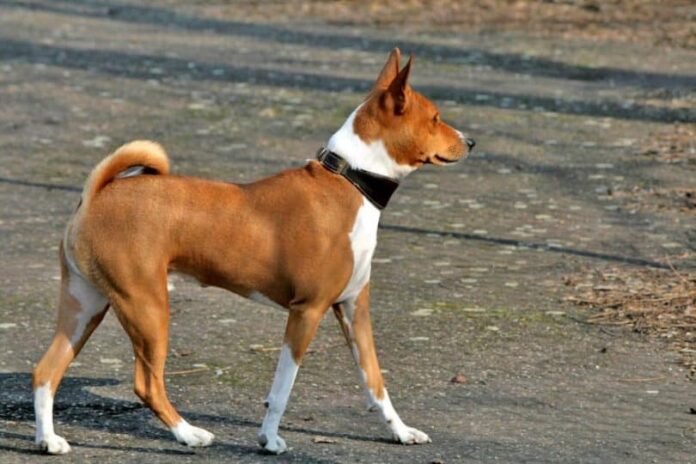
#3 The Basenji

With a weight of just 10–12 kg (males) and 9–11 kg (females), standing at a height of barely 41–43 cm (males) and 38–41 cm (females), the little Basenji fellow is an Ancient African hunting dog.

He’s very alert and fun-loving, but also curious and quite stealth when he wants to, reflecting his original purpose.

That’s why he constantly needs to be exercised, both physically and mentally. Without new challenges and fun activities he will soon become bored and start chewing things up. The Basenji will also prove to be quite a challenge for you too, since he can’t be left unsupervised even in your own yard, and never be left off his leash when walking.

When he sees something moving, he just runs after it and, having hunter blood running through his veins, he won’t easily come back. As such, he’s pretty aggressive with smaller animals and rather weary towards strangers.

He’s not easily trainable, but if you want to have a Basenji of your own you must think like a leader at all times, and don’t let him manipulate you.

Being so intelligent, he will quickly learn and be easily housebroken. On the other hand, his temperament is quite on the independent side so he may frequently try to escape.

Another plus is that he doesn’t shed too much hair and he’s easily groomed so, if you have a strong hand and can offer confident leadership, the Basenji can prove a wonderful, fun dog for you.

#4 The Rhodesian Ridgeback

This medium sized dog reaches a height of 63 – 69 cm (males) and 61 – 66 cm (females), while getting to a usual weight range of 36 – 41 kg (males) and 29 – 34 kg (females).

They don’t have many problems in changing their environment and can resist big temperature fluctuations. However, they are prone to different health conditions, such as dysplasia, dermoid sinus, cysts and mast cell tumors.

Nevertheless, their adaptability makes them fit to also live in an apartment or indoors, provided they are exercised properly. The best environment to raise a Rhodesian Ridgeback in is at a house with a large yard.

He’ll need to run a lot – that’s his favorite way of consuming his energy – so, if you’re looking for a jogging partner, you’ve found one! On the other hand, if you can’t let him run as much as he pleases, he will show aggressiveness and destructive tendencies.

Otherwise, this large, muscular hound is pretty obedient and calm, very loyal, intelligent and courageous.

He’s not very good with young children, even though he’s an affectionate animal, because he can play a little too rough.

He’s not too good with strangers either and he can get a bit defensive, so be sure to socialize him properly.

The reason for all his exercise demands and his temperament around humans is that he was originally bred in Zimbabwe for hunting and defense purposes.

He’s actually a cross breed between different ridgeback dogs brought by Boer settlers 5 centuries ago, and Khoikhoidogs, Mastiffs, Deerhounds or Great Danes, being recognized by the AKC in 1955.

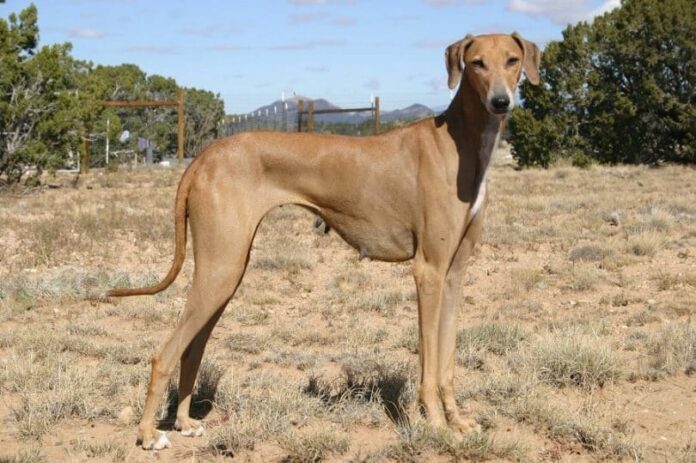
#5 The Azawakh

A sighthound dog breed from Africa, the Azawakh is a tall but very thin dog, as an adult can get to a height of 61 – 74 cm, but weigh only 15 – 25 kg.

His lifespan ranges between 10 to 12 years, and he’s well known for his personality and figure. He’s refined, aloof, rugged and fierce, but likewise very attentive and affectionate.

The Azawakh is a very quiet dog and he mostly keeps for himself, but he’s one of the most loyal, loving dogs out there and he gets so attached to a certain family, that he can only be separated from them with great difficulty.

He was bred in the Sahel region of Africa, and he lived in this desert area with the nomadic people of Touareg, protecting their tents.

That’s why he’s not at all friendly towards strangers and will bark at them. He also has a pretty good prey instinct, so he might chase smaller animals. If you have other pets in your house and teach your Azawakh to live alongside them, he may sometimes forget his training and chase them around the house. He’s pretty good with other dogs though, but he still has to be supervised.

His slim constitution, with long legs and lean body makes him the perfect animal for running. As such, you can keep him indoors, but still have to provide him with the exercise he needs – at least half an hour everyday. You’ll also have to be the one exercising him, he won’t do it by himself, not even in a fenced area.

#6 The Sloughi

Another vigilant, loyal, smart and loving dog, the Sloughi is a North African breed, coming from the sighthound family.

It’s places of origins and main home today is around Morocco. He’s another tall, skinny fellow like his brother the Azawakh, reaching a height of 60 – 70 cm, but getting in a weight range of only 18 to 28 kg.

He has a really elegant and graceful demeanor, being a quiet dog who would do anything for his family. In fact, he gets so closely connected to his owners, that he can’t be moved into a new home very easily.

Besides, he doesn’t like strangers very much, he’s pretty careful and reserved around them, observing them from afar. As such, he also doesn’t like being petted by them.

That makes the Sloughi one of the most territorial and defensive sighthounds, and he would react very badly if he felt somebody threatened him or his family. He’s also one great runner, probably because of the shape of his body and legs, which proficiently aid him when it comes to jumping. That’s why you’ll have to keep him inside a tall-fenced area, otherwise he’ll jump right over the fence.

He’s got a strong prey instinct, chasing all sorts of critters around and he needs to be frequently exercised. You can bring him along on your jogs, as long as you give him a comfortable bed to sleep in after.

All in all, the Sloughi is very loving, but he’s also independent and quite difficult to housebreak.

#7 Coton de Tulear

Named after his place of origin (Tulear, Madagascar) and his cotton-like fur, this little amusing fellow is a small sized dog, reaching a height of only 22 – 30 cm, and a weight between 3 to 6 kg.

His lifespan is pretty long for a dog, as he can live for 12 to 16 years. This is a great dog to have, because he will distract and amuse you with his tricks and playfulness.

He’s also full of life and loving, but he’s deeply intelligent, which in turn makes him easily trainable.

As such, he loves taking part in various agility and obedience competitions. In fact, he was bred particularly for becoming a great companion, and that’s why the best place for him to live is indoors.

Even though he’s quite energetic and simply adores playtime, he doesn’t have very high exercise demands. In the end, he will only be as active as his owners are and all that makes him the perfect dog to have around kids.

As a downside, a Coton de Tulear has to be brushed quite frequently and they also need extra-grooming when they reach adulthood.

Some Coton owners also complain about how difficult they are to be housetrained, but the fact is they will get the gist of it pretty fast if they have a regular schedule and they’re generously rewarded.

You can also crate-train them at first if you have to leave the house for many hours at a time.

#8 The Chinese Crested

A small hairless dog, ranging between 23 and 33 cm in height and only 2.3 to 5.4 kg in weight, the Chinese Crested was bred at first as a companion for invalid people. As such, his personality is sweet-tempered, happy and loving, but he’s also fairly lively, playful and alert. In short, he’s a great dog to have around and bring joy to your day.

His lifespan reaches 13 to 15 years, throughout which the Chinese Crested will prove to be a little furry ball of contradictions.

He can be the epitome of laziness, spending endless hours without doing anything, while he’s also one of the best dogs when it comes to agility and athletic competitions.

He’s a very devoted companion and he doesn’t take to strangers, but he’s very friendly with children. His remarkable intelligence also aids in his training. Otherwise, jumping, digging and climbing are his favorite activities, so make sure you keep him well exercised.

When it comes to his preferred environment, the best place for a Chinese Crested is indoors, with his loving family. He can even tolerate very high temperatures, but he’s pretty bad when dealing with a cold – probably because he’s hairless.

#9 The Aidi

Also called the Atlas Mountain Dog, the Aidi is a medium-sized dog, reaching about 25 kg in weight and 52 to 62 cm in height. His place of origin is Morocco, and he was bred to defend the livestock. Apart from his protecting traits, he’s a good hunter and has an incredible sense of smell.

Being a protector of nomad tribes, like the Berbers, the Aidi is known for his fearlessness and territorial behavior. That’s why he needs to be properly exercised and be socialized from a very young age, because he doesn’t much like strangers, nor small animals which may trigger his chasing instincts.

The Aidi has a muscular body, with a thick but soft coat which is also resistant to different kinds of weather. As such, if you want a great watchdog for your family, the alert, agile Aidi can assume that role if he’s trained young.

#10 The Abyssinian Sand Terrier

Another breed of hairless dogs, this medium sized pooch gets to be 39 to 52 cm in height and 9.5 to 17.7 kg in weight.

He’s very brave and loyal, ready to do whatever it takes to please his owners.

Once he gets to know and love you, he will become very obedient and regard you as a prize to be protected.

As such, you can even trust him with small children – he’s great with them. He’s likewise very good with other dogs, and you needn’t worry that he will become too aggressive.

The Abyssinian Sand Terrier

His preferred environment is indoors, and he can’t deal very well with low temperatures because of his lack of hair.

However, he still enjoys the great outdoors and needs a moderate amount of daily exercise. In fact, running is one of his favorite activities, so if you have a bike or like to jog – bring the little fellow with you!

All that being said, you may ask yourself why these African dogs look so different from each other.

However, since Africa is a huge continent with very different climates and environments, each breed has adapted to a specific place, not to mention the various interbreeding that occurred with dogs brought from Asia or Europe.

But in the end, it’s the variety of breeds, shapes, colors and behaviors that makes all these dogs special!

How Much Pumpkin to Give a Dog: Effective Cure for Diarrhea

How Much Pumpkin to Give a Dog

No matter how well we take care of our dogs, diarrhea is just one of those things that can creep up on us and catch us unawares from time to time. Maybe your dog dug through the trash and ate some mystery meat or rolled in something they shouldn’t.

No one—neither human nor dog—enjoys the experience of diarrhea. Though you sometimes have to allow it to pass naturally, if you know how much pumpkin to give a dog to alleviate the symptoms, you can help end their suffering that much sooner.

Initially, you may be thinking that this doesn’t sound normal, however, pumpkin can really do your dog a lot of good. As a type of fruit that has an impressively high fiber content, if given in the right amount pumpkin makes for a very effective cure for dog diarrhea.

It’s also very delicious and most dogs love the taste of it, so you won’t have any trouble feeding them some—maybe even as a treat for a job well done.

Image showing little dog sitting through some pumpkins

In this article, we’re going to tell you in greater depth why you should feed your dog pumpkin, when to do that, and of course, how much pumpkin to give a dog. We will also explain why you don’t want to give them too much.

Once you have reached the end of this article, you wouldn’t be able to resist going into the kitchen immediately to make some delicious pumpkin treats for your dog.

Also check Chinese dog treats

Nutrient Contents in Pumpkin

Judging from the nutrient contents, you can even say that pumpkin is almost completely geared towards aiding digestion in many ways.

Pumpkin is an extremely fiber-rich vegetable which is also packed with essential vitamins and minerals. You’ll find vitamin A, E, C, potassium, and iron in pumpkin.

The fiber content in pumpkin will assist in absorbing water from your dog’s stool, making it firmer. In the intestines, the fiber goes through a fermentation process which produces essential fatty acids that stimulate water and sodium absorption in the intestines. In addition, it also aids in lowering the pH level within the large intestine.

Artistic image showing three pumpkins

If this is the first time you’re hearing about pumpkin being used to cure diarrhea, then you’re probably curious as to how it helps with dog diarrhea.

We’re going to give you a more in-depth view. First, we are going to give you a better understanding about dog diarrhea, such as what the symptoms are.

When Should You Suspect Dog Diarrhea?

Of course, you have the most obvious symptom of diarrhea which is a loose stool. However, there are other symptoms associated with diarrhea that you need to look out for, such as:

  • Weakness
  • Vomiting
  • Fecal accidents
  • Increased amounts of stool
  • Blood or mucus in feces
  • Fever
  • Abdominal pain
  • Depression

If your dog is exhibiting such symptoms, you might wonder how it happened.

dog feeling sick laying on the floor

Dog owners always take great care to feed their beloved pet only the healthiest food, so why did diarrhea still happen? There are plenty of reasons for that.

Why Do Dogs Have Diarrhea?

Just like humans, a dog’s digestive system can become irritated. Diarrhea in dogs is caused by four reasons:

Osmotic Imbalances

Osmotic imbalances occur in dogs when the concentration of food molecules in the intestine is high. Water in the intestine is produced in excess to push the molecules of out the body. Thus, diarrhea happened.

Intestinal Exudation

Intestinal exudation is best described as blood fluids that break through intestinal tissues. It can be mild or severe.

A dog not feeling too well

If it is severe, seeking out a vet’s help immediately is advised. Any kind of severe bleeding should be a cause for concern.

Motility Disorders

This refers to the activity of the intestines. Sometimes the intestines can under/over function, which results in bowel movement difficulties. When the intestine over functions, this is when diarrhea happens.

Oversecretion

This occurs when the intestine secretes too much fluid. This usually occurs after the intestine has been exposed to harmful bacteria or toxins. The intestine itself causes diarrhea in order to remove the bacteria/toxins as quickly as possible from the body.

Diarrhea can be caused by a variety of things, such as eating garbage, infection, intestinal blockage, and changes in diet.

Of course, your dog could also be experiencing something more severe such as kidney or liver diseases, however, usually, it’s caused by everyday occurrences.

Image showing a dog not feeling good

Monitor your dog’s bowel movements and write them down. In case you need to go to a vet, it’s important that they know the color, texture and times your dog went to the bathroom. This will help them narrow down the causes as to why your dog has diarrhea in the first place.

If your dog is older or a puppy, diarrhea should be taken very seriously as these are both vulnerable ages for dogs. So, we recommend you to take them to a vet immediately.

If your dog is a full-grown adult, in most other cases your dog’s diarrhea should settle on its own within a couple of days, especially if you feed them pumpkin.

How Pumpkin Helps Treat Dog Diarrhea

As we have mentioned above, pumpkins are chock full of nutrients that aid digestion. Both humans and dogs, when experiencing diarrhea, need the enforcement of good bacteria in their stomachs and intestines.

Little dog sitting next to two pumpkins

The fiber in pumpkin acts as a prebiotic. Prebiotics are slightly different than probiotics because they act as a stimulant for the growth of good bacteria in the stomach and intestines while prohibiting the growth of bad bacteria.

Also, since the pH level is decreased with the help of fiber, it allows a healthy environment for the good bacteria to flourish.

You may also help by providing your dog probiotics such a yogurt as these are good bacteria that will help settle the stomach and aid digestion. But generally, feeding them pumpkin should be enough to solve the problem as long as you feed them the right amount.

How to Feed Your Dog Pumpkin

Although feeding your dog pumpkin may seem as easy as simply baking them some treat with it or perhaps even allowing your dog to lick it off of a spoon, if you want your dog to receive the full benefits of what pumpkin has to offer, you’ll want to do the feeding right. Here are the things you have to pay attention to:

Consider the Amount

You don’t want to give your dog too much fiber as it can backfire. The amount of pumpkin you give your dog shouldn’t replace their meal. Pumpkin should be treated as a garnish, so you’re only going to be adding between 1 to 4 tablespoons of pumpkin to their meal.

A dog laying down next to a couple of pumpkins

If your dog is rather sensitive, we recommend that you start out with a smaller amount. It’s best to start off with 1 or 2 tablespoons and wait to see their body’s reaction. Many people wonder if pumpkin can aid with constipation also since it works wonders with diarrhea. The answer is yes. If your dog is experiencing constipation, you can also use pumpkin as a method to ease it.

The same way as when you use it to treat diarrhea, add 1 to 4 tablespoons of pumpkin to your dog’s meals. It’ll help relieve the symptoms. Though, you need to make sure you find the source of why your dog’s experiencing constipation.

Healthy-Pumpkin-Dog-Treats

Try to change the food or walk them more. However, if you don’t notice a change, do consult your vet.

Constipation isn’t uncommon, however, could also be a sign for enlarged prostate, bones in the colon, or other emergency issues which need to be dealt with immediately.

Consider the Pumpkin Source

There are various types of pumpkin available at your grocery store, but knowing which one to get for your dog can be a challenge.

We recommend feeding your dog plain canned pumpkin. You can also do fresh pumpkin meat as well, as both canned and fresh are without sodium and preservatives.

Creamy Paleo Bacon Pumpkin Soup

Canned and fresh pumpkin will provide your dog with an excellent source of vitamins and nutrient.

However, canned pumpkin is known to contain more fiber than fresh pumpkin. Why? This is because fresh pumpkin contains a higher amount of water in comparison to canned.

Though when purchasing a canned pumpkin, read the ingredients and make sure it’s not full of sodium, sugar, and other additives.

These additives will irritate your dog’s system rather than provide them with the nutrients they need. You should be careful as you don’t want to cause further health issues with your dog.

Consider the Parts You Use

If you use fresh, whole pumpkins instead of canned, you’ll want to pay attention to which parts you use.

Though pumpkin is great for your dog, there are certain parts of the pumpkin which your dog cannot eat:

  • Do not let your dog eat raw pumpkin seeds or the innards of a raw pumpkin. They’re not meant for dogs, you should be focusing on feeding your dog the flesh of the pumpkin instead.
  • Do not allow your dog to eat the shell of the pumpkin. If the pumpkin is not grown organically, there may be pesticides on the shell which can harm your dog’s digestive tract. In addition, during the fall season, specifically Halloween, many pumpkins are decorated with glue and glitter. So, you don’t want to get your dog accustomed to eating the shell.
  • Do not allow your dog to eat the stem or leaves of the pumpkin. The stem is covered in prickly hair which can irritate your dog’s digestive tract.

Refrain from feeding your dog other human food since it may interact negatively with the pumpkin. While feeding your dog pumpkin, only give it to them with their daily food. No special sauces or treats, as you want to essentially give them very simple food until their stomach settles down.

Image showing a dog looking at some cookies on the table

Think of the time when you have diarrhea. You eat soup or a bread with light butter. You keep it simple. It’s the same thing with dogs.

Make sure your dog has an ample amount of water during this period. Diarrhea can make dogs extremely dehydrated, so you’ll want to make sure their bowl of water is full.

They may not drink too much water in the beginning but you can monitor their improvement as they’ll start to drink more when they feel better.

If you don’t see any improvement within the following days, then it’s time to take your dog to the vet. There’s obviously a serious underlying condition which cannot be cured by just using pumpkin.

Wrap Up

Our dogs are like our children. We care for them, feed them, walk them, teach them and all because we love them.

Of course, like everyone, sometimes our dogs become sick. When your dog isn’t feeling good, your initial reaction may be to take them to the vet and get them checked out, which is completely normal. However, you don’t need to rush them to the vet right away if they’re only experiencing mild diarrhea.

Of course, you want your dog feeling like their old selves as quickly as possible. Who wouldn’t? However, many of us also know the costs of visiting a vet, which can get extremely pricey quickly.

Now, we’re not saying your dog shouldn’t go to the vet, of course, if they’re not looking well, take them. But sometimes these issues can be easily solved at home, such as by feeding them pumpkin.

Image showing some dog treats in a jar and on a plate on the table

With every meal, feed them 1 to 4 tablespoons of canned or fresh pumpkin. It’ll give them the vitamins and minerals they need plus the extra dose of fiber to remove the water from their bowels.

If you see an improvement over the next couples of days and they return to their regular selves, then you’ve managed to treat their diarrhea.

Now that you know what diarrhea is, the causes and symptoms, what type of pumpkin to feed your dog and how/when to feed them, you’re well on your way to helping your dog recover from diarrhea.

Do Dogs Get Hiccups: What Triggers Hiccups in Dogs & How to Stop Them

Dogs Getting Hiccups

Do dogs get hiccups? If you are a new dog owner, you might be witnessing something that sounds and looks like a hiccup in your pup.

Although you might be tempted to laugh a little when you first notice your pup dealing with hiccups, you could also start worrying and that is really not the case.

Those adorable little creatures just have a normal reaction determined by various factors, which are not threatening for their overall health.

As it follows, you will learn more about hiccups in dogs; what causes them and how they can be stopped.

Hiccups sign

There are very few situations when hiccups are signs of other illnesses, situations which are quite severe and should be taken seriously because there usually is a cure for them if they are detected in time.

Is Your Dog Really Dealing With Hiccups?

Dogs in general and especially puppies really get hiccups. In fact, any creature that has a diaphragm can get hiccups.

This is because the diaphragm is the one that contracts involuntarily and since it is directly connected to some nerves located in the dog’s throat, the dog makes a sound every time it has a spasm.

Simply put, a diaphragm is a muscle that separates the abdomen from the chest and allows lungs to fill with air. The whole process is similar with hiccups in humans and in other mammals that have a diaphragm.

Of course, there are some factors that trigger hiccups in dogs, but, on the other hand, some veterinarians believe that hiccups are a sort of exercise that dogs do for their lungs.

They base their theory on the fact that some puppies get hiccups while they are still in their mother’s womb. Apparently, puppies are supposed to keep getting hiccups until their lungs adjust to the environmental conditions in the outside world.

Considering that most dogs don’t get hiccups after they reach 8 months to 1 year old, they might be right.

Even so, dog hiccups may be mistaken with reverse sneezing or coughing. There are a few differences between these three involuntary actions that are usually caused by some sort of irritants.

You might think that it would be impossible to confuse reverse sneezing with hiccups, but it is actually possible especially in young puppies that have all sorts of inexplicable reactions and make a lot of weird sounds.

You will find out more about reverse sneezing and coughing, as well as what they could mean in terms of health for your dog in the following lines.

What Causes Your Dog’s Hiccups?

  • Until now, specialists didn’t agree on a specific cause of hiccups in dogs.
  • Various veterinarians noticed certain symptoms and they ended up assuming a few apparent reasons that may cause dogs to hiccup.
  • Hiccups may occur because of a nerve irritation of the diaphragm.
  • The rapid absorption of food when the dog eats fast may lead to the occurrence of hiccup.
  • A diet that contains a small quantity of liquid food may leaf to hiccups.
  • Overeating is also considered a cause.
  • Eating food that is spicy.
  • If the dog drinks too little water, then it might get hiccups more often.
  • Inhaling all sorts of gases that may irritate a dog’s respiratory tract.
  • Especially in dogs with short coats, hypothermia can be a triggering factor of hiccups.
  • Sometimes, it was noticed that a puppy may have diaphragm spasms as a result of jumps or violent games with other dogs or kids.
  • If a dog swallows certain objects, then it might have to deal with a long hiccup time.
  • Some dogs that suffer from cardiovascular diseases often get hiccups, so these diseases might be causing them.
  • Plague, hepatitis and other diseases may determine the diaphragm to contract involuntarily.
  • Nervous system lesions are possible causes as well.
  • The infection with intestinal worms causes hiccups in dogs as well.
  • Asthma or other respiratory diseases may have hiccups as a symptom.
  • Excitement, emotion and stress may trigger hiccups too. This is because the dog’s breathing rate changes.
  • A dog on muscles relaxants may start hiccupping.

If a puppy or an adult dog suffers from hiccups and it regurgitates food often and regularly, do not ignore these symptoms.

In this case, you must take your canine pet to the vet as quickly as possible. If you have a puppy that doesn’t regurgitate, but which gets hiccups a lot, then you shouldn’t be alarmed.

However, you should keep it under observation in case any other problems occur.

Regurgitation doesn’t involve an effort for a dog, but vomiting does. When a dog vomits, its abdominal muscles contract, so it makes a lot of effort that weakens its abdominal muscles.

Regurgitation of food after every meal can be a symptom of an abnormal esophagus. In these cases, surgery may be needed, but only the veterinarian can set a diagnosis after reviewing the overall health of the dog.

How to Diagnose Hiccups in Dogs?

A hiccup can’t really be confused with something else. The main idea would be to pay attention to how long a hiccup session lasts.

This is because, vets consider that if a dog goes through a few minutes to a maximum a half hour of hiccups, then everything is normal and the dog owner should not be alarmed.

However, if a puppy or a grown up dog keeps on hiccupping for more than half an hour, then it must be taken to the vet. Since there are other medical causes for hiccupping, the vet should examine the dog and set a diagnosis.

How to Stop a Dog From Hiccupping?

How to get rid of dog hiccups? Fortunately, there are multiple ways you can try to stop a dog from hiccupping, depending on what cause their occurrence in the first place.

The main idea is to calm your dog down when it gets the hiccups because its irregular breathing might make it impossible for it to stop.

There are several ways you can achieve that about which you can find out more below.

In addition, you should stay calm as well, because your puppy can feel if you get agitated with not reason and it will have a hard time calming down and lowering its anxiety levels.

  • A dog gets hiccups when it is growing at a fast rate, so there isn’t something you can do to stop it most of the time. You could try to calm it down in case it starts to act like it feels anxiety, but other than that it shouldn’t be necessary.
  • Just like in humans, you could try to get your puppy or grown dog to drink a little water. This solution often works in humans, together with holding our breath. However, that cannot be achieved with canines.
  • In case the hiccups appear after your doggy eats, then you have to do something about the way it eats. It might be too greedy and eat too much in a short period of time without stopping to breathe or to have a sip of water. In this regard, you could try to feed it less, feed it right from your hand or to put a little water over its food before serving it.
  • Massaging your doggy’s stomach could be a solution as well. Get your dog in a comfortable position and slowly massage its abdomen in order to relax and get rid of the contractions. This method also works in case your pup is agitated.
  • Various dog owners tried an exercise with their dogs to stop hiccups and they said they were successful. The dog has to be laid on its back and its owner should keep its front legs up. This exercise should be done for a few minutes.
  • Dogs that suffer from hiccups should be distracted. In other words, don’t let your canine friend stay focused on hiccupping while you do the same. You both can get your mind off it by starting to play a game. In addition, it seems that any kind of exercise is best to get rid of the annoying spasms.
  • Changing a pup’s breathing pattern is often a very successful option. In order to do that, you could try multiple things, including feeding it. You don’t have to give it a full meal especially if it just finished it, but a tasty treats would be a nice addition.
  • Some foods, especially those rich in grains may determine your beloved pet to get hiccups. Therefore, you should pay attention to what it eats before it gets them. Grains are known to cause hiccups, but your dog might have the same reaction to other foods as well.
  • Chlorpromazine and haloperidol are two medications that might be prescribed by the vet for perfectly healthy dogs that cannot stop hiccupping. These are meant to help its diaphragm relax and stop contracting.
  • In case the cause of hiccupping is hypothermia, it goes without saying that you should do something in order to help your dog warm up. You could use a blanket or the heat of your own body to regulate its temperature until it stops.
  • For some reason, giving your dog something sweet like sugar, honey or maple syrup helps with getting rid of the contractions. The scientific explanation for this solution is not available, but it is often applied by dog owners with a positive feedback.
  • Surgery is done in extremely rare cases. When you and the vet tried everything you could think of, there is one more solution, namely for the vet to intervene on the dog’s phrenic nerve. This step ensures the relaxation of the diaphragm.
  • If your dog is suffering from certain diseases, such as pancreatitis, indigestion, diseases of the gastrointestinal tract, nervous system diseases, infection with intestinal worms that cause contractions of the diaphragm, the vet will determine the appropriate treatment to cure or relieve its symptoms.

What Is Reverse Sneezing in Dogs?

Reverse sneezing is similar with hiccups in dogs. Among the dog owners who took their dogs to the vet, were people who have mistaken hiccupping with reverse sneezing.

It is true that the dog’s behavior when it sneezes reversely is similar with hiccupping because it keeps its mouth closed, its head it slightly inclined backwards and it doesn’t spit off anything.

It actually looks like when a person keeps its mouth shut while hiccupping, without releasing any sound. Reverse sneezing may be accompanied by gagging and sometimes vomiting, just like hiccupping.

Dog nose anatomy

The reason for reverse sneezing in dogs is to remove irritants or various infections, inflammations or gastrointestinal diseases. Nasal cancer is also a probable cause, especially in adult dogs, so don’t avoid the vet if you are really worried.

How Is Coughing Different From Hiccupping?

Some dogs might actually cough, but look like they are dealing with hiccups. The noise they might be making could be a honking noise, they might look like they are gagging and have problems breathing normally.

Therefore, these signs are very similar with the ones for hiccups. If you aren’t convinced that what your pup has are hiccups, then you should definitely take it to the vet.

Kennel cough could be one possibility, together with other numerous affections that involve the dog’s respiratory system.

Fever, loss of appetite and weakness might accompany a dog’s cough, case in which it is definitely suffering from a serious disease and it needs medical attention.

What Are the Symptoms That Might Accompany Hiccups?

As said, a dog with hiccups may be perfectly healthy and growing normally, but it might also get hiccups as a symptom together with other ones, fact which should signal a more serious affection.

Among the diseases that could have hiccups as symptoms are heart diseases, asthma, other respiratory diseases, gastrointestinal diseases, pancreatitis, intestinal worms and so on.

As it follows, you will learn more about the possible symptoms that may signal the aforementioned diseases.

It is essential to be aware of these symptoms in order to detect a possible health problem of your dog in a timely manner.

Heartworm infection infographic

General symptoms of heart diseases in dogs: coughing, difficulty breathing, any types of behavioral changes, loss of appetite, weight loss or weight gain, general weakness and sometimes fainting, restlessness, edema and finally a sudden desire to be isolated.

General symptoms of respiratory diseases in dogs: coughing and hiccupping together with sudden changes in the way the dog breathes are important signs, including dehydration, loud and heavy breathing, nasal discharge, sneezing, decreased exercise ability, restlessness and collapse.

General symptoms of gastrointestinal diseases in dogs: vomiting, diarrhea, bloating, loss of appetite, discomfort, constipation. All these may start from what it looks like hiccupping, but you should pay attention to the other ones as well. Things will become clear if the dog will have bloody stools.

Dog worms of many types

General symptoms of intestinal worms in dogs: vomiting, diarrhea, tiredness, hardened stool characterized by a very dark color, worms in vomit or in feces and so on. Hiccupping may precede vomiting, so try not to conclude that it was a result of intense hiccupping.

Although the emphasis was on hiccupping being harmless to pups and adult dogs, if you notice any of the symptoms enumerated above, then you should schedule a visit to the vet.

You might mistake hiccups with reverse sneezing or with coughing even if you are convinced that you’re not.

So, you shouldn’t risk your doggy’s health and go straight to a specialist if you have any doubts regarding your canine friend’s health condition.

Sometimes it is difficult for an expert to diagnose tricky affections, so rely on professional help when it comes to the health of your beloved canine pet.

In Conclusion

A very normal reaction of a muscle called diaphragm from the dog’s body may contract involuntarily or, in other words it may have spasms from time to time.

If this reaction is triggered by normal factors, then it doesn’t represent any danger for the life of the pup or the adult dog. Conversely, it may be a symptom of another affection that could be serious and even life-threatening.

This is up for the veterinarian to determine and advise the dog owners accordingly. Generally, hiccups are normal and they should not be a reason of concern for any dog owner.

In both humans and dogs there is a saying that the animal or person in question that gets the hiccups is actually growing. This applies in case of doggies, especially for those that grow very fast in a short period of time.

Their diaphragm has to get used with the body’s new dimensions and work together with the lungs in order to keep up with its requirements.

Besides this totally rational explanation, there are a multitude of other reasons that cause hiccups and that make sense.

So, try to stay as calm as possible and view the hiccup matter from an objective point of view even if you are actually subjective when this happens to your pup!

Strongest Dog Breeds: Top 10 of the World’s Most Physically Gifted Canines

Strongest Dog Breed

It is often difficult, when we look at our canine companions, to even imagine their physical capabilities. Apart from attempting to pull your arm out of your shoulder every time they tug on the leash, we cannot really see the power that they pack.

In fact, there are some pretty strong dogs out there, and some breeds have been bred with strength in mind.

From wrangling cattle to fighting bears, from bringing down raging bulls to chasing away entire packs of wolves, dogs have done it and have been doing it for a long time now.

Even though we have evolved and most of the old days are behind us, we count down the top 10 strongest dog breeds in the world and take a look at how they have evolved and how their heritage has been maintained.

Of course if you’re interested in learning about other strong breeds, we recommend you a pleasant lecture: The Dog EncyclopediaYou’ll learn quite a lot about various breeds all over the world.

When looking at the strongest dog breeds we excluded extinct dog breeds and chose to dismiss Guinness world record holding dogs as being an exceptional individual of his or her breed and not a clear cut representative of that breed.

We have also chosen to look for the dog breeds that manifest the biggest power / weight ratio and no simply stop at the breeds that rely on their body weight alone to give the illusion of strength.

That being said, let’s have a look at the dog breeds that stand out as being the stronger ones.

Husky

This one came as no surprise to anyone, and is by far the most deserving of all the dog breeds in this countdown.

The Husky was bred for one thing and one thing only, pulling a sled. These dogs, even though they are not the biggest or the meanest on the block, they are by far some of the strongest.

Strong Huskies

With strong broad shoulders to push into the harness and muscular hind legs to power them forward, these medium sized dogs have been treading the frozen tundra with their masters, pulling sleds and carrying supplies, as well as people, over great distances, through impossible terrain, while braving some of the harshest weather conditions known to man.

One of the biggest assets in this dog’s bag of tricks is its ungodly endurance level. Indeed a husky will never relent and he or she will power through anything and everything in order to reach the destination.

The husky remains a popular sled dog to this day, being one of the most versatile, nimble and powerful traction dogs of them all.

German Shepherd

This one is by far the most famous and easily recognizable dog in the world, and it is easy to see why.

This dog is beautiful, majestic, with a royal feel, and at the same time intimidating, fierce and not exactly what you want to see running towards you at full speed.

But it does not stop here, because the military, anti-terrorist organizations, security agents, law enforcement from around the world, all prefer the German shepherd for a few good reasons, and above all is its strength.

The German Shephered dog

Indeed the German shepherd is a really strong dog, and if trained properly, this dog will be able to take down a large human being in just a few seconds.

Another asset that the German shepherd possesses is a remarkable level of intelligence, and make no mistake about it, this dog knows how to use his strength, exploit weakness, and tell the difference between right and wrong.

The German Shepherd has been used throughout time as not only a guard dog, but also a search and rescue dog, a law enforcement officer, a military asset and even as a secret agent, and people still prefer the German shepherd for these jobs today.

Now, if you want to keep such a dog as a pet, it’s of paramount importance to offer him the correct level of activity and a place of its own in the house. For such a large dog you will need a durable crate that is tear resistant and a high-quality dog bed. Also, think of the fact that large breeds tend to have hip problems in the old age so you wouldn’t want him lying on the hard floor.

To learn more about what this breed has to offer, be sure to check out this article on the German Shepherd.

English Bulldog

It’s easy to dismiss this breed by simply looking at it, with no prior knowledge. Short, stubby, makes weird noises, waddles around and generally reminds us of a couch potato.

That being said, have you ever wondered why it’s called a bulldog? Because these dogs were bred to take down bulls. This is also the reason why all the aggressive and dangerous dog breeds were created using bulldogs.

This dog breed is man made in huge proportions, and it was almost driven extinct when dog fighting was outlawed in England.

Luckily for bulldogs, people really love this breed and a handful of bulldog enthusiasts have saved the breed from extinction.

Even today, a properly bred, fed and trained bulldog will do wonders when it comes to strength and pure power.

It is not the tallest dog by any stretch of the imagination, and its short legs take swimming and excessive speeds out of the question, but a compact body, jam-packed with pure muscle from head to toe, a stubborn will and the desire to put those muscles to use, make this one of the strongest dogs out there.

Before you consider making this breed a part of your family, however, you should definitely check out this great article on the English Bulldog so that you can prepare properly.

Pit Bull

Speaking of bulldog heritage, in comes the Pit Bull at 7, fear incarnate for those out there who have a true phobia for dogs. It’s easy to see why this breed made it on our list, however it’s more than safe to say that all the bad rep that these neat dogs have been getting is a bit exaggerated.

Pit Bulls have been bred for fighting, nothing else. They are built to a T for fighting, and every single ounce of effort has gone into making this dog the perfect fighter.

The Pit Bull is nimble, agile, fast and above all strong. His entire body, just like a bulldog, is covered in dense powerful muscle.

The-Pit-Bull-dog

This dog/s body manages to exert so much power, that a pit bull jumping full power on your chest is the closest you can get to being hit with a cannonball and surviving.

These dogs are so strong that there are actually competitions in which pit bulls pull weights. The current record is the weight of a small sedan which was pulled by a single pit bull over a distance of 12 feet.

Sadly the breed is one of the most misunderstood in the world and many people fear this cute, cuddly dog. If you want to extend your knowledge on the breed, we recommend the Encyclopedia for Dog Breeds, a fantastic book for dog lovers and beginner owners alike.

It’s worth mentioning that pit bulls are not bad dogs. They are loyal, playful and gentle dogs. The only way in which you can turn a pit bull into a psychotically violent dog is if you train him to become that.

Even so, pit bulls are the dogs with the highest reform rate in the world, and even pit bulls that have been abused and used in fights for 10 years have been successfully reformed.

Dogo Argentino

This is not a famous breed, it is not a Hollywood poster dog, it is not a super soldier, nor a killer in the ring. What Dogo Argentino actually is, is a hunter.

That’s right! This is actually a hunting dog, bred in Argentina for the purpose of hunting medium sized game, like hogs.

This dog’s body has a very muscular appearance, and for good reason. Dogo Argentino was bred from the Cordoba Fighting dog, a dog that was notorious for his love to fight tot the death, an incredibly high pain tolerance and pure viciousness.

Dogo Argentino

Dogo Argentino inherited the power, the endurance and the high pain threshold, resulting in a dog that is strong enough to fight wild boar, enduring enough to not give up, and at the same time loyal enough to always stay by his master no matter what.

Rottweiler

We all know that big black dog with a never ending jaw line and a temper problem, the Rottweiler. Rottweiler’s have been a staple for ranchers, cattle herders and people that generally handle large animals.

This is due to the fact that a Rottweiler is the kind of dog strong enough to herd an entire herd of cows and maneuver them around without a hitch.

Rottweiler

With powerful shoulder, chest and leg muscles, this dog can easily out power most living things that could come his way. Rottweiler’s were used in the past to guard ranches, heard livestock and even pull small wagons around to transport supplies.

When owners were no longer legally allowed to use dogs to haul supplies, a lot of Rottweiler’s became house pets, and people discovered that they had a temper problem.

That being said, if you plan to own a Rottweiler, you should remember to start training when he is just a pup and never stop, and always keep your leash arm worked up, they will dislocate your shoulder in a heartbeat if they shoot off with all their force suddenly.

St. Bernard

This dog is amazing, and was really close to getting the number 1 spot on our list; however it was not quite strong enough.

The St. Bernard is by origin a Swiss dog, and it was used by Swiss authorities in the past to basically hunt down lost tourists and guide them back to safety.

For reference, they used to have a small keg containing an alcoholic beverage around their necks in order to help the poor tourist get warmer and survive the harsh environment, however with the recent advances in technology the St. Bernard’s services were no longer required and so they serve as pets now.

The St. Bernard rescue dogs

There have been a lot of stories in the past of St. Bernard’s that were strong enough to dig through the snow until they reached either the ankles or the collar of tourists that were trapped under the snow as a result of an avalanche, grab said ankles or collar and simply pull them out of the snow using nothing but their strength.

Even today this 4 legged guardian angel saves lives, and there are still tales being told of their courageous and selfless efforts. These are in fact very big and very strong dogs however there is one thing that lets them down, they are prone to a lot of shoulder problems in their old age, and can lose their strength rather rapidly.

Kangal

All dogs are nice, all dogs are beautiful, and we’ve just counted down 9 of the strongest, however we have reached the champion, the strongest of them all. There is only one breed that can take this spot, the Kangal.

This is no ordinary dog, this in fact one of the oldest breed around, and can be traced to times predating the original Mastiffs. Indeed the Kangal has been on this earth for longer than we can remember, and it has served man by helping him with livestock.

Kangal dog bread

Make no mistake about it, this is not a herder, this is not a sheep dog, this is not a cattle wrangler, this is a guard dog, the biggest and most powerful guard dog in the world. Standing on all 4 legs, the top of a Kangal’s head reaches just above the elbow of an average man standing upright next to the dog.

This dog is not all fat and body weight, this dog actually packs a lot of power, and the average man has next to no chance stopping a Kangal on a leash by simply pulling.

Indeed this dog will overpower humans with ease, so you might end up wondering who is actually walking who.

This dog is of Turkish origins however it has spread to Africa and Asia, and there have been a lot of stories, sightings and even videos circulating on the internet with Kangals that took on tigers, lions, packs of wolves, bears, and successfully taking them down without too much trouble.

When it comes to endurance, this dog is the very definition of it. No other dog has managed to achieve the level of endurance of the Kangal.

Combining that endurance with a hefty dose of love and loyalty, you have yourself what can be considered as the perfect dog.

This dog has a very powerful set of protective instincts, and he will literally take a bullet for you and throw himself in harm’s way just so that you can walk away without a scratch, without the slightest hesitation.

This dog also has a very high threshold for pain, being able to endure a lot of physical punishment while fighting large and potentially dangerous animals.

We have chosen the Kangal as the strongest dog because of the ancestry, the performances that the Kangal displays and the general development of the breed itself.

Conclusion

That being said this is our list of the world’s strongest 10 dog breeds, with brief information and a bit of insight into every single one of the aforementioned breeds. If you choose one of these breeds as a pet, remember that these dogs are a little more pretentious and a bit more demanding than your standard dogs.

Now, to lighten the mood a bit! These dogs are indeed strong and they can be dangerous if not raised properly. However, when trained and raised in a loving family they prove their loving nature, big heart, and witty personality.

So, if you’re looking to have a bit of fun or you want a Halloween partner that will guard you against evil and score you the most candy in the group, you should take a quick look at costumes for dogs.

For instance, one of the greatest costumes for a big dog is a lion wig – it won’t bother Fido and you’ll get to have the time of your life with your best pal.

Homemade Dog Cone: Money-Saving DIY Project for Your Dog’s Needs

DIY Homemade Dog Cone

There are circumstances that no dog owner looks forward to when it comes to their dog’s health. Whether it’s a major surgery or your dog is incessantly licking his paws, there are going to be times when you need to use a dog cone.

Also called and emergency collar, e-collar, or Elizabethan collar, it prevents your dog from getting to other areas of his body that he should leave alone.

They’re typically made from hard plastic, and you can find them in many pet stores.

However, instead of selling out money on both gas and a cheap product, why not consider making them yourself?

Making a temporary DIY dog cone allows you to be creative in the materials that you use, and also allows you to make exactly what you need for your dog’s specifications.

They can also be a good substitute if the collar provided by your vet has already been destroyed (never underestimate the perseverance of a dog).

Many of these ideas can be made from objects you already have around the house, while others requires you to pay for a few items at a craft store or hardware store to make what you need.

Bucket collar

This is exactly what it sounds like. This is suitable for any dog size, as it depends on the size of the hole that you cut.

You can use your dog’s collar to determine the size of the hole and add a few inches to accommodate his ears fitting through. Then cut a hole in the bottom of a plastic bucket and simply slip it on over his head.

Bucket collar

It would be best to sand down the edges of the plastic to avoid any sharp edges harming your dog.

The bucket can be worn with the edges facing out, like a regular cone, or the other way around, depending on the area that you need to prevent your dog from getting to.

Cardboard or Poster Board Collar

If you have large pieces of these lying around from children’s projects, then they work perfectly as makeshift temporary collars in an emergency.

Using the circumference of your dog’s collar, draw a semi-circle in the middle of the cardboard or poster board. This may seem too big at first, but it will fit together perfectly when the edges are overlapped to form the cone.

Cardboard or poster board collar

The next step is to draw the outer edge of the collar. The distance between the inner and outer semi-circles should be about 1/2 the measurement of your dog’s neck. This allows your dog to eat and drink with the collar on.

Then, connect the ends of the semi-circles with straight lines and cut out the shape. Use a hole puncher to make a series of holes along the inner semi-circle.

You can choose to weave your dog’s collar through the slits, or use zip ties to connect the cone to your dog’s collar.

You can also use shoe string to lace through the holes and then tie it to your dog’s collar, if you want to make it easier to remove.

For an easy demonstration of how to make this collar, you can watch the videos below:

Paper Plate Collar

For extremely small dogs, you can make an emergency collar quite easily out of a simple paper plate. This can be good to use when you need to get your dog to a vet immediately and don’t want your dog messing with his wounds.

Take a paper plate, and cut out a circle in the middle that is just big enough to slip onto your dog’s head.

Alternatively, you can cut out a strip from the plate and fashion a cone shape like the above instructions, and fasten the ends together with tape.

Neck Pillow

If you’re one of those people that sleeps on planes during air travel, then you might have invested in one of these already.

What you may not have known is that they can serve as very good “cones” for your dog.

The air in them holds your head in place so that you don’t suffer from neck strain. The same principles prevent your dog from moving his head too much so that he can’t get to certain areas of his body.

Neck dog pillow

These devices are great to use, as they are quite soft and you won’t have to risk your furniture being damaged or your legs being run into.

It can be easily removed as needed and put back in place without much fuss to your dog. It also increases his visibility when he’s walking around and he can eat and drink throughout the day without you having to remove it.

Soft Neck Restrictor

This collar is especially useful for breeds of dogs with short legs. It can be troublesome to walk around with a collar constantly dragging on the ground.

This different style of collar allows the free range of movement and won’t inhibit your dog from eating or drinking.

The materials you’ll need are:

  • measuring tape
  • pen and paper
  • thick foam
  • felt
  • needle and thread

The first thing you need to do is measure the circumference of your dog’s neck. Then measure from the back of his ear to his shoulder.

This will tell you how wide you need the neck restrictor to be. It’s a good idea to do this a few times in order to obtain a good average measurement.

Soft neck restrictor

Due to the thickness of the foam, the piece is going to need to be a bit longer than your measurements, about six inches or so depending on the thickness of the foam you’re using.

This way, the restrictor can overlap and still be comfortable for your dog. Cut the foam to these measurements. Then, cut out a sleeve out of your felt so that the foam will fit inside it.

Add four to five inches to the length in order to accommodate the Velcro that needs to be sewn on. This creates a flap that can be secured and provide comfort, even when it is overlapped.

Sew around the edges and leave one end open to insert the foam. You can choose to sew this closed or you can leave it open to make it easy to replace the foam as needed.

Add the Velcro on the flaps and where it will meet the body of the restrictor so that it fits snuggly around your dog’s neck. Using extra wide Velcro will provide added sturdiness and makes sure it stays on.

Then place it on your dog and adjust it accordingly.  The use of felt makes the restrictor more colorful and less of an eyesore, and you can find patterns and colors that match your dog’s personality. He won’t have to feel like a prisoner of the plastic any longer.

The kind of restrictor is not good for dogs who are prone to licking their front legs. Rather, it’s more suitable to prevent dogs from turning their heads and getting to their back ends or bellies.

Keep that in mind when considering the kind of emergency collar that you want to make for your dog.

Towel Collar

If you don’t have the money to invest in foam or felt to make your collar, you can choose to use a simple towel instead. You probably have spare towels lying around your home, which make them quite convenient to use in an emergency situation.

Towel dog collar

This kind of restrictive collar is similar to the soft neck collar mentioned above, so it’s not suitable for preventing your dog from getting to his front paws.

If you’re desperate enough and you don’t have anything around to serve as an e-collar, there are other items that you can use to keep your dog’s paw injuries safe from infection, such as the use of boxer shorts, baby booties, sweaters, or cloth bandages.

They won’t restrain your dog enough, as he can still chew these off, but they work well in a pinch if you are carrying him to the vet immediately and need something to cover the affected areas. Be aware that they won’t work for very long if your dog is an avid licker.

Dogs can start to act a bit strange the first time that they wear a collar. They’re likely to bump into furniture, walls, and even your legs.

Many dogs won’t eat while they’re wearing collars, or just stand in one spot, staring at the floor in expectation that it will fall off on its own.

Owners shouldn’t fall for these attempts at sympathy, especially if the collars have been put on after a surgery. The last thing you need is to pay for money to fix some chewed stitches.

If there is the need to remove them, however, such as to allow your dog to eat, supervision is recommended to prevent your dog from getting at his wounds or stitches.

The collar should be placed back on when you are not at home or when you are sleeping. Dogs are remarkably adaptable creatures, and will adjust to wearing them in time.